This is an archive article published on April 25, 2020
‘Time to be firm and take the best decisions for patients’
Dr. Krupa Pathak, assistant professor at the medicine department of SSG hospital and rotational incharge of the COVID-19 isolation ward talks about life on the frontlines for healthcare workers as they treat COVID-19 patients.
Written by Aditi Raja
Vadodara | Updated: April 25, 2020 07:43 PM IST
4 min read
Whatsapp
twitter
Facebook
Reddit
The nodal medical coordinator in Vadodara has decided to keep doctors on isolation ward duty for a week at a time. (Representational)
Between her frantic trips to the COVID-19 isolation ward and intensive care during her rotational duty as the incharge, assistant professor at the medicine department of SSG hospital, Dr Krupa Pathak communicated with her eight-year-old daughter via hurried text messages. The child had only begun to understand the pandemic, owing to conversations between adults around her and television news. Even as the doting daughter periodically checked whether her mother had eaten and taken safety precautions, Dr Pathak did not return home for a week, fearing carrying the virus back to her children — the second, a three-year-old boy.
“It was the first time I had left my son for a week. Whenever I video-called, he would cry so I stopped calling on video… it was difficult for me. He especially had a hard time at night, but somehow managed as my parents are at home. My daughter took a couple of days to adjust to the idea that I was on COVID-19 duty,” says Dr Pathak, who along with six resident doctors first attended to patients at SSG hospital for three days, and then took charge of the COVID-19 ward at GMERS Gotri for four days. The nodal medical coordinator in Vadodara has decided to keep doctors on isolation ward duty for a week at a time.
Pathak says she had to take the most difficult decisions pertaining to a 62-year-old woman who had contracted the infection during a tour to Sri Lanka and eventually died on April 6. “It was the longest day we had spent in the isolation ward… Between 8 am and 6 pm, we did everything we could do to stabilise her. But it ended in the way we didn’t want,” Pathak says. “Unlike regular critical cases, where relatives are asked for consent, the doctor has to take a call and inform the relatives in COVID-19 cases. We also have to inform our superiors, nodal medical officers and health department officials in Gandhinagar, constantly update them on video conferences. In this patient’s case, I had to ascertain what treatment would work because she had not responded to hydroxychloroquine. Doctors from Gandhinagar also took a keen interest in her line of treatment, but she passed away. She had co-morbidities and we couldn’t do much for her…there was silence after. The reality of COVID-19 had hit us.”
The 38-year-old doctor, who is slated to go back to the isolation ward in May, says that there has been anxiety among medical staffers with little research to rely on. “After this patient passed away, the people from the cluster in Nagarwada — which was declared a red zone containment area on April 5 — began pouring in. We had 17 positive cases in a day and 20 in another. We also had to attend to suspected cases; till the reports came, all suspect cases were treated as positive,” says Pathak. “At the end of each day, after I had bathed, washed my clothes and called my family, I would read up on what was going on around the world. This included guidelines of hospitals and state governments. It helped me make decisions and calm down the patients while attending to them.”
Pathak says she has found strength in the recoveries of patients under treatment. “This is going to be a long war. When you go in, you are armed with knowledge, but it is tough because you have to weigh in whether or not the treatment will work. It is the time to be firm and not hesitate in taking decisions in the best interest of patients,” she says. She adds that she is ready to put on her protective gear of a face mask, a shield, a body suit, a pair of gloves and shoe covers, whenever she is called again.
Aditi Raja is an Assistant Editor with The Indian Express, stationed in Vadodara, Gujarat, with over 20 years in the field. She has been reporting from the region of Central Gujarat and Narmada district for this newspaper since 2013, which establishes her as a highly Authoritative and Trustworthy source on regional politics, administration, and critical socio-economic and environmental issues.
Expertise:
Core Authority & Specialization: Her reporting is characterized by a comprehensive grasp of the complex factors shaping Central Gujarat, which comprises a vast tribal population, including:
Politics and Administration: In-depth analysis of dynamics within factions of political parties and how it affects the affairs in the region, visits of national leaders making prominent statements, and government policy decisions impacting the population on ground.
Crucial Regional Projects: She consistently reports on the socio-economic and political impact of infrastructure projects in the region, especially the Statue of Unity, the Sardar Sarovar Project on the Narmada River, the Mumbai-Ahmedabad High Speed Rail bullet train project as well as the National Highway infrastructure.
Social Justice and Human Rights: Her reporting offers deep coverage of sensitive human-interest topics, including gender, crime, and tribal issues. Her reports cover legal proceedings from various district courts as well as the Gujarat High Court (e.g., the Bilkis Bano case remission, POCSO court orders, Public Interest Litigations), the plight of tribal communities, and broader social conflicts (e.g., Kheda flogging case).
Local Impact & Disaster Reporting: Excels in documenting the immediate impact of events on communities, such as the political and civic fallout of the Vadodara floods, the subsequent public anger, and the long-delayed river redevelopment projects, Harni Boat Tragedy, Air India crash, bringing out a blend of stories from the investigations as well as human emotions.
Special Interest Beat: She tracks incidents concerning Non-Resident Gujaratis (NRIs) including crime and legal battles abroad, issues of illegal immigration and deportations, as well as social events connecting the local Gujarati experience to the global diaspora. ... Read More


 4 min read


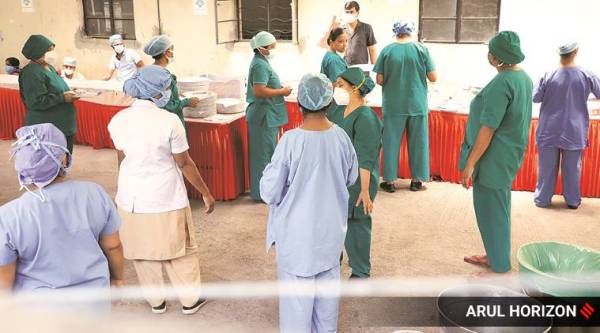 The nodal medical coordinator in Vadodara has decided to keep doctors on isolation ward duty for a week at a time. (Representational)