Stay updated with the latest - Click here to follow us on Instagram
© IE Online Media Services Pvt Ltd
 5 min read


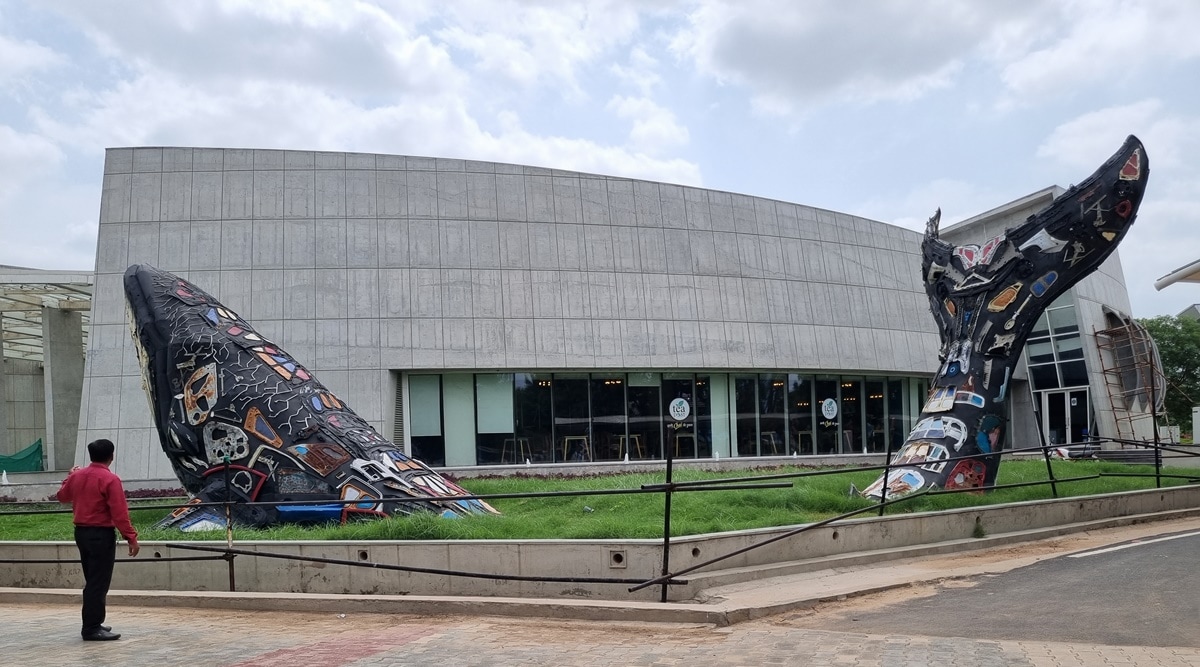 The Aquatic Gallery, which is divided into five sections—Indian, Asian, African, American, and Oceanic—houses about 11,000 fish among other species. (Express Photo)
 Crowded like any busy vegetable market in old Ahmedabad, if you are not careful you might step on another person while visiting the walkway tunnel at the Aquatic Gallery of Gujarat Science City.
The Aquatic Gallery is but one of the attractions at Gujarat Science City, which also houses an IMAX 3D Theatre said to be the first in the country. Visitors can go to the Hall of Space and Hall of Science in its main dome-shaped building replicating the top half of the globe. It also has an Energy Education Park, a Life Science Park, a Children’s Activity Centre, simulated thrill rides, an amphitheatre, a musical fountain, and a Planet Earth pavilion which informs about the planet and its natural processes.
And, the visitors will tell you the eight-hour tour is not enough to see all these galleries.
Shark tunnel
On a Tuesday, families, groups, and individuals on a visit to the Aquatic Gallery—claimed to be the “largest public aquarium” in the country—watched the fish in awe, recorded their movements, and captured them on camera as they swam above the tunnel.
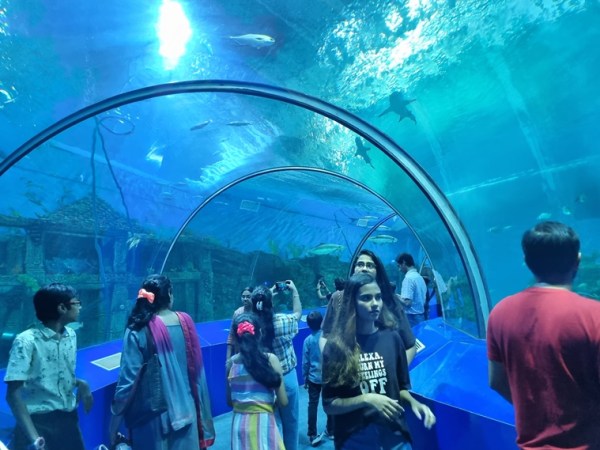 A key attraction of the Aquatic Gallery is the 28-metre walkway tunnel. (Express Photo)
Sprawled in an area of over 15,000 square metre, the Aquatic Gallery has 188 marine species, including amphibians and penguins, in 68 tanks of fresh, brackish, and marine water. It was virtually inaugurated by Prime Minister Narendra Modi along with the Robotics Gallery in July 2021.
The Aquatic Gallery, which is divided into five sections—Indian, Asian, African, American, and Oceanic—houses about 11,000 fish among other species.
A key attraction of the Aquatic Gallery is the 28-metre walkway tunnel. It is only one of the 650 exhibits among the nine different sites on the premise. What visitors find the most attractive of all is the four different species of sharks: lemon, white-tip, black-tip, and the more recent addition of the sandbar shark, which was introduced into the gallery from quarantine on June 18.
Sohil Dagia, a visitor from Mumbai, says he has come just to see the Aquatic Gallery. “You don’t get to see something like this around. I like the penguins and coypus,” the car modifier says of the large semi-aquatic rodent native to South America that lives in freshwater and penguins brought from South Africa.
“I enjoyed the Aquatic Gallery the most. It was the first time I saw many fish of different colours. The tunnel was more beautiful,” Karuna Nagar, who is with her three children and a niece, says.
Starting from the tank of brackish water with a mangrove theming containing shad fish, spotted catfish, mono fish, and puffer fish, to the tank that has the newly introduced sandbar shark—the first spotted since the beginning of the tour—is filled with different species and colours of fish.
Both marine and freshwater species are on display. But it can be difficult to differentiate between the two if you are not familiar with aquatic life.
Dev Patel, a tour guide, explains to the puzzled visitors, “You can easily identify freshwater and marine water by the theming. Fresh water has a rocky theming with some artificial trees and marine water has coral theming.”
Another draw-in
The robotics gallery, Roboseum, also sees many visitors. But some complained many of the robots were not functioning.
A disappointed Vikram Singh, a loco pilot from Rajasthan, said, “They don’t show you how the robots work”. “The robotics gallery was a little boring. The robots were dancing with only their hands. Some were static also. But it was okay,” Nagar also adds.
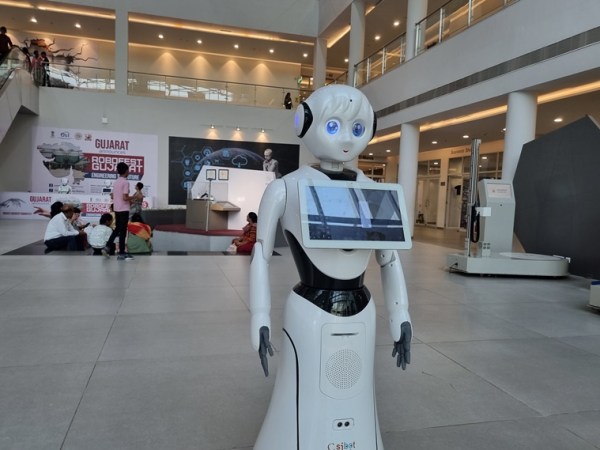 Though the Robotics museum had many visitors, some complained that the the museum does not explain how robots function. (Express Photo)
Sanjay Patel, Manager (Visitor Experience), Science City, said they do face such problems. Patel said, “The introductory robot dances to welcome the visitors. The other is the informative robot, which usually speaks to visitors. But they are not working due to some server issues. For the other robots in the gallery, whenever 40-50 tourists are approaching, they will start explaining about the exhibit.”
Encouraging scientific temperament
The Gujarat government had established the Gujarat Council of Science City (GCSC), registered as a society in 1999, to build the Gujarat Science City. Functioning as an autonomous body under the Department of Science & Technology (DST), it was registered as a wholly owned government society and was considered former chief minister Keshubhai Patel’s dream project.
With an aim of merging science education with entertainment to encourage a scientific temperament, the objective was to focus on “an informal community-based learning,” and has often been a popular school trip destination, with subsidised ticketing to incentivise visits by students.
Apart from a number of bureaucrats on the Science City’s board, councils and committees, other members include those from the scientific community, such as the director general of the National Council of Science Museum (NCSM), which also runs the Science City in Kolkata, and director of the Isro Space Application Centre (SAC), Ahmedabad.
The Science City had also served as the key venue for the biennial Vibrant Gujarat Global Summit until 2009.
Stay updated with the latest - Click here to follow us on Instagram