This is an archive article published on July 30, 2023
India’s history should be be written from people’s perspective: Ganesh Devy
Stating that the people of India are multilingual by nature, Devy said the Vadodara-based Bhasha Research and Publication Centre, founded by him before moving to Dharwad in Karnataka in 2016, was working on establishing the "evident connections of language pan-Asia".
Written by Aditi Raja
Vadodara | July 30, 2023 07:03 PM IST
4 min read
Whatsapp
twitter
Facebook
Reddit
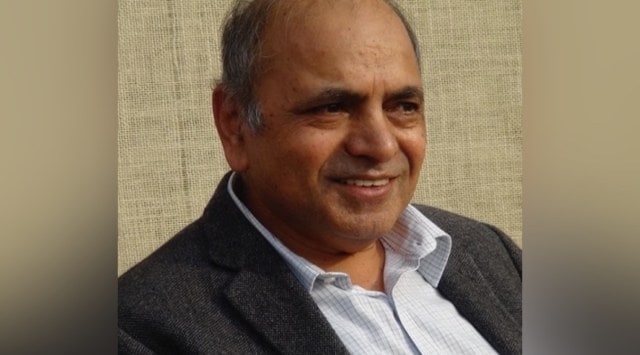
Tribal activist and Sahitya Akademi award winning author Ganesh N Devy. (Source: gndevy.in/)
Listen to this article
India’s history should be be written from people’s perspective: Ganesh Devy
x
00:00
1x1.5x1.8x
The history of India should be written from the “perspective of people” to have a more “realistic” version, said noted linguist, tribal activist and Sahitya Akademi award winning author Ganesh N Devy in Vadodara Saturday.
“There are unidentified problems from the Bhakti period, which is when several sects of Jainism also emerged…or in Buddhism, in Sri Lanka, too, similar reactions were seen. We still need to have a more realistic history of India. We will have it only when we write it from the people’s perspective like we have written languages… Otherwise, people who use the old scripts say that the problems (such as the exact details of the Harappan civilisation) have been solved but it will take 100 years more,” said Devy who was in Vadodara to promote his new book ‘The Indians: Histories of a Civilisation’, a work on the history of India from the first habitation of humans (Homo sapiens) until 2000.
Stating that the people of India are multilingual by nature, Devy said the Vadodara-based Bhasha Research and Publication Centre, founded by him before moving to Dharwad in Karnataka in 2016, was working on establishing the “evident connections of language pan-Asia”.
“A small idea that we have (through linguistic research) is that right from the regions of Syria and Turkey to Japan, we are one people… The Armenian language is known to be connected to Indian languages… So, right from Thailand, Malaysia, Sri Lanka and other Asian countries, we have linguistic inter-relations. Our next ambitious project will research on how this human civilisation moved to diversity,” Devy said.
He also highlighted the contribution of Maharaja Sayajirao Gaekwad III in “promoting diversity”. “Maharaja Sayajirao Gaekwad III encouraged many languages and promoted diversity… His Ministers were Bengali, Tamilians and also Maharashtrians… In fact, it is true that in every household in India, mothers are multi-lingual and do not speak only in their native tongue, which is also called the mother tongue. Every language that a mother speaks to a child in a house should be called the mother tongue. Therefore, Bhasha considers it a duty to focus on pan Asian diversity. We are trying to complete this research in the next five years.”
Talking about the “revisions” being made to historical texts that have been part of the education system so far in the country, Devy said, “History has to go through a lot of trials before it comes to be accepted as history… The council, which has been appointed (by the government) to revise history, has put its project on hold because academic researchers and writers are working hard to raise questions… Science is an open theory that can be challenged, religion is not. Once created, it is an absolute. History also needs experts from different domains to come together with authentic accounts…”
At the event, Kannada writer and critic Rahmat Tarikere said that the erstwhile royal states of Kolhapur, Mysore and Baroda were contemporaries with a common teacher, Sir AH Elliot, as their guru. Tarikere added that Devy had shifted from Vadodara to Karnataka in 2016 with a ‘shroud’ on his head. “While working on the research with Professor Devy, I have seen the pluralism of India in languages, religions, regions and people… He is a weaver, who moved to Karnataka and turned the literary threads into a fabric… But when he came to Karnataka, there was so much threat (following the murders of literary writers and social activists) that the situation was not good… He came with a kaffan (shroud) on his head and it would be right to say that he overcame the kaal (death).”
Story continues below this ad
Devy’s book is co-edited by Tony Joseph and Ravi Korisettar. It will soon appear in translation in Marathi, Hindi, Malayalam, Bangla, Hindi, Gujarati and Odia.
Aditi Raja is an Assistant Editor with The Indian Express, stationed in Vadodara, Gujarat, with over 20 years in the field. She has been reporting from the region of Central Gujarat and Narmada district for this newspaper since 2013, which establishes her as a highly Authoritative and Trustworthy source on regional politics, administration, and critical socio-economic and environmental issues.
Expertise:
Core Authority & Specialization: Her reporting is characterized by a comprehensive grasp of the complex factors shaping Central Gujarat, which comprises a vast tribal population, including:
Politics and Administration: In-depth analysis of dynamics within factions of political parties and how it affects the affairs in the region, visits of national leaders making prominent statements, and government policy decisions impacting the population on ground.
Crucial Regional Projects: She consistently reports on the socio-economic and political impact of infrastructure projects in the region, especially the Statue of Unity, the Sardar Sarovar Project on the Narmada River, the Mumbai-Ahmedabad High Speed Rail bullet train project as well as the National Highway infrastructure.
Social Justice and Human Rights: Her reporting offers deep coverage of sensitive human-interest topics, including gender, crime, and tribal issues. Her reports cover legal proceedings from various district courts as well as the Gujarat High Court (e.g., the Bilkis Bano case remission, POCSO court orders, Public Interest Litigations), the plight of tribal communities, and broader social conflicts (e.g., Kheda flogging case).
Local Impact & Disaster Reporting: Excels in documenting the immediate impact of events on communities, such as the political and civic fallout of the Vadodara floods, the subsequent public anger, and the long-delayed river redevelopment projects, Harni Boat Tragedy, Air India crash, bringing out a blend of stories from the investigations as well as human emotions.
Special Interest Beat: She tracks incidents concerning Non-Resident Gujaratis (NRIs) including crime and legal battles abroad, issues of illegal immigration and deportations, as well as social events connecting the local Gujarati experience to the global diaspora. ... Read More


 4 min read