© The Indian Express Pvt Ltd
 4 min read


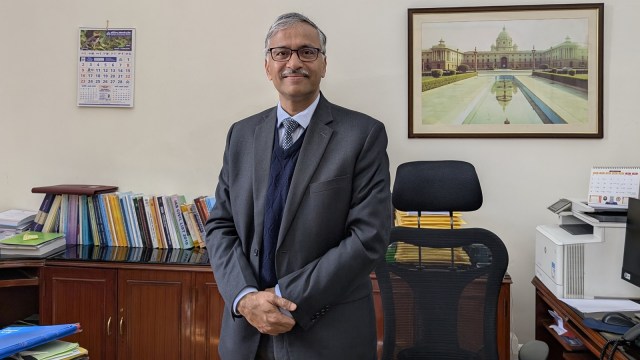 Manoj Govil, Expenditure Secretary.
The government remains focussed on investment in capital formation and is hopeful of a sizable increase in overall capital expenditure, including that by states. The total outgo on capital formation–Centre’s own capex and revenue grants to states–is estimated to grow by 17 per cent year-on-year to Rs 15.48 lakh crore in 2025-26 (FY26), Expenditure Secretary Manoj Govil told The Indian Express.
The Union government is also expected to tweak conditions in capex loans for states for the next financial year, and is working out the details, Govil said.
For FY26, the Centre has estimated its capex at Rs 11.21 lakh crore, 10 per cent higher than the revised estimate for FY25. It is, however, just around 1 per cent higher than the budget estimate for the current fiscal. The FY25 central capex had undershot the initial budget estimate due an election-induced slowdown in spending.
“One is the capex which the central government agencies do directly and another is the capex that is done by the state governments based on the revenue grants given by the Government of India, which are counted as revenue expenditure but should lead to formation of capital assets on the ground level,” Govil said.
“If you count both of them, then the revised estimate for this year is Rs 13.18 lakh crore and is slated to go up to Rs 15.48 lakh crore in the next financial year, which is a 17 per cent growth. So, I would say that the focus on capex has been kept,” he added.
In addition to the grants to states for capital assets, the government is also working on tweaking the modalities of the interest-free loans to states for FY26. In the Budget, Finance Minister Nirmala Sitharaman proposed an outlay of Rs 1.5 lakh crore for the 50-year interest free loans to states for capex and incentives for reforms.
“We still have to firm up the features of that scheme. We will also consult concerned departments in the Government of India before we finalise. But, as of now, we expect that it might have a component of untied allocation and a component of allocation tied to certain reform activities to be taken by the states, but the details are to be worked out,” Govil said.
The government also announced in the Budget that infrastructure-related ministries will come up with a three-year pipeline of projects that can be implemented in public-private partnership (PPP) mode.
Elaborating on the proposal, Govil said: “The idea behind this was that each department should have a shelf of projects, which they can think about and start implementing over the next three years. They should not bring the projects in one go or sporadically, but think about their sector and prepare a pipeline of projects which can be funded over the next few years.”
The Centre will also encourage states to undertake the same exercise and to seek support from the India Infrastructure Project Development Fund (IIPDF) to prepare PPP proposals.
On the Unified Pension Scheme (UPS)—set to begin on April 1–Govil said the fiscal impact of payouts is estimated to be an additional Rs 6,250 crore for current employees and Rs 800 crore in arrears in FY26. The government is in discussions to chalk out an investment strategy for the centralised fund under the UPS.
Govil said that the UPS corpus could “initially start with a more safe strategy and evolve in future”. “The idea is to make the corpus a viable corpus. (Also) maybe we need to take a higher equity exposure as compared to the benchmark exposure. But these issues need to be discussed with experts and will take some time,” he said.
The Expenditure Secretary added that the pension payouts under the UPS are likely to peak after 10 years or so, depending on various factors, such as the hiring patterns and sanctioning of new posts for central government employees.
“Based on the experience of a few years, we will get to know whether the actuarial assumptions made at the time of formulation of the scheme need some tweaking… It will also depend on how returns are in the markets and on the investment pattern. We are even thinking of a proper investment strategy for the centralised fund,” Govil said.