6 min read

Journalism of Courage



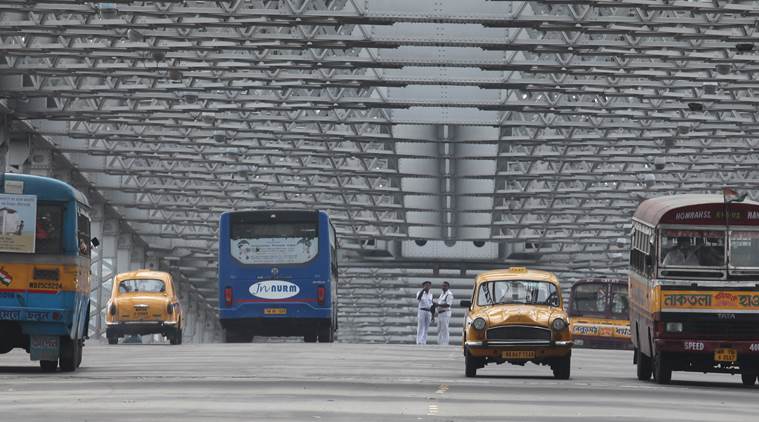 Driving off into the sunset: the iconic Ambassador has been sold to a French company. (Express Photo by Partha Paul)
Two years ago, when Hindustan Motors announced its decision to stop the production of its iconic Ambassador car, what remained was a truncated ‘Hind Motors’, a city-township that, over the years, came up around the company’s factory at Uttarpara, a municipal town on the banks of the Hooghly river. With the company announcing the sale of the Ambassador brand to French manufacturer Peugeot for Rs 80 crore, the city now finds itself at a deserted crossroad.
It was here that the Ambassador was first launched by Hindustan Motors in 1957 and remained in production till 2014. But the factory, and consequently, the township, came up as early as 1948. Proximity to Kolkata — Uttarpara is 22 km from the state capital — and river connectivity had made it an ideal location for the BM Birla-owned Hindustan Motors to pioneer an Indian automobile experiment.
The result wasn’t just a car modelled on the British Morris Oxford, but also a city that grew around the legend of the “king of roads”. Thousands of families flocked to Uttarpara from Bihar and other parts of Bengal, not just to find work, but to also be a part of the car’s journey. “It was like magic. It’s hard to explain now, when everybody has a car. An Ambassador was a status symbol… like having the royal crown. We could hear its horn from a kilometre and we would all run to see the car. My elder brother worked in the factory. As a teen, I left my family in Bihar to come live with him, just so that I could see the cars every day,” said Amandas Kothari, a retired government worker, who lives outside the gates of Hind Motor, in an adjacent colony. Kothari, like many others, didn’t leave Hind Motors when the factory shut and doesn’t plan to either. He has no illusions that the Ambassador will be back on the roads, but, as he puts it, “This is home. I like walking through the factory. There is an old temple inside. That, they haven’t closed and anyone can go pray.”
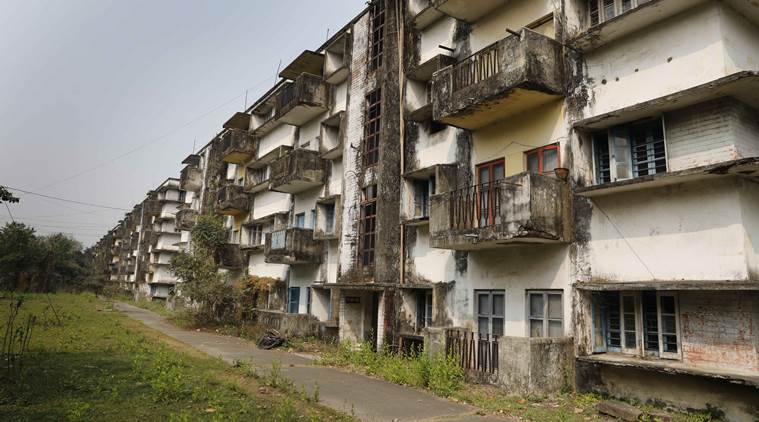 Abandoned staff quarters at Uttarpara factory. (Express Photo by Partha Paul)
Officials said Hind Motors had a population of around 30,000 in 2011; now, it’s one-third of that. When the factory stopped production in 2014, it had an estimated 2,400 workers on its payrolls. Now, most families who live within the township and the colonies around it, go to Kolkata to work as taxi drivers or in call centers. A few others work in Titagarh Wagons Limited, a private railway wagon manufacturing entity spread over 741 acres within the township.
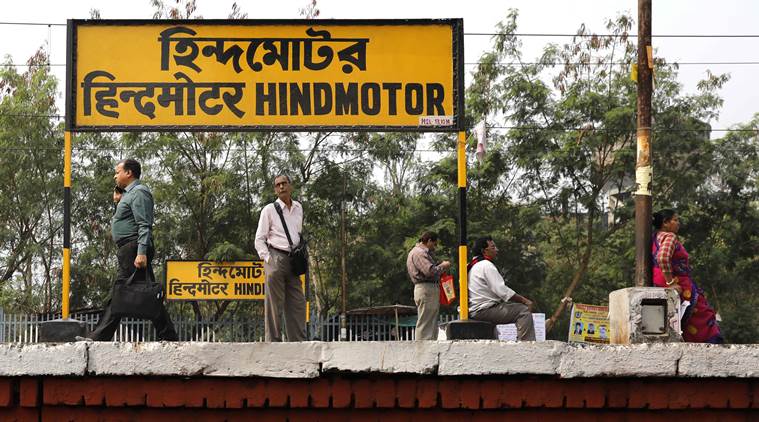 The Hind Motor railway station, located east of the factory complex. (Express Photo by Partha Paul)
A little over two years after the factory shut, the locked main gate is guarded by a security guard, who admits their crew of about 15 is “very understaffed” for the “amount of area we cover”. Inside the factory are training barracks for security staff and a lake, besides a temple and a school — the only functioning establishments. Rusted gates, staff quarters overgrown with vines and walls with political graffiti from a time when the Left was still a force in the area — it is apparent that decay has set in and it is impossible to set the clock back. To the east of the factory complex is the Hind Motors station, which falls on the Howrah-Bandel line. Located a few stations before the arterial Howrah station, at least 17 trains pass through the Hind Motors station daily.
“What will happen to us? They’ve sold the brand to a French company? Will the new company come to Hind Motors,” asks Subir Mishra, a rickshaw driver, sitting outside the station. The question bore the air of one that is often asked but rarely answered. This time though, Subhashish Dutta, a 23-year-old student, the son of a retired HM manager, waiting for his train to Kolkata, answered: “No, very unlikely.”
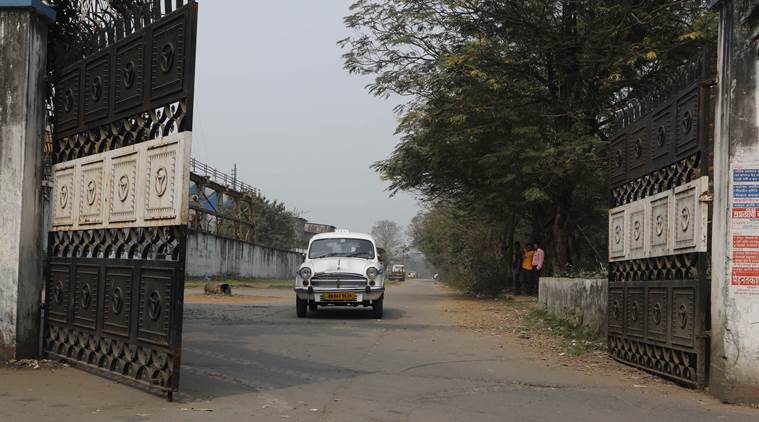 The Ambassador is now a rarity on Indian roads. (Express Photo by Partha Paul)
In Kolkata, it is easy to forget that the Ambassador has ceased production. A few hundreds of them, mostly the iconic yellow taxis, still rule the roads. But it’s the question of paying former employees their dues that’s now occupying conversations here.
Ajit Chakraborty, general secretary of the HM Employees’ Union, affiliated to the Indian National Trade Union Congress, said: “it’s disappointing that the management sold the brand” while workers’dues were pending. He said that about 600 of the 2,400 workers hadn’t availed of the VRS scheme offered in 2014 and were suffering. “Those who opted for the scheme haven’t realised their gratuity yet,” he said.
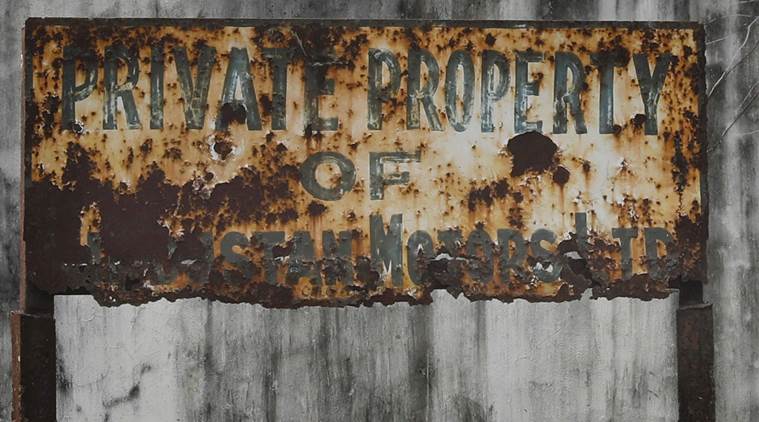 Rust is all that remains of the Amby’s home. (Express Photo by Partha Paul)
Manindra Chakraborty of the CITU-affiliated HM Workers’ Union, said they moved the Kolkata HC, “protesting the various moves of the management”. A government official of the financial department said, “The problem is that of the industry. As long as Hindustan Motors was running, Hind Motors ran too. With the city on its last legs, people choose Kolkata for work. But there are only so many jobs. What will people do?”