5 min read
Stay updated with the latest - Click here to follow us on Instagram

Journalism of Courage



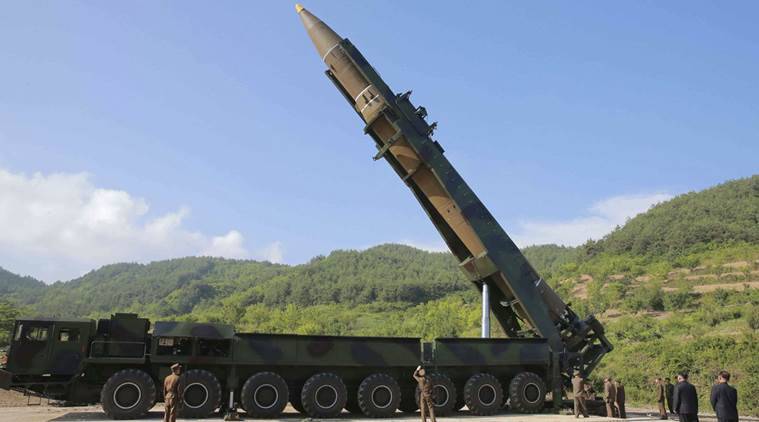 After a lull of two months, Pyongyang has launched an intercontinental ballistic missile (ICBM) which “went higher than any previous shot taken,” as per Mattis. (Korean Central News Agency/Korea News Service via AP)
North Korea fired a ballistic missile on Tuesday that splashed in the Sea of Japan, evoking angry reactions from the US with its Defence Secretary Jim Mattis expressing apprehension that the hermit state seems to be developing missiles that can reach “anywhere in the world”.
After a lull of two months, Pyongyang has launched an intercontinental ballistic missile (ICBM) which “went higher than any previous shot taken,” as per Mattis.
The ICBM was believed to have harmlessly landed in Japan’s exclusive economic zone (EEZ).
Japanese Prime Minister Shinzo Abe said the latest missile launch was a “violent act” that “can never be tolerated” and called for an emergency UN Security Council meeting. US and South Korea also reacted in similar fashion and asked for an emergency UNSC session, which, according to a media release, will be held today around 4:30 pm EST.
“We will never yield to any provocative act. We will maximise our pressure,” on Pyongyang, Shinzo Abe told reporters.
The provocative action comes just a week after the US slapped fresh sanctions on North Korea and declared it a state sponsor of terrorism.
US President Donald Trump, who according to the White House, “was briefed, while missile was still in the air, on the situation in North Korea”, exuded confidence that the situation would be handled.
“A missile was launched a little while ago from North Korea. But let me tell you that we will take care of it. We have General Mattis in the room with us and we will have a long discussion on it. It is a situation we will handle,” Trump told reporters.
The US Department of Defence detected and tracked a North Korea missile launch on Tuesday at about 1:17 pm EDT. Initial assessment indicates that this missile was an intercontinental ballistic missile (ICBM), the Pentagon Spokesman Col Rob Manning said in a statement.
“The missile was launched from Sain Ni, North Korea, and traveled about 1000 km before splashing down in the Sea of Japan, within Japan’s EEZ,” Manning said.
Trump said he wants the military to be funded now.
“Nothing changed. Nothing changed. We have a very serious approach, but nothing changed. We take it very seriously,” he said in response to a question.
Mattis, also briefly spoke with the media.
“A little over 2.5 hours ago North Korea launched an ICBM. It went higher than any previous shot taken,” he said.
“Their Research and Development effort… on their part they seem to be developing missiles that can reach anywhere in the world…In response South Korea has launched pinpoint missiles out into the water to make certain North Korea understands they could be under fire from our ally,” Mattis said.
“Bottom line is continued effort to build a ballistic missile threat that endangers world peace, regional peace, and certainly the US,” he told reporters.
In New York, US Ambassador to the United Nations Nikki Haley, along with her counterparts from Japan and South Korea requested an emergency UN Security Council meeting to be held in the open chamber in response to North Korea’s latest test of an intercontinental ballistic missile.
The Security Council session will be held today around 4:30 pm EST, a media release said.
Strongly condemning the missile launch, US Secretary of State Rex Tillerson said North Korea’s relentless pursuit of nuclear weapons and the means to deliver them must be reversed.
“Together the international community must continue to send a unified message to North Korea that the DPRK must abandon its WMD programs. All nations must continue strong economic and diplomatic measures,” he said.
“In addition to implementing all existing UN sanctions, the international community must take additional measures to enhance maritime security, including the right to interdict maritime traffic transporting goods to and from the DPRK,” he added.
Tillerson said the United States, in partnership with Canada, will convene a meeting of the United Nations Command Sending States to include the Republic of Korea and Japan and other key affected countries to discuss how the global community can counter North Korea’s threat to international peace.
“Diplomatic options remain viable and open, for now. The United States remains committed to finding a peaceful path to denuclearization and to ending belligerent actions by North Korea,” he said.
Stay updated with the latest - Click here to follow us on Instagram