The product placement on the cash counter of Kanu Tadvi’s roadside convenience kiosk shows his business acumen. Arranged neatly, under the usual retail-outlet door hangings of flavoured chips, are used one-litre ‘Bisleris’ refilled with petrol.
Bottled fuel is one of Tadvi’s best-selling items. Most of his customers, almost everyone from Gora village’s 80 houses, invariably give in to the impulse to buy this extremely essential commodity. As Tadvi pours petrol into the empty tank of a self-start gearless two-wheeler owned by a regular, he checks how far the latter needs to go. “Just about 2 km down the road,” says the helmet-less driver. That’s where most of Gora heads these days.

Tadvi likes to talk to his clients. His second question is slightly cryptic, at least to outsiders. “How far has it reached?” he asks. The man points to his knees and looks around, before he spots a mini-truck parked by the road. “The toe nails are as big as that truck,” he says.
Eyes widen, jaw drops. Thankfully, Tadvi recovers fast to share his surprise. “Sardar nu putdo (Sardar’s statue)… Statue of Unity,” he drops the 600-feet hint. A less-shocked and more informed bystander, a young Goraite, fishes out a smartphone. He volunteers to show a WhatsApp forward, of a picture of a massive bronze head of Sardar Vallabhbhai Patel tied to a fork-lift. Not many believe it’s real; they say it’s too small a bust for “the world’s tallest sculpture” — a showpiece project of the BJP governments in the state and the Centre.
Gora is good with measurements. They know their milimetres, metres and kilometres pretty well here in this hamlet of the Narmada district of south Gujarat. They need to. They also have a fear of heights, and distances as well. It’s in their DNA. For generations, their life has revolved around the height of the Sardar Sarovar Dam on “Ma Rewa (as they call the Narmada)” and the acres they have lost because of that. Of late, the narrative has changed. These days the dream is 600-ft tall.
As more villagers flock around the rundown shed, that sells everything from vegetables and cooking oil to spices — and if you wish, all put together in a meal and served at a smaller dilapidated hut next door — Gora’s several kilometres’ long complaint list rolls out.
The nearest petrol pump from the dam/statue site/Gora is about 12 km at Garudeshwar; closest school after Class VII a further kilometre away still. A well-equipped government hospital is at Rajpipla, all of 25 km away, and the same is true for a cinema hall. “Miscalculating distances or the mileage of your vehicle can mean the difference between life and death,” says Raipal, who spent his youth in Gora but is now stationed at Rajpipla, where he is an educator. Politicians don’t quite inspire confidence among the locals.
Story continues below this ad
BJP’s Shabdsharnbhai Tadvi is the sitting MLA, with Gora falling in Nandod constituency. The villagers say they haven’t seen him in a while. Meanwhile, as our Tadvi replaces the bottled fuel on the cash counter, you know that Gora’s Biyani knows his retail.
The 41-year-old wasn’t always into selling kirana items. For years, the Tadvis, listed as a Scheduled Tribe, were farmers. Like the Vasavas, Tadvis call themselves indigenous people, the original inhabitants of the plains next to the Narmada. They grew jowar, gram, cotton and vegetables. Land was fertile, life wasn’t complicated. “In 1961-62, the Sardar Sarovar project started and the government asked my grandfather to give his land. We had 16 acres, and we got Rs 36,000 for it,” says Tadvi.
This patch of family holding, like 20 other separate land masses belonging to different Gora families, wasn’t to be submerged by gated water. It was for storing the sea of building material wheeled in for dam construction. “We were told once the project got over, we would get our land back,” says Tadvi, who was given a job at the site as an added incentive. “With no land, I worked at the site after completing Class 10. My education was wasted though since I was a labourer there doing manual job.”
After 25 years of work, his last salary was Rs 3,000. Cut to 2017. The dam project is over, the steel rods and cement bags are no longer stacked on land, and the godowns that once held them are empty. The 20 families now want their land — a total of 105.66 hectares, as mentioned in last month’s Sardar Sarovar Narmada Nigam Limited’s land-for-land demand to Kevadia Colony collector — back.
Story continues below this ad
“The work was over long back. Now they are saying take Rs 5 lakh and let us keep the land. We want land, not money,” says Tadvi. He fears that his land will now be used to beautify the surrounding of the Giant Sardar so that it can be promoted as an international tourist destination.
Wouldn’t he benefit if Gora gets a piece of the tourist trade, with his strategically placed “24X7”, “ask for anything” shop? Wouldn’t he make a killing with his first-mover advantage? Tadvi isn’t even listening. He is someone whose ears have become deaf to promises; he has been sold dreams before. “You see that handpump… That’s where I get my water from,” he says. There is a collective shake of heads around. Everyone around gets the sarcasm of the man who spent 25 years building a dam.
“Do you think my shop will survive once this becomes a tourist place?” Tadvi adds. It’s the cynicism of a defeated man who doesn’t have it in him anymore to put up a fight. “I went with Medha Patkar to the Supreme Court three times. Remember Deve Gowda (the former prime minister), we were taken to him. Nothing. Absolutely nothing. Those whose lands were submerged by water were better. At least they were compensated,” laments the tiny man with a booming voice.
He points a finger to the horizon ahead, where his land lies. “Since it’s empty now, we farm it. There’s an empty godown on my patch, we house our livestock there. Around it I have grown vegetables and tuvar. But with the land not in my name, I don’t have kisan card, crop insurance and I can’t get loan on it,” Tadvi’s voice trails off as he gets distracted by a man who is dragging his scooter to his shop.
Story continues below this ad
But as he picks up another bottle from the counter, he smiles. It’s the smile of a self-made man, an enterprising Gujarati, whose vikas has been subject of many debates this election and whose identity stolen by actors in promotional videos.


 7 min read


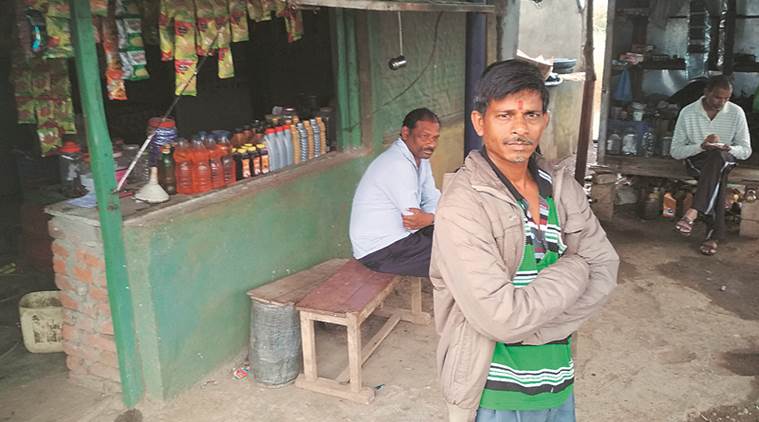 Tadvi at his shop near the Patel statue site. (Express Photo by Sandeep Dwivedi)
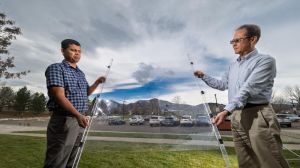
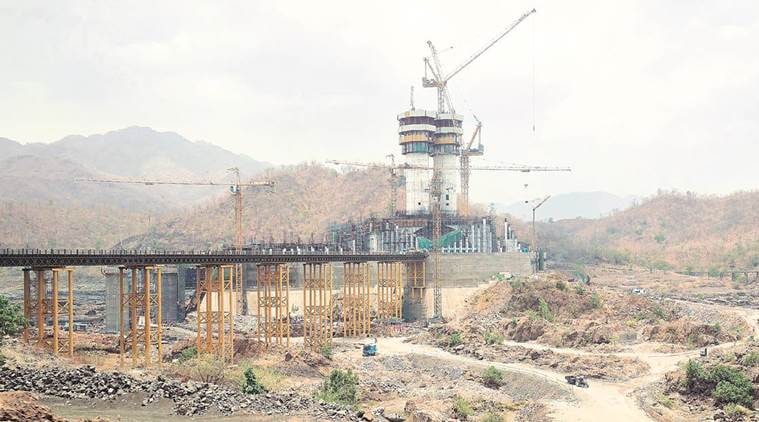 BR5-UNITY6: The Statue of Unity, taking shape, has reached a height of 117 meters from the mean sea level, which is 59 meters of the actual height of the 182 meter statue. Express Photo by Bhupendra Rana