Journalism of Courage
The number of international migrants soared to 244 million this year, an increase of more than 40 percent from the year 2000, as economic need, global markets and a desire for better lives put more people on the move, the United Nations said.
More than twice as many asylum seekers and migrants —859,000, arrived illegally on the shores of Greece and Italy during the first 11 months of 2015 than in the previous five years combined, according to Frontex entry data.
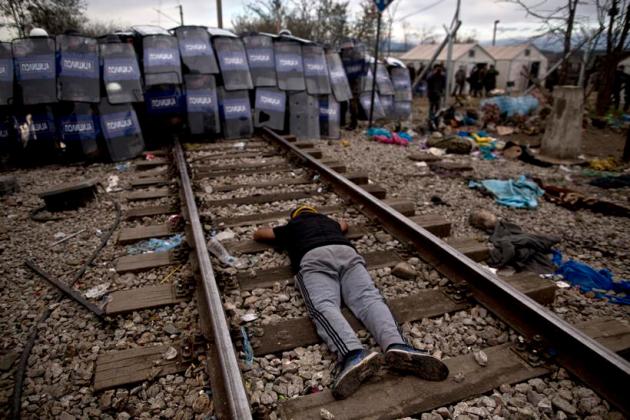
A migrant lies on the railway track in front of Macedonian policemen during clashes at the Greek-Macedonian border, near the northern Greek village of Idomeni, Saturday, Nov. 28, 2015. Tension has flared on the Greek side of the Greece-Macedonia border when a migrant who was stopped from crossing into Macedonia, suffered severe burns when he climbed on top of a stationary train carriage and touched a overhead power cable. (Source: AP)
Nearly half of the world's migrants were born in Asia, which has provided the most migrants — 1.7 million people per year —over the last 15 years, followed by Europe, according to a report by the UN Department of Economic and Social Affairs.
The numbers of people reaching the continent in Europe's worst migration crisis since World War Two would be at least four times more than for 2014, he said, adding this was "extraordinary" and a record.
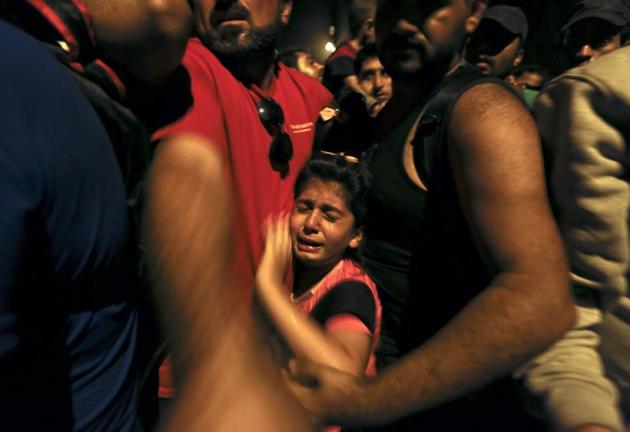
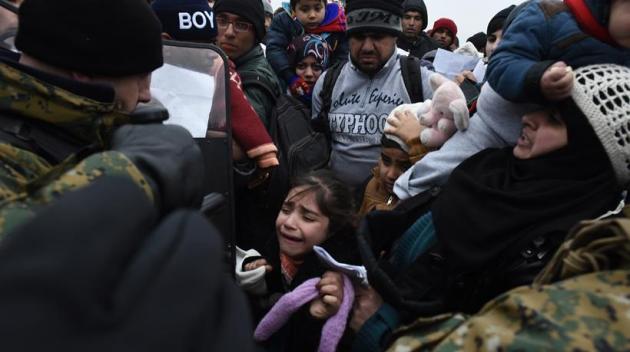
A Syrian refugee child cries as she is squeezed by other refugees and migrants trying to move ahead at Greece's border with Macedonia near the village of Idomeni early morning September 7, 2015. (Source: Reuters)
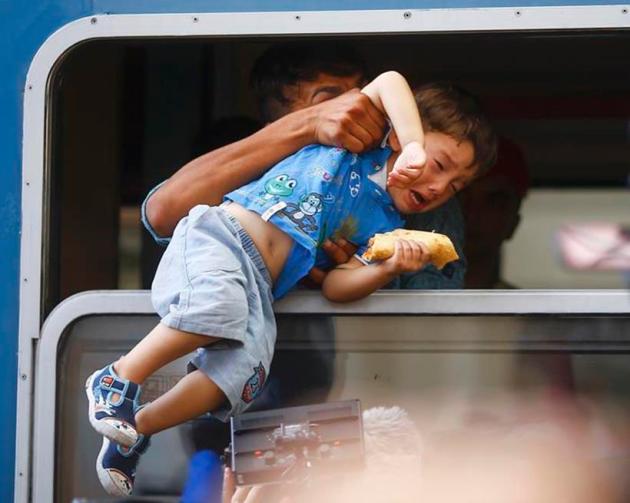
Hungarian authorities on September had closed Budapest’s main train station to refugees and migrants and all trains to the west had been stopped from leaving. Police in helmets and wielding batons surrounded Keleti station’s grand, crumbling facade and dozens of refugees and migrants who were inside were forced out. The closure of the station to refugees and migrants appeared prompted in part by pressure from other EU countries trying to cope with arrivals from Hungary.
A migrant pulls a boy inside a train through a window at the Keleti train station in Budapest, Hungary, September 3, 2015. (Source: Reuters)
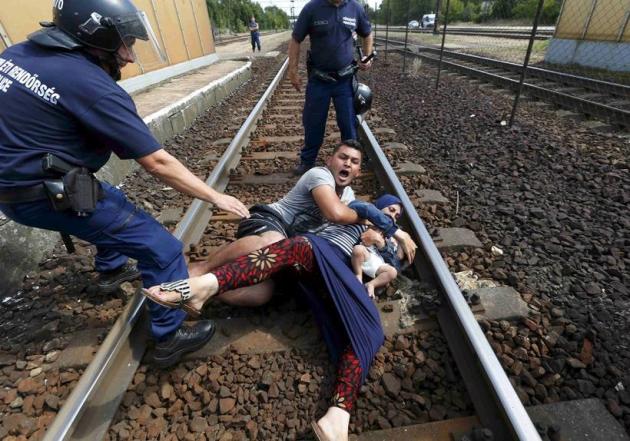
Trains with migrants were allowed to leave Budapest’s Keleti station after the end of a two-day police blockade that prompted around 3,000 people trying to travel to western Europe to camp outside. Trains bound for Sopron near Hungary’s border with Austria, were however, halted by scores of riot police at the town of Bicske, an hour from Budapest, where one of Hungary’s four main refugee camps is located. Passengers deemed to be migrants were ordered to disembark. Migrants protested the move and shouted “No camp, no camp!”
Hungarian policemen stand by the family of migrants as they wanted to run away at the railway station in the town of Bicske, Hungary, September 3, 2015. A camp for refugees and asylum seekers is located in Bicske. (Source: Reuters)
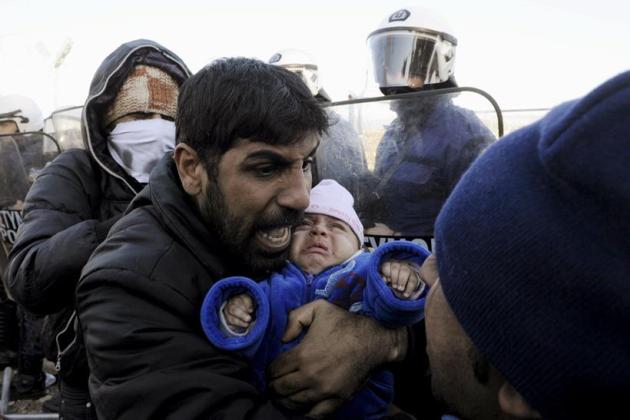
Around 3,000 asylum seekers remain stuck at the Idomeni border crossing in Greece after Macedonia refused to allow entry for those who cannot prove Iraqi, Syrian or Afghan citizenship.
A stranded migrant holding a baby shouts next to a Greek police cordon following scuffles at the Greek-Macedonian border, near the village of Idomeni, Greece, December 3, 2015. (Source: Reuters)
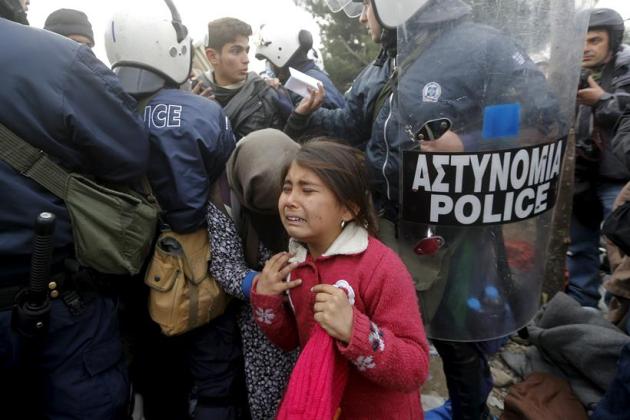
Greece later dispersed more than 2,000 refugees who were stuck for weeks in a camp near the Macedonian border, as the EU announced that over 1 million people had now claimed asylum within its borders since the start of the year. Syrians, Afghans and Iraqis continue to be allowed into Macedonia and the Balkans, but people of other nationalities,have been stopped at the border since early November. In a recent decision taken by some Balkan countries to bar people of certain nationalities from heading towards northern Europe from countries such as Iran, Morocco and Pakistan.
A refugee girl cries after passing through a Greek police cordon before crossing the Greek-Macedonian border near the village of Idomeni, Greece December 4, 2015. (Source: Reuters)

As the Macedonian government began filtering them since December on the basis of their perceived need, hundreds protested the move. Many even stitched their mouths and sat on the railways tracks to oppose the government's move.
A Macedonian police officer gestures towards a refugee who is preparing to cross the Greek-Macedonian border near the village of Idomeni, Greece December 4, 2015. (Source: Reuters)
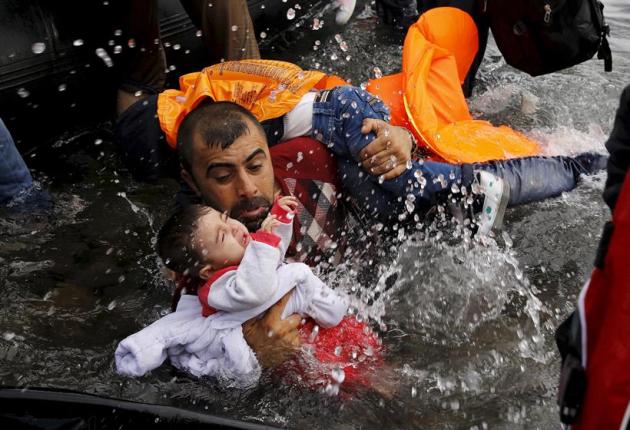
Over 500,000 migrants have entered Europe this year and approximately four-fifths of those have paid to be smuggled by sea to Greece from Turkey, the main transit route into the EU.
Lesbos is the entry point for around half of the 230,000 who have arrived in Greece so far this year but the Greek authorities’ response to the crisis has so far been woefully inadequate.
Hundreds, many of them children, have died in various accidents, this year when the flimsy boats and rafts they were travelling on overturned. The island Mayor in November had said that Lesbos has run out of room to bury the bodies of desperate migrants trying to reach Europe.
A Syrian refugee holds onto his children as he struggles to walk off a dinghy on the Greek island of Lesbos, after crossing a part of the Aegean Sea from Turkey to Lesbos.(Source: Reuters)
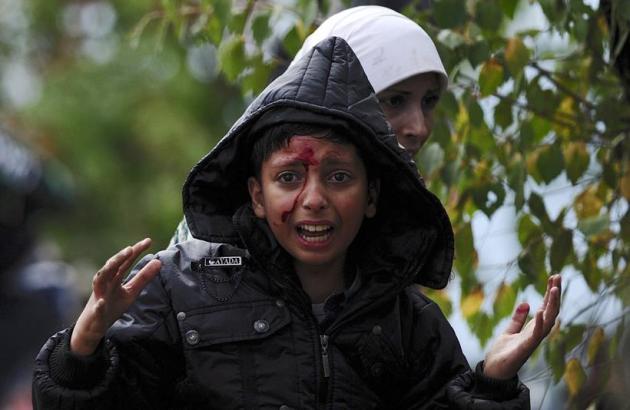
Nearly half of the world's migrants were born in Asia, which has provided the most migrants — 1.7 million people per year —over the last 15 years, followed by Europe, according to a report by the UN Department of Economic and Social Affairs.
The numbers of people reaching the continent in Europe's worst migration crisis since World War Two would be at least four times more than for 2014, he said, adding this was "extraordinary" and a record.
A girl cries after crossing Greece's border into Macedonia near Gevgelija, Macedonia.(Source: Reuters)
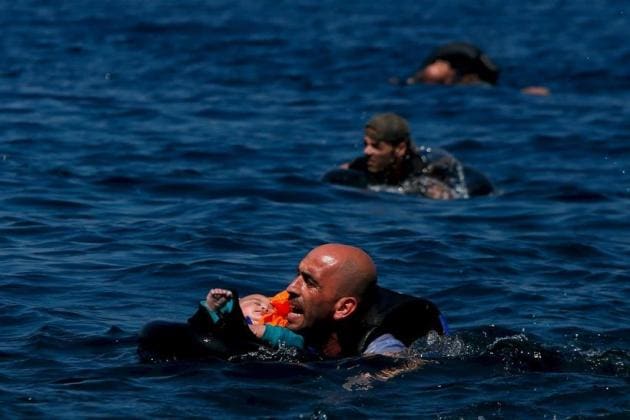
Lesbos, which lies less than 10km from the Turkish coast in the north Aegean Sea, has been a primary gateway for thousands of migrants entering the EU's outermost border.
More than 500,000 refugees have entered Greece through its outlying islands this year. The overcrowded boats have lead to the deaths of many including children, who have been desperately fleeing war in many countries.
A Syrian refugee holding a baby swims towards the Greek island of Lesbos. (Source: Reuters)
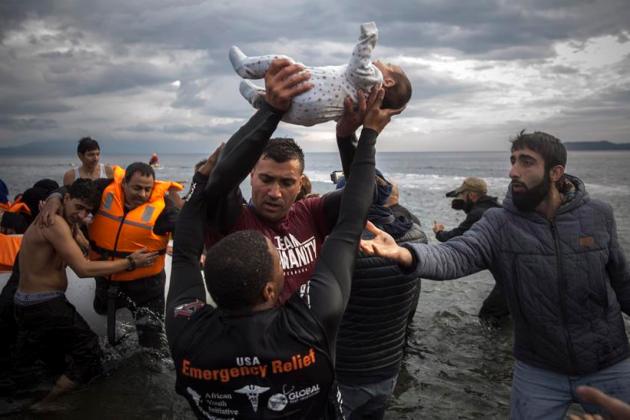
Two thirds of all international migrants live in just 20 countries, the report said. The largest number, 47 million, live in the United States, followed by 12 million in Germany, 12 million in Russia and 10 million in Saudi Arabia, it said.
Europe has seen nearly 900,000 refugees and migrants so far this year, about half of them Syrians fleeing war in their homeland, the UN High Commissioner for Refugees said earlier in December.
A volunteer holds up a baby as others help migrants and refugees to disembark from a dinghy after their arrival from the Turkish coast to the Greek island of Lesbos. (Source: AP)
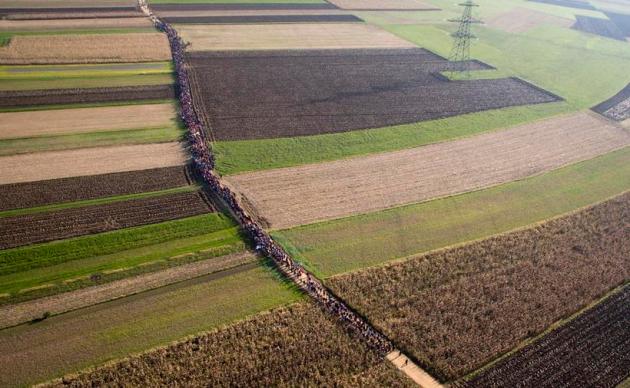
For days the Hungarian government had blocked refugees from travelling by train. Frustraded and deperate to reach their desired destination hundreds thereafter began walking a 100 mile stretch of road. Drone footage over one of Hungary's motorways emerged showing the number of migrants prepared to make the long walk from Budapest to the Austrian border.
In this aerial photo from October, a column of migrants moves through fields after crossing from Croatia, in Rigonce, Slovenia. (Source: AP)
The European Union's border agency, Frontex, said it will use its higher 2016 budget to deploy more border guards, buy equipment for registering refugees and lease planes and cars for patrols to help protect the bloc's external borders, its head said.
Tempers have flared at Greece's main border crossing with Macedonia, where riot police pushed back thousands of migrants jostling to cross over, after Macedonia blocked access to people deemed to be economic migrants and not refugees.
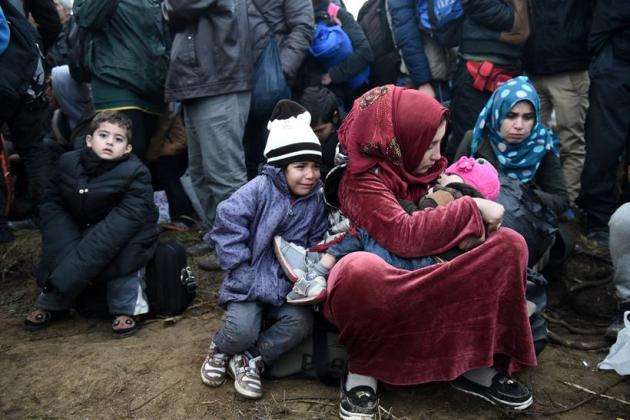
A boy cries as he waits with his family to pass from the northern Greek village of Idomeni to southern Macedonia. (Source: AP)
Leaders of the 28 EU member countries also pledged quick action to better restrict violent extremists' ability to finance their actions, including via the imposition of asset freezes and other restrictive measures. However some leaders, including Greek PM Alexis Tsipras, made clear their opposition to giving Brussels powers to send in EU border guards without the consent of the country concerned. Ultimately, officials acknowledged, the EU has little direct leverage over how member states police the bloc's external borders, beyond the implicit threat to boot them out of the Schengen free-travel zone if they don't cooperate — a breakup German officials say would be disastrous for Europe.
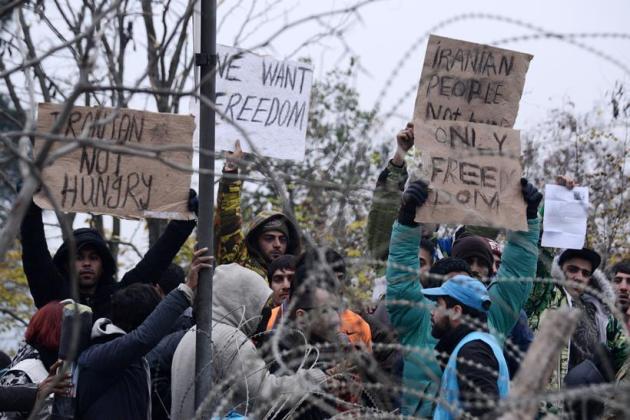
Migrants hold up placards as the wait on man's land near the northern Greek village of Idomeni. (Source: AP)
EU leaders set a six-month deadline for deciding whether to push ahead with plans for a border guard agency that could deploy to member states unable or unwilling to manage their borders as thousands of migrants continue to arrive in Europe daily. They also kicked off negotiations with Britain on many of the cornerstones on which the EU is built, with the survival of Britain as a member state hanging in the balance.
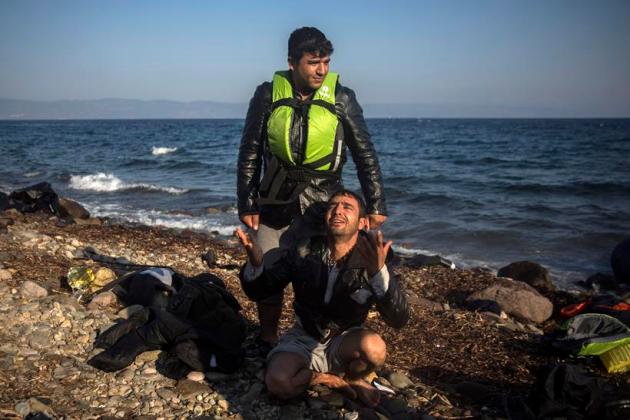
Migrants react after their arrival from the Turkish coast to the northeastern Greek island of Lesbos. (Source: AP)
European law says migrants must stay in the country where they first enter the bloc, and that is determined by where they give their fingerprints. Until recently, most migrants have simply refused to be identified, moving north from Greece and Italy by foot, train or bus.
A girl cries as she waits with other refugees to be allowed to cross from the northern Greek village of Idomeni to southern Macedonia.(Source: AP)
In an effort to stem the flood of migrants pouring into Germany, France and the rest of Europe from the frontline countries, the EU has called for stricter enforcement of the rules and detention in so-called "hotspots" until migrants agree to be identified.
To relieve the burden of having to take in all the migrants expected to reach Greece and Italy, a relocation programme has been set up for Syrian, Eritrean and Iraqi refugees but, so far, fewer than 200 have been transferred out of Italy.
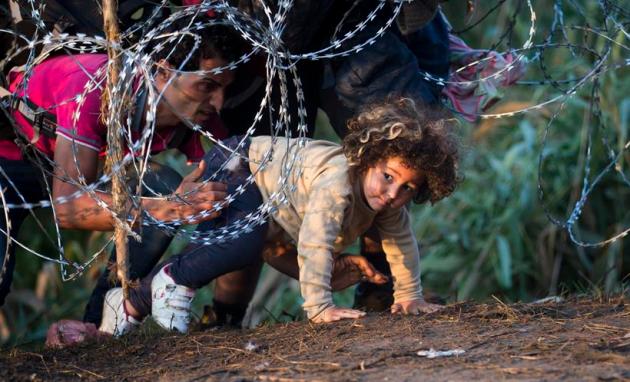
A child is helped cross from Serbia to Hungary through the barbed wire fence near Roszke, southern Hungary. Round the clock, thousands of refugees cross daily along the approximately 110-mile border with non-EU member Serbia to the south. (Source: AP)
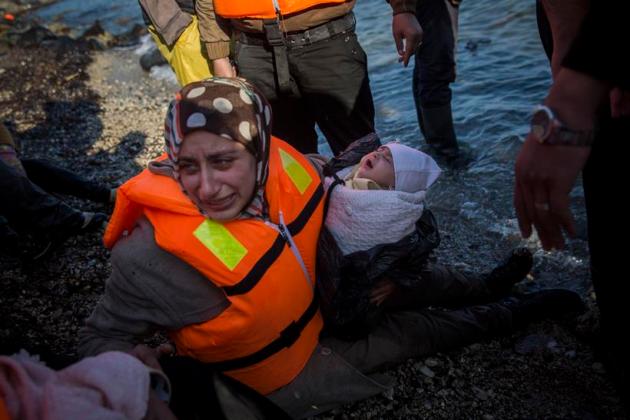
More than 680 people, many of them children, have lost their lives trying to cross the Aegean to Greece this year, according to the International Organization of Migration, many of them refugees fleeing conflict in Syria and elsewhere. Nearly 3,000 others have died on the perilous Mediterranean crossing to Italy.
A woman cries while holding her baby on a beach next to the town of Mytilene, shortly after crossing a part of the Aegean sea on a dinghy, with other refugees and migrants, from Turkey to the northeastern Greek island of Lesbos. (Source: AP)
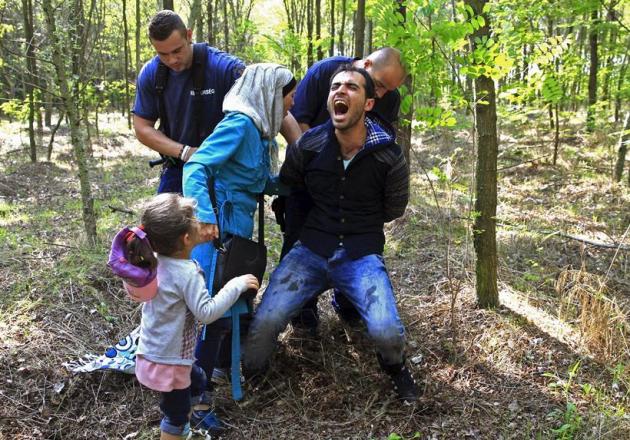
In a bid to shut down the main corridor for refugees and asylum seeker to Central Europe, Hungary fortified its border with 109 miles of razor-wire fencing. The Hungarian stiffness did not just stop there, following the razor fencing, the police detained over 1,000 refugees, mostly from war-torn Syria, Afghanistan and Iraq. Currently, mostly men detained and separated from their families are locked in overcrowded Hungarian prisons or police detention cells.
Hungarian policemen detain a Syrian migrant family after they entered Hungary at the border with Serbia, near Roszke. (Source: Reuters)
The Macedonian government too constructed a barrier fence along its southern border with Greece, to control the refugee influx. The government had said that the fence was designed to direct the flow of refugees to controlled points for registration, but Macedonia and other Balkan nations reportedly have been turning away refugees for several weeks.
Thousands of them since then have been protesting along the sealed borders for uninterrupted passage to other EU nations.
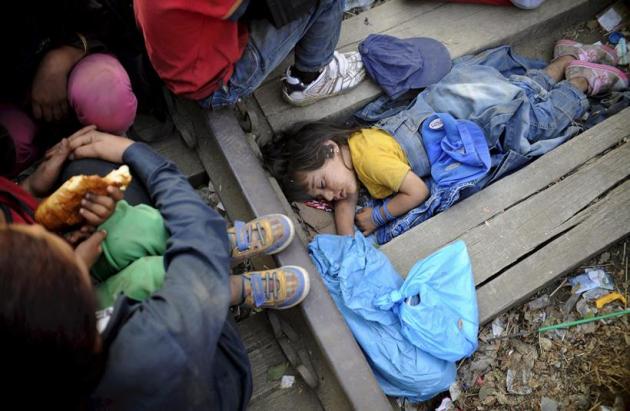
Four-year-old Rashida from Kobani, Syria, part of a new group of more than a thousand immigrants, sleeps as they wait at border line of Macedonia and Greece to enter into Macedonia near Gevgelija railway station. (Source: Reuters)
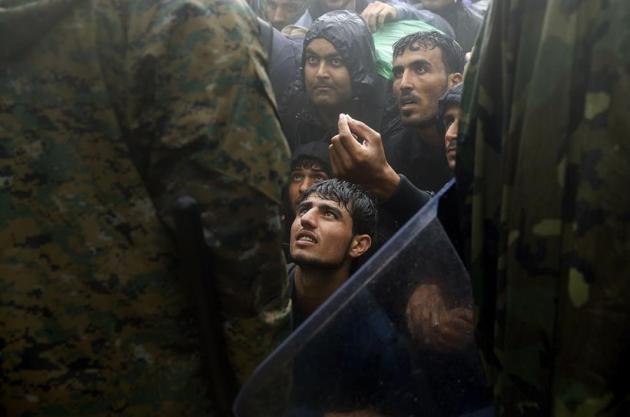
Macedonian authorities took the decision to exclude migrants from non-war countries earlier on the heels of similar action by Serbia, Croatia and Slovenia. The refugees other than, Syria, Afghanistan and Iraq were barred from entering the Balkan countries. The excluded migrants camping in Idomeni protested against the move but little has been acheived yet.
Migrants and refugees beg Macedonian policemen to allow passage to cross the border from Greece into Macedonia during a rainstorm, near the Greek village of Idomeni. (Source: Reuters)
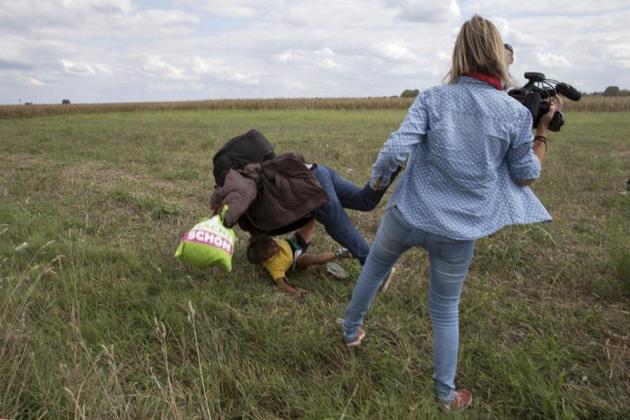
Videos and photographs of a Hungarian camerawoman kicking and tripping refugees running away from the police forces in Roszke went viral within few hours.
In videos and images posted online by multiple videographers and photojournalists, she can be seen making sideways karate-style kicks into the knees of two people — a young man and a pony-tailed teenage girl — as they ran past her. Both stumbled but neither fell as she continued filming.
The woman drew international ire after the footage went viral, was later fired by the ultranationalist online TV channel, N1TV.
A migrant carrying a child falls after tripping on TV camerawoman (R) Petra Laszlo while trying to escape from a collection point in Roszke village, Hungary, September 8, 2015. (Source: Reuters)
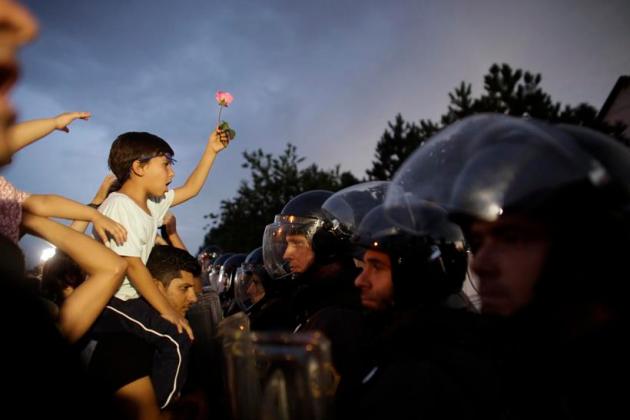
Slovenia too erected a razor-wire fence at its border with Croatia to stem the inflow of migrants. Soldiers rolled out the wire along the Slovenian bank of the Sotla River, which forms part of the 400-mile border with Croatia.
Slovenian Prime Minister, Miro Cerar, said that it was very likely that many of the 30,000 migrants who were traveling north from Greece could become stranded in Slovenia, which has limited room to accommodate them.
A boy with a flower sits on the shoulders of a man as a group of refugees and supporters face Slovenian police blocking the entrance to Slovenia at the border crossing in the Croatian village of Harmica. (Source: AP)

Migrant whose boat stalled at see while crossing from Turkey to Greece swim to approach a shore of the island of Lesbos, Greece. (Source: AP)
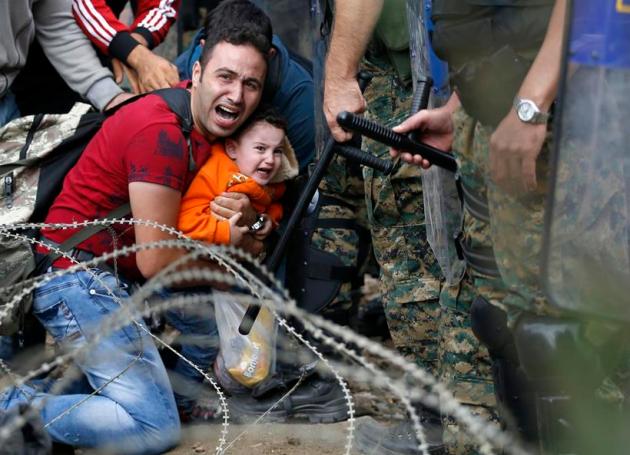
Macedonian riot police officers clash with migrants near the border train station of Idomeni, northern Greece, as they wait to be allowed by the Macedonian police to cross the border from Greece to Macedonia. (Source: AP)