© The Indian Express Pvt Ltd
Latest Comment
Post Comment
Read Comments
 8 min read


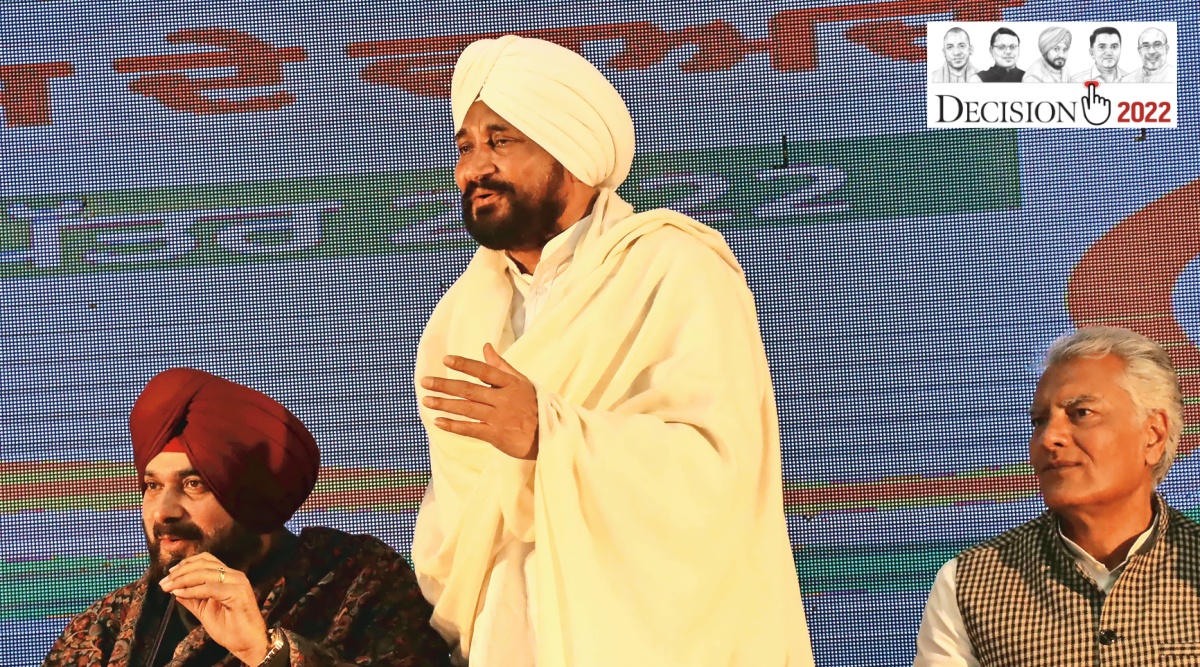 Chief Minister Charanjit Singh Channi, Navjot Singh Sidhu (left) and Sunil Jakhar (right) release the Congress’s poll manifesto, in Chandigarh on Friday. Kamleshwar Singh
At Amit Shah’s rally in the heart of Ludhiana a few days before Election Day, was a muted presence, and a conspicuous absence. Narendra Modi, who dominates BJP rallies outside Punjab in visually standalone ways, was downplayed in both rhetoric and imagery — his was not the gigantic cut-out, nor was his name chanted the most. It was a nod, perhaps, to the toll taken by the farmers’ movement on his stature in Punjab.
The one who was not mentioned at all, however, was Captain Amarinder Singh, the Congress chief minister who was turfed out from his office and party barely four months before elections, and floated a new outfit, Punjab Lok Congress (PLC), that has tied up with the BJP. The period of his incumbency was spoken of only in unflattering ways.
In fact, several of the PLC’s candidates — including one who spoke in the Ludhiana rally — have chosen to fight this election on the BJP’s symbol of lotus, instead of the PLC’s hockey stick and ball. The uncomfortable, unsung predicament of Captain Amarinder Singh is a striking feature of this Punjab election. It speaks of a tall leader’s crumpling.
In 2017, Singh was the Captain in the winning slogan: “Chaunda hai Punjab, Captain di sarkar”. Five years later, in 2022, his fall from the pedestal is steep — disowned by the party he led to power in the last election, barely acknowledged by the one he has joined forces with.
This campaign has not been easy for the Congress, either. After all, it is tough to be the incumbent in an election in which, amid deep cynicism, hopelessness and sense of siege, the only positive vote appears to be the one for change.
In places, the Congress has dealt with the difficulty by simply joining the Opposition’s clamour against its own government when it was led by Amarinder Singh.
In the Congress office near Patiala’s Fawara chowk, its candidate Vishnu Sharma, pitted against the Captain himself on the latter’s home turf, says: “I am available to the people 24 hours. The palace doors (of Amarinder Singh) were closed. Even when I was a mayor here, ministers in government would come to my house because he wouldn’t meet them.”
The biggest issue in Punjab, for Sharma, in this election: “For 4.5 years, no work has been done in the CM’s city, no one got anything from his government.”
In Bathinda, a more prominent Congressman, Manpreet Badal, recites poetry, invokes a golden Congress past in Punjab and skips over the part where he was a leading player in the Captain-led government: “Imtihan ki ghadi aan padi hai toh koi fikr nahin/ hamne sau baar zamaane ke bhram ko toda hai (the time of reckoning is here again, but there is no reason to worry, for those who have always defied the odds).” In Bathinda, now, he says, “government schools are better than private schools…” And “it was the Congress that gave Punjab the Bhakra dam, PGI, PAU…”
The Congress also banks on the Channi factor — “Saada Channi, Saada CM (Our Channi, Our CM)”, party posters say — to buck anti-incumbency against itself: The first Dalit CM of the state with the highest proportion of Dalit population, nearly 32 per cent, took charge after the exit of Amarinder Singh.
That puts the party in the peculiar position, however, of disowning four and half years (Singh), and promoting 111 days (Channi) of the same Congress government. It’s a last-minute gambit many voters see as too clever by half. At the same time, the strategy is meeting with limited success — because of announcements by the Channi government on pending bills of electricity and water, and because his candidature evokes a measure of solidarity among Dalits.
In Nandgarh village, district Patiala, Karam Singh Dhiman speaks of the waiving of dues. “Paani, bijli sasti hoi hai (Water, electricity has become cheaper)… Captain was in cahoots with the Badals, Channi saab vadiya ne (Channi is doing better)”, he says.
“Saadi taan masaa baari aayi hai (we have only just got our turn)”, says Jarnail Singh in the SC mohalla of Balad Kalan village in Sangrur. “This opportunity has come after 70 years, Channi is one of us,” says Bikar Singh, a Ravidassi (SC) Sikh, in village Dhaula of Bhadaur.
But even in Bhadaur, which is one of the two constituencies Channi is contesting from, scepticism can be heard alongside the hope, in both Jat and SC clusters of the village. Gurmail Singh holds up a newspaper cutting of a report on the ED’s claim of recovering Rs 10 crore from Channi’s nephew: “He is SC, but is he poor?” And Ladi Singh, a Ramdassia (SC) Sikh, says: “Channi did not come through on his ailaan (announcements). We will give our vote to to those who benefit us, not because they belong to our bhaichaara or biradari (caste or community).”
In the Doaba region, too, which is home to the greatest concentration of the state’s Dalit population — this is also the state’s NRI belt where, like NRIs from other castes, Dalit NRIs send home remittances — it is clear that the Channi factor may not paper over divisions already etched on the ground.
Its Dalit population is large but Dalit consciousness in Punjab has always been divided within — between Hindu and Sikh, by its many sub-castes, through allegiance to different Deras and because of the varying spread of the population in the state’s three geographically and culturally distinct regions.
All mainstream parties woo and get the Dalit vote. There is no distinct vehicle for Dalit aspirations — like, for all its waning electoral fortunes, the BSP is in UP, founded by Kanshi Ram who belonged to Punjab. Punjab’s Dalits have been politically active since at least the 1930s — but not as Dalits.
Dalit consciousness may be in search of a unifying symbol in Punjab. But at least for now, it does not seem to be Channi. In the SC mohalla of village Khurdpur in Jalandhar district, young Kulbir Singh, who describes himself as “berozgar”, and who is poised to go to Croatia — “all my friends have gone abroad, only I am left…” — says: “The vote in our village will split three ways, between SAD, Congress and AAP… Channi is not a factor… AAP has no dharha (faction) but it has voters in our village”. While in Nanda Chaur village of Hoshiarpur district, Sandeep Kumar, SC, says: “Congress government has done a lot of work here in the last five years… and Channi saab is the messiah of the poor…”
As Punjab prepares to go to polls, then, there is a vote for change that not just the opposition, but also the incumbent, the Congress under Channi, is attempting to court.
But the question on Sunday will also be this: Is the vote for change going to be enough to chip away at hardened old loyalties and habits in a state that also has an enduring sense of itself, is also set in its ways?