5 min read

Journalism of Courage



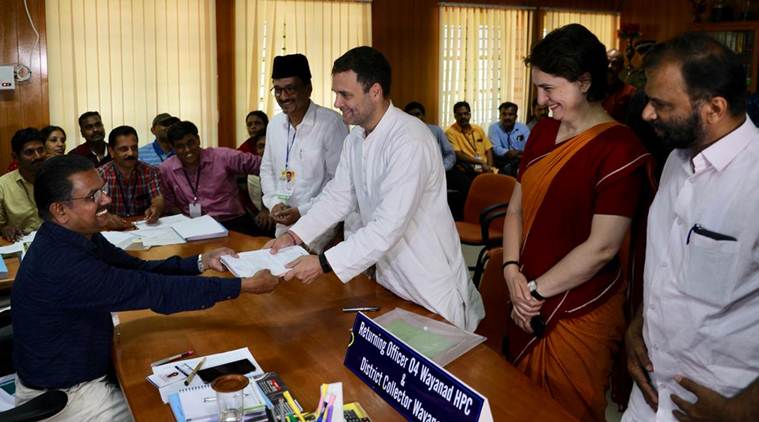 Rahul Gandhi’s foray into Wayanad was a good-natured wave to the South or signalled alienation from Amethi. (File photo)
While the pundits were leading the debate on whether Rahul Gandhi’s foray into Wayanad was a good-natured wave to the South or signalled alienation from Amethi, a low hubbub of complaint was issuing from the global Malayali community, signalling a different issue altogether: now, they said, all the Delhi journalists ignorant about Kerala would descend upon the district to pontificate about the land, the people and their good points and bad points. And indeed, India Today immediately despatched Gaurav Sawant, whose natural habitat is generally held to be at the other end of the subcontinent, in the region of Drass and Batalik.
Elsewhere in India Today TV’s footprint, there’s an Election Express luxury bus, last seen in Hyderabad, being rubbernecked by the locals as Owaisi was interviewed in its rexine-rich interior. And Rajdeep Sardesai has hit the southern gastronomic trail with Elections on my Plate, which combines food and politics in pathbreaking ways (in the past, he has been heckled by locals at the table, in very poor taste). Hope he’ll have the time to swing by Mangalore for a gadbad sundae, the dessert whose name makes it symbolic of an election where everyone knows that something is going on, but no one really knows what it is. If they claim they do, they are either optimists or idiots, which is much the same thing. Let us ignore them, and enjoy the election as pure entertainment.
For variety entertainment, there are the foreign channels, which are still agog with the Brexit story, vote on vote. It is like an endless loop played over and over again, with the same dramatis personae, including a prime minister who refuses to quit. Never before have so many the world over owed so much entertainment to so few in Westminster. Indeed, it is being groused about that Theresa May is splitting the Tories much more successfully than she is separating London from Brussels. The latest twist to the story is provided by an inadvertent intervention by the press. On April 4, the sitting of the House of Commons had to be suspended when torrents of water fell upon the press gallery from the ceiling. The source of the deluge, apparently, was the press refreshments area on the floor above.
The Indian avatar of the Westminster model is also seeing events which may cast a long shadow. In quick succession, we have seen the launch of an anti-satellite missile, announced by the prime minister himself rather than a space scientist or defence official, and the silent launch of the Namo TV channel, which is apparently available on all carriers without seeking the usual permissions. Wags are saying that the first should be used to down the satellite which the second is using. Joking apart, in the first case, the Election Commission has found the Model Code of Conduct unviolated, and the latter has just come to public notice.
A legalistic reading will be available at some point, but the immediate question is that of appropriateness. Democracy works on the confidence that all sides will play by commonly understood perceptions of public propriety. Four decades ago, the letter of the law had countermanded the election of Indira Gandhi from Rae Bareli because her election agent Yashpal Kapoor was still a government servant. Later, the misuse of some jeeps also came up. The appropriation of Doordarshan over the years, for the promotion of leaders and government programmes with electoral outcomes, was actually much more improper, but even that seems trivial in comparison with the new normal. By pushing the envelope on propriety to the limit, the 2019 election is opening doors that are best left closed.
Now, two questions that were still in the air but were apparently settled: first, India’s global channel WION concluding that the Ethiopian Airlines Max 8 crashed because the pilot “could not fight the artificial intelligence” of Boeing. This is a trampoline leap of the imagination, since there was only feedback control involved. The aircraft used a sensor for monitoring the wing’s angle of attack. If it was too steep, the plane would stall and go into a flat spin, so a feedback loop between the sensor and control surfaces kept the wing level. In the tragedy, the sensor misfired and the plane’s nose was pushed too far down. And it re-engaged unexpectedly after being overridden by the pilot. This was an avionics malfunction for which Boeing is responsible, not artificial intelligence running riot. It’s the sort of misreading that gives AI a bad name.
Second, Foreign Policy ran a story by Pentagon correspondent Lara Seligman on April 4, which quotes US defence sources to find that all of Pakistan’s F-16s are present and accounted for (they have been physically counted by Americans), and that none were shot down by Indian aircraft. Who says you can’t teach an old dogfight story new tricks.