


Stay updated with the latest - Click here to follow us on Instagram
Tags:


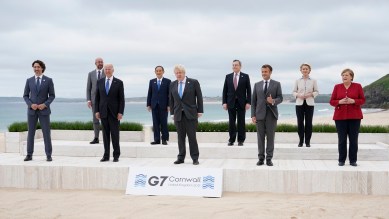
G-7 leaders have called on China to respect human rights of the minorities, including the Uyghur community, in its Xinjiang region and to restore a higher degree of autonomy in Hong Kong, a draft version of the G7 summit communique said.
G7, the group of seven richest democracies — Canada, France, Germany, Italy, Japan, the United Kingdom and the United States — also demanded a more transparent study on the origin of Coronavirus Disease (Covid-19), amid claims that a possible laboratory leak in central China’s Wuhan city may have a connection with the start of the pandemic.


The G7 leaders also underscored “the importance of peace and stability across the Taiwan Strait, and encourage the peaceful resolution of cross-Strait issues.”
They added, “We remain seriously concerned about the situation in the East and South China Seas and strongly oppose any unilateral attempts to change the status quo and increase tensions”.
US President Joe Biden on Saturday had sought action against China’s alleged practice of forced labour, including against the Uyghur minority detained in the camps in Xinjiang.
Canadian Prime Minister Justin Trudeau had led a Group of Seven discussion of China on Saturday and called on leaders to come up with a unified approach to the challenges posed by the People’s Republic.
The summit also decided on a global infrastructure plan to offer to developing nations, in an effort to counter China’s multi-trillion-dollar Belt and Road Initiative (BRI).
Meanwhile, China on Sunday pointedly cautioned G-7 leaders that the days when “small” groups of countries decided the fate of the world were long gone.
“The days when global decisions were dictated by a small group of countries are long gone,” a spokesman for the Chinese embassy in London said. “We always believe that countries, big or small, strong or weak, poor or rich, are equals, and that world affairs should be handled through consultation by all countries”.
The re-emergence of China as a leading global power is considered to be one of the most significant geopolitical events of recent times, alongside the 1991 fall of the Soviet Union that ended the Cold War.
The G7, whose leaders met in southwestern England at an English seaside resort of Carbis Bay, has been searching for a coherent response to the growing assertiveness of President Xi Jinping after China’s spectacular economic and military rise over the past 40 years.
Beijing has repeatedly hit back against what it perceives as attempts by Western powers to contain China, and says many major powers are still gripped by an outdated imperial mindset after years of humiliating China.
(With inputs from Reuters)


Stay updated with the latest - Click here to follow us on Instagram


