8 min read
Stay updated with the latest - Click here to follow us on Instagram

Journalism of Courage



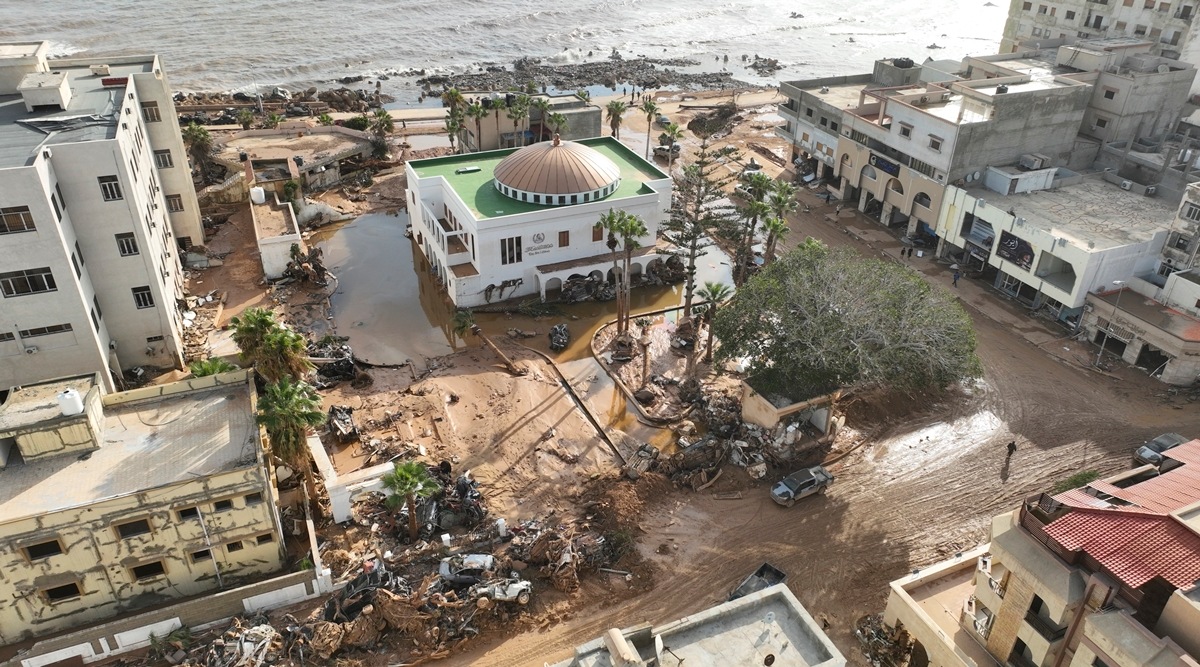 Floodwaters from Mediterranean storm Daniel are visible on Sept. 12, 2023. (AP)
 Written by Mohammed Abdusamee, Vivian Nereim and Isabella Kwai
More than 5,000 people were killed in Libya after torrential rains caused two dams to burst near the coastal city of Derna, destroying much of the city and carrying entire neighbourhoods into the sea, local authorities said Tuesday.
Libya, a North African nation splintered by a war, was ill-prepared for the storm, called Daniel, which swept across the Mediterranean Sea to batter its coastline. The country is administered by two rival governments, complicating rescue and aid efforts, and despite its vast oil resources, its infrastructure had been poorly maintained after more than a decade of political chaos.
In the city of Derna alone, at least 5,200 people died, said Tarek al-Kharraz, a spokesperson for the interior ministry of the government that oversees Eastern Libya, according to the Libyan television station al-Masar. But the floodwaters also swept through other eastern settlements, including Shahhat, Al-Bayda and Marj, and at least 20,000 people were displaced.
Thousands more were missing and the death toll is likely to rise in the coming days. The flooding left bodies scattered in the streets while buckling buildings, sinking vehicles and blocking roads, impeding access to the most stricken areas.
“We still cannot comprehend the magnitude of what has happened,” said Jawhar Ali, 28, a Derna native who lives in Turkey and spent two sleepless nights seeking news from his family back home, where communications were cut off by the disaster. “The shock we are experiencing is terrible.”
Analysts said the country’s woes — political division, economic instability, corruption, environmental degradation and dilapidated infrastructure — seemed to coalesce in one catastrophe when the dams south of the city collapsed. The flooding came days after an earthquake in Morocco, another North African nation, killed more than 2,900 people.
But to Anas El Gomati, director of the Sadeq Institute, a Libyan policy research center, the two events felt profoundly different, given the unpredictable timing of the Earth’s tremors compared with a storm like Daniel, which can be forecast hours or days ahead.
Even after the storm displayed its destructive power last week in Greece, Turkey and Bulgaria, killing more than a dozen people, Libyan authorities seemed to have no serious plan to monitor the dams, warn residents or evacuate them, El Gomati said.
The devastation from storm floods in Libya is truly catastrophic.
At least 5,000 people have died. Many thousands more missing.
How much death and destruction will it take for world leaders to take climate change seriously?
pic.twitter.com/iE1yzM6nmn— Jeremy Corbyn (@jeremycorbyn) September 12, 2023
“We say Mother Nature, but this is the act of man — it’s the incompetence of Libya’s political elites,” El Gomati said. “There’s no words you can find to describe the biblical level of suffering those people have to endure.”
The dams unleashed water that poured through Derna, a city of roughly 100,000 people, Ahmed al-Mosmari, a spokesperson for the Libyan National Army, the dominant political force in the area, said in a televised news conference Monday.
“It’s the first time we’ve been exposed to this type of weather,” al-Mosmari said, calling the scenario “completely unexpected.” Conditions were making it difficult to orchestrate rescue and aid operations, with all roads to the most affected areas either cut off or nearly cut off, he said.
Citizens who escaped Derna left the city “as if they were born today, with nothing,” he said.
The flooding recalled the effects of Hurricane Katrina in 2005, when the storm struck Louisiana and became a calamity after levees in New Orleans ruptured, inundating vast parts of the city.
It also underscored how climate change can combine with political conflicts and economic failure to magnify the scale of disasters.
Libya is divided between the internationally recognised government based in Tripoli, the capital, and a separately administered region in the east, including Derna — where the main power broker is the Libyan National Army and its commander, Khalifa Hifter, a longtime militia leader.
“Libya for the past 10 years has gone through one war to another, one political crisis to another,” said Claudia Gazzini, a senior Libya analyst for the International Crisis Group. “Essentially this has meant that, for the past 10 years, there hasn’t really been much investment in the country’s infrastructure.”
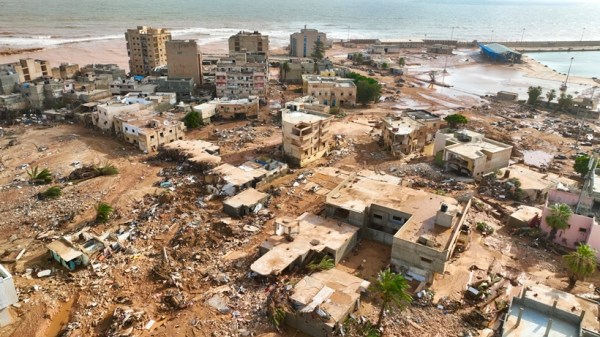 A general view of the city of Derna is seen on Sept. 12., 2023. (AP)
The country is also especially vulnerable to climate change and severe storms. Warming causes the waters of the Mediterranean to expand and its sea levels to rise, eroding shorelines and contributing to flooding, with low-lying coastal areas of Libya at particular risk, according to the United Nations.
Libya endured 42 years of autocratic rule under Moammar Gadhafi before he was overthrown in a revolt in 2011, during the Arab Spring.
Over the next decade, the country was fractured by a civil war that drew in multiple foreign players, including the United States. At one point, Turkey backed a provisional government in Tripoli while Russia, the United Arab Emirates and Egypt supported Hifter, a former Libyan general.
Today, the country is governed by the western administration based in Tripoli, led by Prime Minister Abdul Hamid Mohammed Dbeibah, and an eastern-based authority led by Osama Hamad. Dozens of armed groups remain influential, a point reinforced by deadly clashes last month in Tripoli. Despite possessing the largest oil and gas reserves on the African continent, the country was ill-equipped to deal with disaster.
Thousands in Tripoli performed the absentee funeral prayer for the victims of floods in east #Libya pic.twitter.com/lmzUMN7Z2A
— The Libya Observer (@Lyobserver) September 12, 2023
The different authorities in Libya appeared to be working together to some extent to coordinate the search and rescue efforts, as medical teams began converging on the region to treat survivors and search for the missing. They included rescue workers sent by the government in Tripoli as well as others sent by Turkey and the UAE, who arrived in Benghazi on Tuesday. Several aid groups also said they were scaling up their services in the country.
President Joe Biden, in a statement on Tuesday, said that the United States was “sending emergency funds to relief organisations and coordinating with the Libyan authorities and the UN to provide additional support.” President Emmanuel Macron of France also announced the country would send financial support and other aid for organisations working on the ground.
However, it was unclear how much aid had reached the most-affected areas; Benghazi is more than 180 miles from Derna by car, and many of the area’s roads had been cut off by the flooding, the Derna City Council said Monday. It called for the opening of a maritime passageway to Derna and for urgent international intervention.
Convoys carrying emergency aid are pouring into storm-stricken cities in east #Libya from all regions of the country. pic.twitter.com/HsYMgPC1Cz
— The Libya Observer (@Lyobserver) September 12, 2023
As Libyans struggled to reach their loved ones through communication blackouts, many of them turned to Facebook, where groups were filled with inquiries from relatives of people in Derna.
In Turkey, as he waited anxiously with a friend from Derna, Ali was elated to finally hear Tuesday that his family was safe — but his friend, whose sobbing punctuated Ali’s voice messages to a Times reporter, had lost seven relatives when their home was swept away, including his wife, his mother, his father and his infant child.
“The city is experiencing a tragic situation, a catastrophe unlike anything we have ever seen,” Ali said, pleading for international assistance. “The residents of Derna are searching for the bodies of their loved ones by digging with their hands and simple agricultural tools.”
Stay updated with the latest - Click here to follow us on Instagram