


Stay updated with the latest - Click here to follow us on Instagram
Tags:


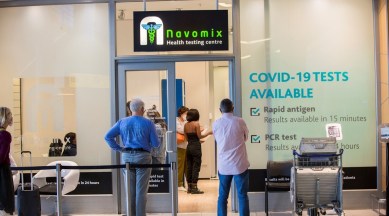
In early November, laboratories in South Africa’s Gauteng province began picking up something unusual while processing Covid-19 tests: they weren’t able to detect the virus gene that creates the spike protein enabling the pathogen to enter human cells and spread.
Around the same time, doctors in the region saw a sudden flood of patients with fatigue and headaches. The new cases appeared after weeks of calm that ensued following a delta variant-driven third coronavirus wave, which had ripped through Johannesburg and the capital Pretoria in July.

The anomalies in samples were first detected by scientists at the privately owned Lancet Laboratories, who sounded the alarm, according to Glenda Gray, the president of the South African Medical Research Council. “They didn’t know what was wrong so they alerted the virologists, who began to sequence the samples,” she said in a Nov 29 interview.
Junior Lancet scientist Alicia Vermeulen was credited with making the initial find on the afternoon of Nov 4, when she noticed an anomaly in a single positive test and told her manager, according to News24, a South African news website. Over the next week, the same anomaly was picked up several times, and Allison Glass, head of molecular pathology at Lancet and a member of the government’s Ministerial Advisory Council on Covid-19, was informed, the website said.
Together with the National Institute for Communicable Diseases, Lancet was able to determine by Nov 22 that there was a new variant, initially known as B.1.1.529, News24 reported. The S-gene couldn’t be detected because it had mutated, it said.

Scientists in Botswana had meanwhile also picked up the same anomalies in samples from tests conducted on travelers in early November, and the quirk also surfaced in a sample taken from a person who had returned to Hong Kong from South Africa and was in quarantine.
The data was uploaded onto GISAID, a global repository, and quickly leaked. By Nov 24, there were initial reports about the new variant in the British media.
Public announcement
Nicholas Crisp, the acting director general of South Africa’s Department of Health, said he was first informed on the evening of Nov 24. Other key government officials were told early the next day and a press conference was hastily convened, where Tulio de Oliveira, the head of two gene-sequencing institutes in South Africa, announced the discovery.

For now, doctors say, omicron seems to be causing mild disease. But with the outbreak initially taking off in a relatively young cohort of college students it’s hard to tell what the effect may be once it takes hold in older, more vulnerable segments of the population.
“Whatever I tell you today may be false tomorrow,” Gray said.
The World Health Organisation has warned of the potential for Covid surges with “severe consequences” fueled by omicron, whose constellation of mutations suggests it may be both more transmissible and capable of evading the immunity provided by vaccination or a prior infection.
The speed of the discovery is a testament to South Africa’s gene-sequencing capabilities that were built up with the aid of research money that was plowed into tackling other diseases. The country has the most people infected with the HIV in the world and has one of the largest tuberculosis epidemics.
Travel bans
“South Africa has some world-class virologists and gene sequencers. We have this because of HIV and TB,” Gray said. “All of these people have transitioned to Covid-19.”
The events that unfolded following omicron’s discovery have dismayed the South African government and business groups. Flight bans were quickly imposed just as the country’s crucial summer holiday season began and threaten to derail efforts to rebuild an economy that contracted by the most in at least 27 years in 2020.
“We have to question the purpose of creating the panic that the public announcement has no doubt created,” said the South African Chamber of Commerce and Industry, the country’s biggest business group.
While the WHO said South Africa and Botswana should be thanked for the speed of the announcement, the response has instead felt like a punishment.
“Our scientists did what they were supposed to do, they did what they are ethically obliged to do,” said Angelique Coetzee, the chairwoman of the South African Medical Association. “Now we are the villains of the global travel community.”
Stay updated with the latest - Click here to follow us on Instagram


