9 min read
Stay updated with the latest - Click here to follow us on Instagram

Journalism of Courage



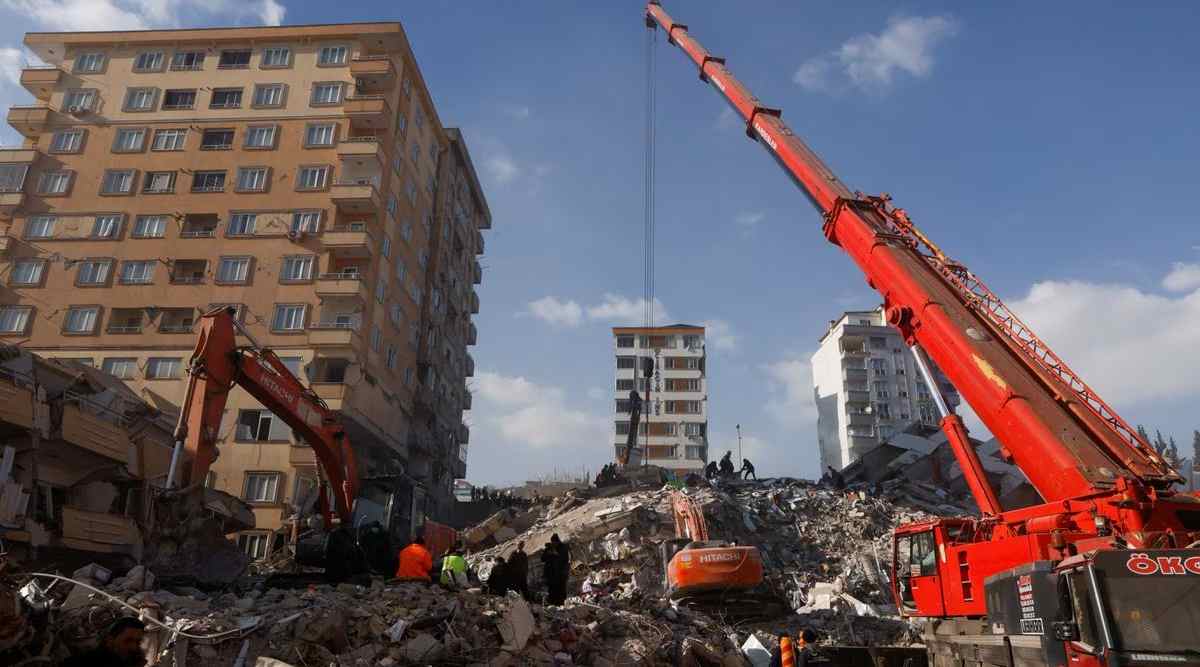 Cranes remove debris from demolished buildings following the deadly earthquake in Maras, Turkey, February 11, 2023. (REUTERS/Emilie Madi)
 Kevser said she could hear her two sons trapped beneath the rubble of their collapsed apartment building in the Turkish city of Antakya but for two days she was unable to find an emergency response leader to order their rescue.
“Everyone’s saying they’re not in charge. We can’t find who’s in charge,” she said on Tuesday last week, standing on a downtown street where at least a dozen other buildings had collapsed. “I’ve been begging and begging for just one crane to lift the concrete.”
“Time’s running out. A crane, for God’s sake.”
When Reuters returned to the street a day later, neighbors said no more survivors had been pulled from the wreckage of the building.
Many in Turkey say more people could have survived the 7.8 magnitude earthquake that struck the south of the country and neighboring Syria a week ago if the emergency response had been faster and better organized.
Reuters spoke to dozens of residents and overwhelmed first-responders who expressed bewilderment at a lack of water, food, medicine, body bags and cranes in the disaster zone in the days following the quake – leaving hundreds of thousands of people to fend for themselves in the depths of winter.
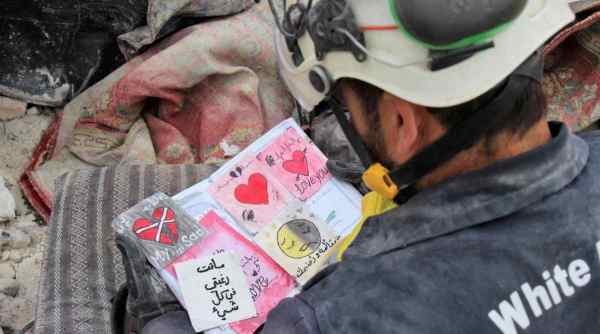 A White Helmets member looks at a notebook found at a damaged building, in the aftermath of an earthquake, in rebel-held town of Jandaris, Syria, February 10, 2023. (White Helmets/Handout via REUTERS)
The death toll from both countries on Monday exceeded 37,000, making it among the world’s worst natural disasters this century and Turkey’s deadliest earthquake since 1939.
“The general problem here is of organization, especially in the field of health,” Onur Naci Karahanci, a doctor working in Turkey’s southeastern city of Adiyaman, said on a call hosted by the Turkish Medical Association (TTB), the professional grouping for doctors. He said there weren’t enough body bags for the dead, especially in the first two days after the quake.
In the cities of Antakya and Kahramanmaras, close to the epicenter of the quake, Reuters reporters saw very few rescue teams in the first 48 hours.
Some survivors said they had tried unsuccessfully to contact Turkey’s Disaster and Emergency Management Authority (AFAD) and ended up begging local teams to rescue their relatives from the wreckage – only to be told that such requests must go through AFAD’s coordination centers, Reuters witnesses said.
Asked about the rescue efforts, AFAD’s press department directed the news agency to the interior ministry, saying its teams were busy in the field. The interior ministry did not immediately respond to a request for comment.
AFAD has been tasked since 2009 with coordinating disaster response and aid efforts in Turkey by its 7,300 personnel and more than 600,000 volunteers, as well as by other Turkish and foreign groups.
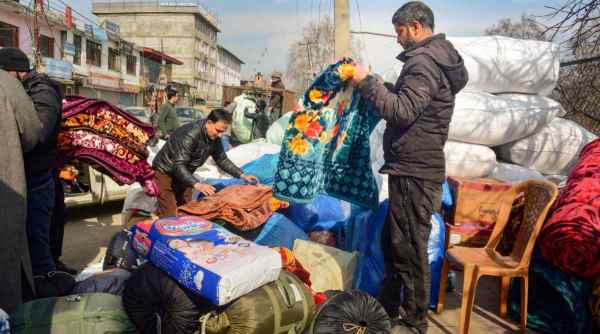 People donate blankets, clothes and other items for victims of earthquake-hit Turkiye and Syria, in Srinagar, Monday, Feb. 13, 2023. (PTI Photo)
AFAD said on Saturday in its regular public briefing that more than 218,000 AFAD responders, police, gendarmerie, soldiers, volunteers and other personnel were now deployed in the quake zone.
However, AFAD’s top officials have not publicly addressed some residents’ criticism of its slow response.
Two experts consulted by Reuters partly blamed the delays on the centralization of emergency response under AFAD by President Tayyip Erdogan’s government.
This included restricting the military’s freedom to deploy its troops without direct instruction from civilian authorities, and sidelining of other first-responders, such as the Red Crescent and the AKUT search and rescue group, they said.
Hetav Rojan, a Copenhagen-based security advisor for Danish authorities and expert on the region, said Turkey’s politics and governance has “gravitated towards centralization” under the ruling AK Party.
“But centralization is bad in disaster management,” he said. “Top-down implementation stymies response effectiveness. Local units should be mandated to act according to local needs. This is not happening in Turkey.”
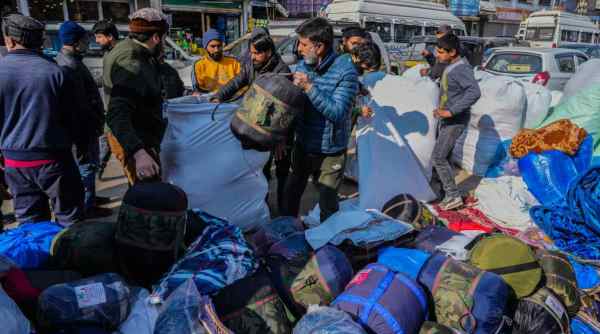 Members of We the helping hands foundation, a local voluntary organization, sort relief supplies for earthquake victims in Turkey and Syria, at a collection point in Srinagar, Indian controlled Kashmir, Monday, Feb. 13, 2022. (AP Photo/Mukhtar Khan)
Erdogan’s office did not respond to requests for comment. A senior official who requested anonymity said authorities could have been better prepared by storing more first aid, medicines and blankets in warehouses in a region known to be earthquake prone.
The president – facing tight elections this year after two decades in power – acknowledged last week the search-and-rescue response was not as fast as the government wanted, partly due to bad weather and damaged roads that hampered early movements in the vast area spanning 450 km (280 miles).
Having risen to prominence more than two decades ago partly due to his critique of the response to a major 1999 earthquake, Erdogan has rejected criticism of his own administration’s response this month.
U.N. aid chief Martin Griffiths, speaking in Kahramanmaras on Saturday, called Turkey’s disaster response “extraordinary” given the quake’s historic size. “In my experience people are always disappointed in the beginning,” he said, in an apparent reference to criticism.
CRITICAL REPORT
Some opposition politicians have increasingly pointed the finger at AFAD’s lack of preparation.
A report by AFAD into its response to a much smaller 5.9 magnitude tremor in northwest Turkey in November, reviewed by Reuters, acknowledged that its vehicles and resources were insufficient to address a larger disaster. The tremor injured 98 people but caused no deaths.
The report found that AFAD struggled to find suitable people to respond to the Nov. 23 quake and its local coordination was poor as administrators were not fully informed of the emergency plan. An improvised team of 300 teachers and imams lacked expertise and made mistakes assessing the damage.
“Disaster groups were unprepared, AFAD centers were selected wrongly, and there was insufficient coordination and cooperation between institutions,” the report said. It noted that more drills were needed to prepare for disasters.
Referring to the report, Kemal Kilcdaroglu, leader of the main opposition party, said that even more damaging than the magnitude of last week’s quake was the “lack of coordination, lack of planning and incompetence”.
The interior ministry did not respond to a request for comment on what steps were taken in the wake of the report.
Interior Minister Suleyman Soylu said he commissioned the report precisely to improve Turkey’s disaster response.
“Exploiting this matter, creating a political benefit from this creates more damage than that generated by the earthquake,” he said on Friday.
AFAD’s budget for 2023 was cut by a third to 8.08 billion lira ($429 million), down from 12.16 billion lira in 2022. However, the budgets of the bodies it helps coordinate, including the police and coast guard, were boosted.
MILITARY’S ROLE
Following a failed coup in 2016, Erdogan tightened his grip on economic, foreign and defense policy. The government arrested thousands of people and expelled tens of thousands more from state jobs for alleged links to the Gulen movement it accused of orchestrating the coup.
Until 2018, AFAD fell under the prime minister’s office. But then, when Turkey shifted to a centralized presidential system with Erdogan as head of state, AFAD came under the purview of the interior ministry that reports to the presidency.
Nasuh Mahruki, founder of the AKUT search and rescue organization, said the army did not respond soon enough to last week’s disaster because it needed civilian authorization to mobilize manpower.
In 2010, in an effort to diminish the sway of Turkey’s powerful military, Erdogan’s government annulled a protocol that allowed the army to conduct internal operations under certain conditions without civilian consent.
“In such colossal events a mass effort altogether is essential,” Mahruki said. “Now the responsibility seems to be with AFAD, but of course it is not prepared.”
The defense ministry referred questions to the interior ministry.
In a statement, Defense Minister Hulusi Akar said soldiers had established emergency centers in southern Turkey within an hour of the quake and their ranks had grown to more than 25,000 by Saturday.
CENTRALIZATION
Turkey is crisscrossed by two major fault lines and Turks are accustomed to terrifying tremors. But they have generally seen the state’s emergency response as effective.
One nurse, who asked not to be named for fear of being removed from her relief work, said she was ready to rush to the quake zone on Monday but had to wait for orders from AFAD and only arrived 40 hours later.
When she arrived in Hatay, the hardest-hit region, she encountered a field hospital with no water, power or portable toilets – and located too far from the city of Antakya for many to reach.
She told Reuters she had rushed to every major Turkish disaster in the last 25 years, including the 1999 tremor that killed more than 17,000 people, but was shocked by the response to last week’s disaster.
“I don’t know why AFAD failed so miserably,” she said.
Stay updated with the latest - Click here to follow us on Instagram