Express at COP30: Countries reject draft text as it skips roadmap on fossil fuel phase-out
A group of 29 countries, mainly small island states and those from Europe, rejected the draft text because it skipped any mention of a roadmap on fossil fuel phase-out, which was one of their key demands.
Written by Pratip Acharya
Brazil | Updated: November 22, 2025 03:22 AM IST
4 min read
Whatsapp
twitter
Facebook
Reddit
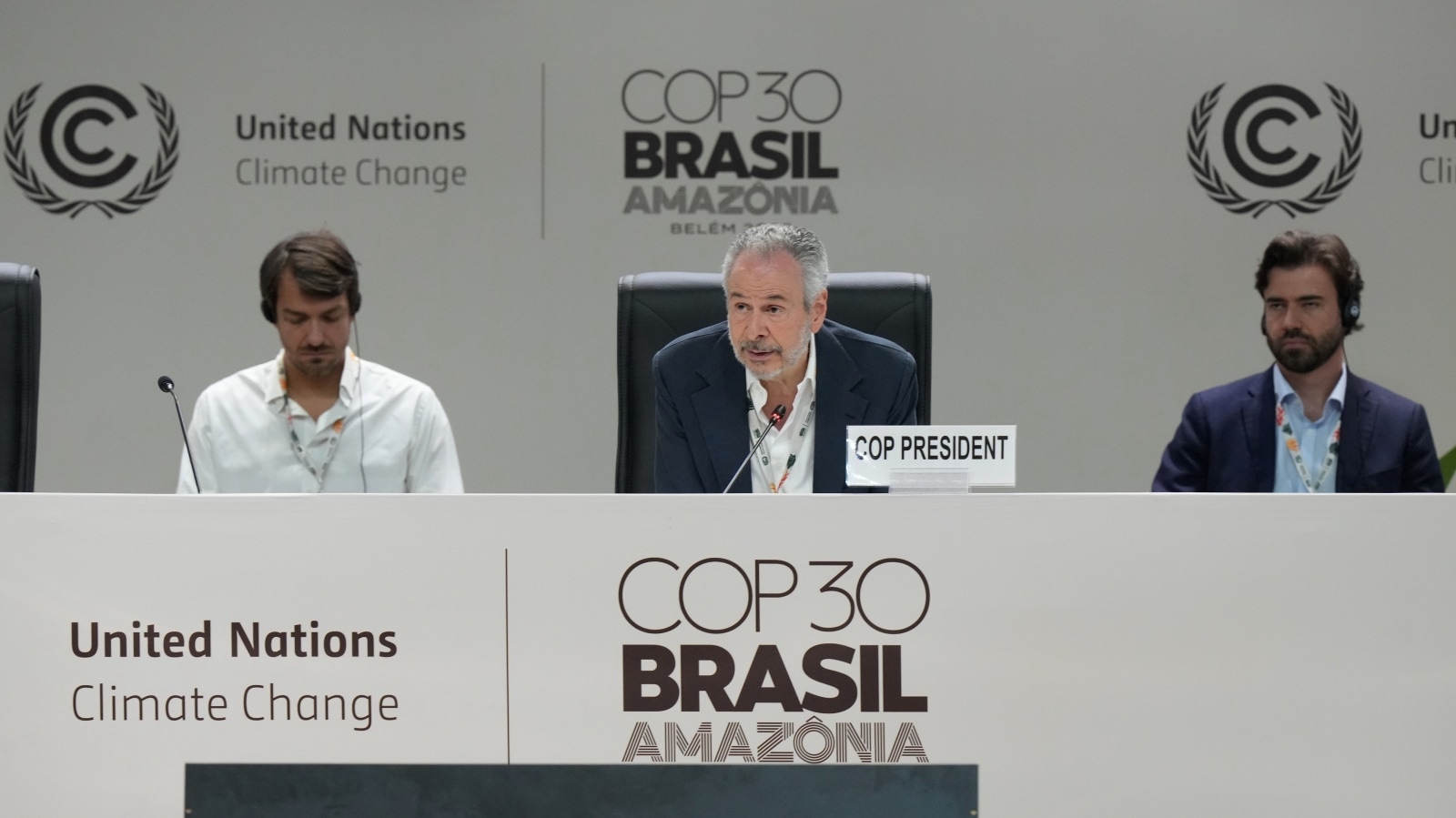
COP30 president André Corrêa do Lago speaks during a plenary session at the climate summit in Belem, Brazil, on Friday. (AP)
THE COP30 climate meeting stared at a deep crisis on Friday, the last day of the two-week event, after a new draft text on a political package skirted each of the four long-standing issues it was meant to resolve, leaving almost everyone unhappy.
A group of 29 countries, mainly small island states and those from Europe, rejected the draft text because it skipped any mention of a roadmap on fossil fuel phase-out, which was one of their key demands.
“We cannot support an outcome that does not include a roadmap for implementing a just, orderly and equitable transition away from fossil fuels. This expectation is shared by a vast majority of Parties… in its present form, the proposal (draft text) does not meet the minimum conditions required for a credible COP outcome,” the 29 countries said in a joint letter.
The political package was meant to address four long-standing concerns of different groups of countries. These concerns could not be accommodated in the official agenda of the COP30 meeting because of the deep differences between the countries on these issues. In order to ensure that these issues do not become a roadblock to progress on the other items on the agenda, COP30 presidency Brazil had conducted several rounds of consultations on these difficult issues, and had planned a separate outcome document addressing each of these issues.
Two of the issues were dear to the developing countries including India, while the other two were being pushed largely by the developed world.
The four issues included the demand of the developing countries regarding full implementation of the finance provision contained in Article 9.1 of the Paris Agreement. These countries claimed that this particular provision had been ignored till now. Their other concern, voiced repeatedly by India and China, was related to trade measures like Carbon Border Adjustment Mechanism (CBAM) imposed by the European Union. These countries argued that CBAM was a unilateral and discriminatory trade practice disguised as climate action.
The developed countries had been asking for raising of mitigation ambition in pursuance of the 1.5 degree Celsius target mentioned in the Paris Agreement. Their other issue related to greater transparency in reporting of climate actions.
Story continues below this ad
Weaved into these four broad issues were demands for a roadmap on phase-out of fossil fuels and a tripling of adaptation finance.
The draft text that emerged on Friday addressed none of these issues in any concrete manner. It completely avoided any mention of fossil fuel phase-out, and proposed a two-year work programme on climate finance to discuss all matters related to finance, including Article 9.1, which was basically kicking the can further down the road.
On unilateral trade measures, the draft said that the countries agreed that responses to climate change must not constitute a means of “arbitrary or unjustifiable discrimination or a disguised restriction on international trade” and proposed further discussions on different platforms on this issue.
The draft political package was rejected almost immediately by the group that had been pushing for inclusion of a language on fossil fuel phase-out. Their representative Colombia called a press conference to announce that the draft package was unacceptable to it.
Story continues below this ad
Colombian Environment Minister Irene Velez Torres told reporters that the problem was “the methodology of consensus”. Any decision at COP meeting can only be arrived through consensus, which means nothing is agreed till everyone agrees.
“The problem right now is this methodology of consensus, because this (process of) consensus has turned into a veto. And what is being left aside (as a result) is the ambitious agenda. The most ambitious agenda has been eliminated. Veto is what is happening here,” Torres said.
Like almost every other meeting before it, COP30 is also set to get extended, with negotiators expected to work through the night to come up with another draft that can be agreeable to everyone.
The writer is in Belem to cover COP30 as part of his fellowship on investigative journalism on climate reporting under the Ministry of Foreign Affairs of Denmark.
Pratip Acharya is a seasoned journalist based in Mumbai reporting for The Indian Express. With a career spanning over a decade, his work demonstrates strong Expertise and Authority in critical urban issues, civic affairs, and electoral politics across Eastern and Western India.
Expertise & Authority
Current Role: Journalist, The Indian Express (IE), reporting from Mumbai.
Core Authority: Pratip's reporting focuses sharply on local democracy and development, specializing in:
Urban Governance and Civic Affairs: Providing in-depth analysis of municipal decision-making, city planning, and local infrastructure, essential for informed urban reporting.
City Politics and Environment: Covering the political dynamics of Mumbai and surrounding areas, alongside critical environmental challenges impacting the metro region.
Electoral Coverage (High-Stakes Experience): He has extensive experience in high-stakes political reporting, having covered major elections, establishing his Trustworthiness in political analysis:
National: Lok Sabha elections in 2014 and 2019.
State: West Bengal Assembly elections in 2016 and Maharashtra Assembly elections in 2019.
Major Assignments (Ground Reporting): Pratip demonstrated commitment during crises by conducting ground reporting throughout the Covid-19 pandemic since its breakout in 2020, offering first-hand accounts and analysis of the public health crisis.
Experience
Extensive Experience: Starting his career in 2014, Pratip has built his foundation across multiple prominent English dailies:
Started at The Times of India in Kolkata (2014).
Relocated to Mumbai (2016) and worked with The Free Press Journal and Hindustan Times before joining The Indian Express.
Pratip Acharya's diverse experience across major publications, coupled with his specialized focus on the intricate details of urban governance and a track record of covering major electoral and health crises, establishes him as a trusted and authoritative source for news from India's critical metropolitan centres. ... Read More


 4 min read