Journalism of Courage



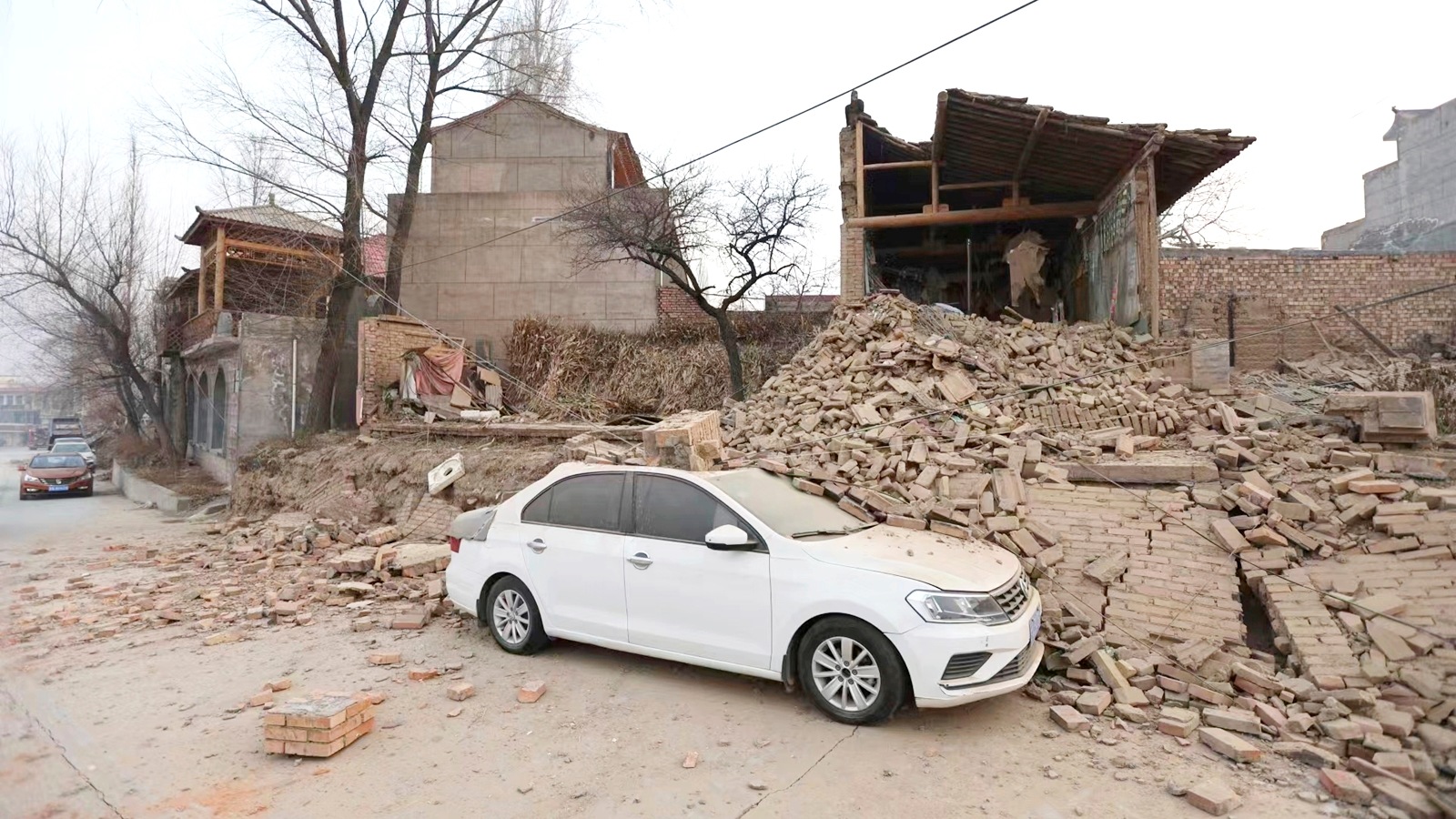 A vehicle is partially covered by a collapsed building in the aftermath of an earthquake in Dahejia village of Jishishan county in northwestern China's Gansu province on Dec. 19, 2023. (Chinatopix via AP)
At least 127 people have been killed in China after a 6.2-magnitude earthquake struck two northwestern provinces of the country on Monday midnight, reported local media.
In a press conference on Tuesday morning, local authorities said that as many as 127 people have been killed and hundreds injured in Gansu and Qinghai provinces, reported Reuters. More than 155,000 homes in Gansu were either damaged or destroyed.
The provinces of Gansu and Qinghai have been most affected by the quake, but the epicentre of the quake was in Jishishan county, reported SCMP. Local media reported that parts of Sichuan, Shaanxi and Ningxia Hui Autonomous Region also experienced tremors.
Chinese state media arriving at the sixth commune of Dahe village, one of the worst-hit areas in China’s northwestern Gansu province, found many houses were either at risk of collapse, or had already crumbled to the ground, especially homes built from earth and clay.
The China Earthquake Networks Centre said that a shallow quake jolted the region at 11.59 pm on Monday, with a focal depth of 10 kilometres. Shallow quakes tend to cause heavy damage to infrastructure.
#UPDATE: Video captured the moment when a 6.2-magnitude earthquake shook Linxia Hui Autonomous Prefecture in NW China’s Gansu on Monday night. The quake can be felt in major cities like Xi’an and Chengdu. pic.twitter.com/CrDeQBbnyO
— People’s Daily, China (@PDChina) December 18, 2023
Some water, electricity, transportation, communications and other infrastructure have been damaged. Dozens of highways and rural roads were damaged amid multiple landslides, although no casualties were reported. However, a major hydropower dam 50 km from the epicentre was unaffected by the quake. CCTV reported that the dam, on the upper Yellow River, was operating normally.
Rescue work has proved challenging in sub-zero temperatures, after a powerful cold snap swept across the country. Personnel are working to prevent secondary disasters caused by factors beyond the quake, Xinhua said. The temperature in Linxia, Gansu, near where the quake occurred, was about minus 14 degrees Celsius (6.8 Fahrenheit) on Tuesday morning.
Although the 72 hours after a quake are the most likely time to rescue survivors, that will be shortened by the harsh weather, with trapped victims facing higher risk, it said.
Chinese President Xi Jinping has instructed officials to “make every effort” to provide aid and relief, said the SCMP report. A Global Times report said that Jinping has demanded full-scale search and rescue efforts, proper resettlement of affected people, and maximum efforts to ensure the safety of people’s lives and property.
Meanwhile, China’s state planner has allocated 250 million yuan ($35 million) to earthquake-hit Gansu and Qinghai provinces for reconstruction work, it said in a statement.
It is the deadliest earthquake in terms of casualties in China in the past 13 years, second only to the 2010 earthquake in Yushu, Qinghai Province, as per Global Times. It added that houses, roads, as well as other infrastructures have been damaged.
China has upgraded the national earthquake emergency response to Level II after a magnitude-6.2 earthquake jolted northwest China late Monday evening.
The quake jolted Jishishan County in NW China’s Gansu. It so far has killed 100 people in Gansu and 11 in neighboring Qinghai. pic.twitter.com/d7fvmYsLtV
— China Focus (@China__Focus) December 19, 2023
A resident living near the epicentre of the quake told Global Times that it felt like being “tossed up after surging waves”. “I live on the 16th floor and felt the tremors so strongly. The moment of the earthquake was feeling like being tossed up after surging waves… I woke my family up and we rushed down all 16 floors in one breath,” he said.
A student at Lanzhou University posted photos and videos that showed students hurrying out of a dormitory building and standing outside with long down jackets over their pajamas. “The earthquake was too intense,” said Wang Xi, the student who posted the images, told Reuters. “My legs went weak, especially when we ran downstairs from the dormitory.”
Meanwhile, Taiwan’s presidential office said that President Tsai Ing-wen expressed condolences to China on the Gansu earthquake and said Taiwan was willing to provide assistance to China.
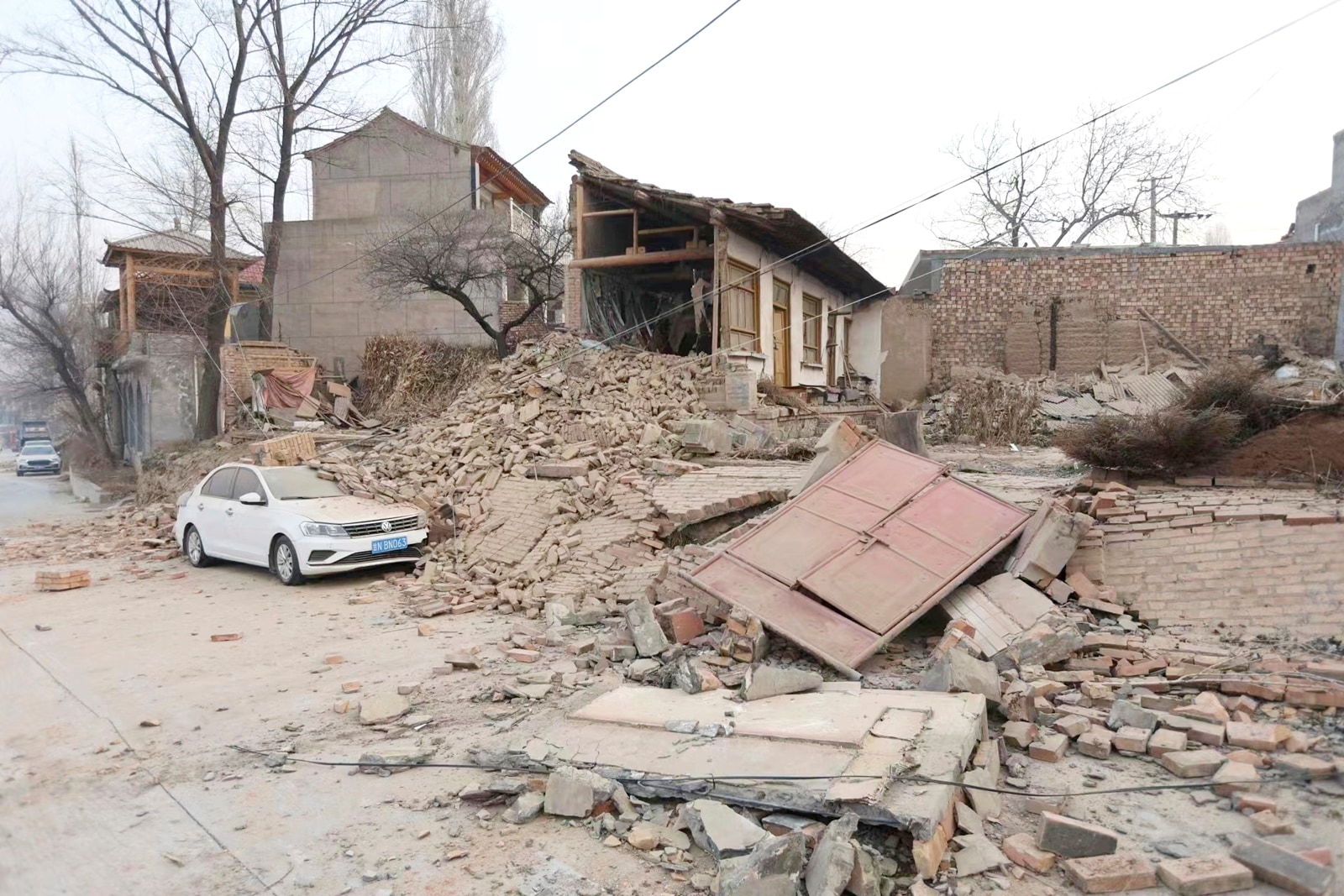 A vehicle is partially covered by a collapsed building in the aftermath of an earthquake in Dahejia village of Jishishan county in northwestern China’s Gansu province on Dec. 19, 2023. (Chinatopix via AP)
Hu Changsheng, the ruling Communist Party chief of Gansu, and Ren Zhenhe, the governor of Gansu, have rushed to the disaster-hit area to command rescue and relief efforts.
Preliminary analysis shows that the quake was a thrust-type rupture, one of three above magnitude 6 to have struck within 200 km of the epicentre since 1900. The state media reported at least 32 aftershocks in the hour after the quake hit.
A total of nine aftershocks at magnitude 3.0 and above were recorded by Tuesday morning, two of which were at least 4.0 in magnitude.
About 3,000 km from Jishishan in Xinjiang region, another earthquake struck at 9:46 a.m. (0146 GMT) Tuesday, with a magnitude of about 5.5 and at a depth of 10 km. On Tuesday night, a magnitude-3.1 quake hit Sichuan, with the epicentre at a relatively shallow depth of 8 km. No casualties have been reported.
(With inputs from agencies)

 5 min read