1 min read
Stay updated with the latest - Click here to follow us on Instagram
© IE Online Media Services Pvt Ltd



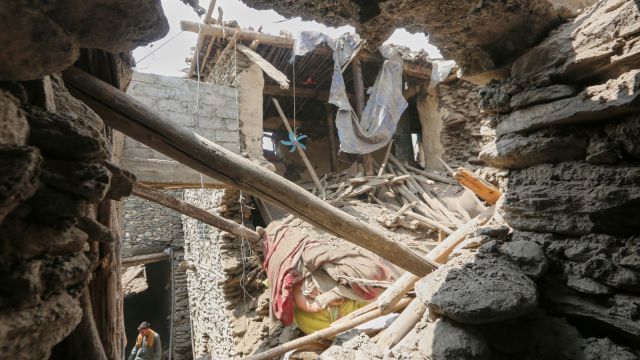 A local resident walks through a partially collapsed house in an area devastated by Sunday's powerful 6.0-magnitude earthquake that killed many people and destroyed villages in eastern Afghanistan, in Dara Noor, Kunar province, Tuesday (AP)
Almost two days after a 6.0 magnitude earthquake struck eastern Afghanistan leaving a trail of destruction, another quake of 6.6 magnitude hit the southeastern part of the country. Tuesday’s quake occurred at a relatively shallow depth of 10 km, the same as the one that struck at midnight on Sunday. The rescue workers are scrambling in a “race against time” to reach the mountainous and remote area, while several people are believed to be trapped in the rubble. The death toll has surged over 1,400 and more than 3,000 have been injured in the aftermath of the deadly quake.
As the quake occurred in rough terrain, accessible only by road and not by helicopters or any other mode of transportation, rescue workers faced major hurdle. Road access was difficult in the area's steep terrain, where landslides had struck. Homa Nader, the acting head of the International Federation of the Red Cross and Red Crescent in Afghanistan, was quoted as saying by The New York Times, it took Red Cross teams four hours overnight to reach the most affected area, in Nur Gal district, from Jalalabad, the closest large city just 56 km away. Later, by Monday afternoon, the road linking Jalalabad to Kunar Province had reopened and several ambulances rushed to the affected areas while dozen others were carrying back to the city.
With hundreds believed to be trapped in the rubble, the United Nations has urged international community to step forward. “We cannot afford to forget the people of Afghanistan who are facing multiple crises, multiple shocks, and the resilience of the communities has been saturated,” Indrika Ratwatte, the UN's resident coordinator for Afghanistan, was quoted as saying by Associated Press. He urged the international community to step forward. “These are life and death decisions while we race against time to reach people.”
The epicentre of the earthquake which occurred on Sunday was near Jalalabad, a city of about 2,00,000 people that is less than 160 km from Kabul, the capital and close to Pakistan border. The quake was shallow, 8 km from the surface and after the initial shaking halted, people went out in search of neighbours trapped in the rubble. The quake also sent aftershocks into Kabul early on Monday, where residents were rescued from their homes overnight.
Only a few countries have extended support to the quake-hit country so far, including Iran, India, Japan, UK and the European Union, the spokesperson for the Taliban-run Ministry of Foreign Affairs, Hafiz Zia Ahmad Takal, told The New York Times. The UK has promised to provide 1 million pounds (Rs 11.79 crore) in emergency funding to be split between humanitarian agencies rather than the Taliban government, which the UK does not approve of. Prime Minister Narendra Modi condoled the loss of lives and External Affairs Minister S Jaishankar assured of assistance.
As the country ruled by the Taliban faces cuts to aid funding, a weak economy, and millions of people forcibly returned from Iran and Pakistan, the rescue operation seems troublesome, exacerbated by the rough terrain. The Taliban government, which took over power in 2021, has requested for assistance from foreign governments and the humanitarian sector. Kate Carey, who is the deputy head of the UN Office for the Coordination of Humanitarian Affairs in Afghanistan, said more than 420 health facilities had closed or were suspended due to the “massive reduction” in funding, with 80 of them in the eastern region, the heart of Sunday’s quake. “The consequence is that the remaining facilities are overwhelmed, have insufficient supplies and personnel, and are not as close to the affected populations as the more local facilities at a time when providing emergency trauma care is needed in the first 24 to 72 hours of the earthquake response,” said Carey.
The country is prone to deadly earthquakes, especially in the Hindu Kush mountain range, where the Indian and Eurasian tectonic plates meet and the worst in recent years was a magnitude 6 quake in 2022 that killed 1,000 people. Several quakes in a single month in 2023 altogether killed 1,000 people and destroyed many villages. The Sunday quake is the third major one since the Taliban takeover.
Stay updated with the latest - Click here to follow us on Instagram