8 min read

Stay updated with the latest - Click here to follow us on Instagram
© IE Online Media Services Pvt Ltd



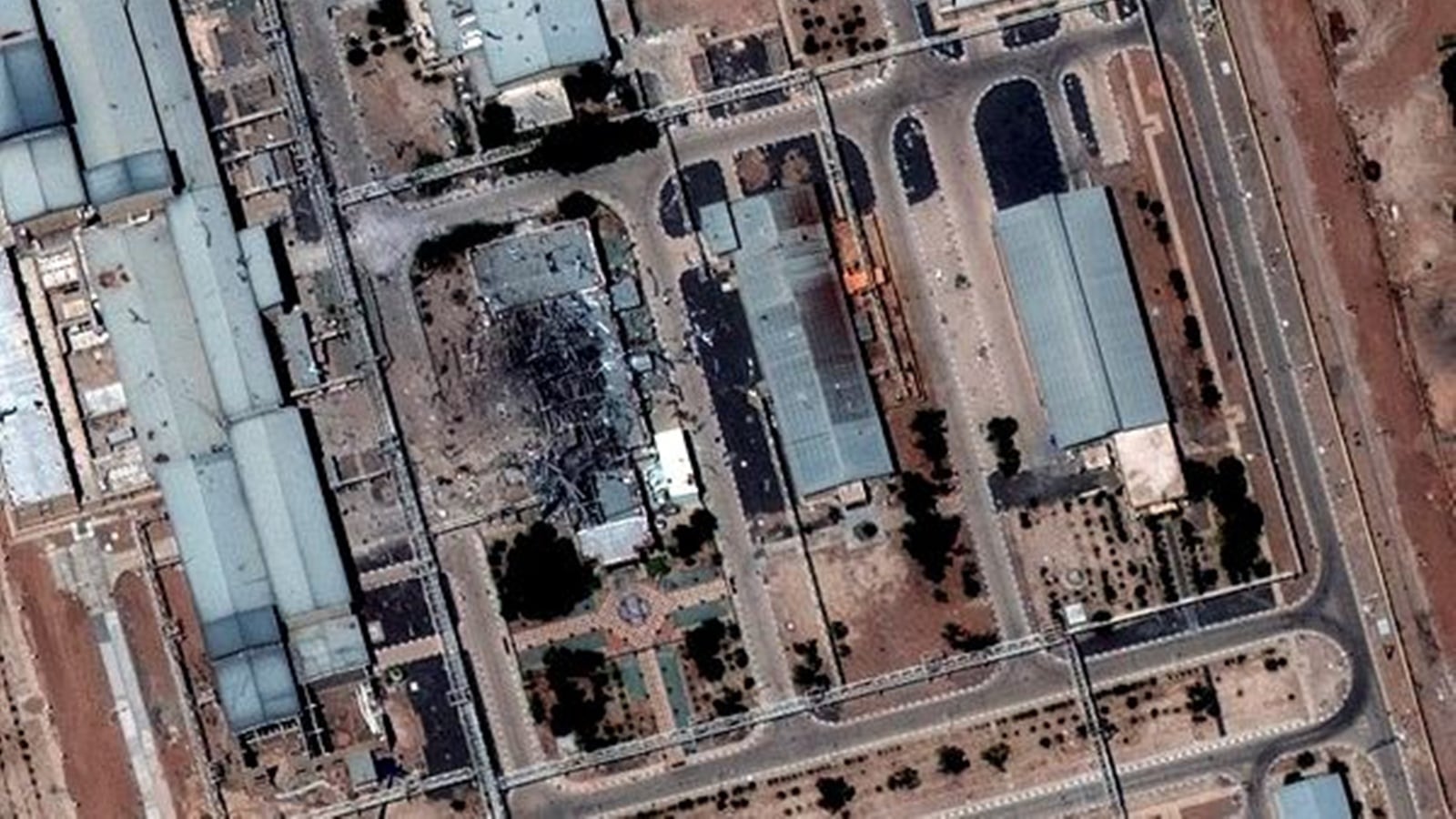 This satellite image provided by Maxar Technologies shows a close view of the Isfahan nuclear technology in Iran before U.S. strikes, Monday, June 16, 2025. (Maxar Technologies via AP)
In 1973, a war-weary US Congress passed the War Powers Act to rein in presidents who overstepped in Vietnam. Five decades later, President Donald Trump’s unilateral strike on Iran has reignited a debate the Founders thought they had settled in 1787.
On June 22, when Trump announced a series of coordinated airstrikes on Iran’s nuclear facilities — hitting targets in Fordow, Natanz, and Isfahan — he did so without notifying Congress, let alone securing its approval. The sites were hit with precision-guided missiles and 30,000-pound bunker-busters. While Tehran stopped short of a formal declaration of war, officials warned that retaliation was inevitable.
At an emergency meeting of the UN Security Council, Iran’s ambassador, Amir Saeid Iravani, accused the United States of having “destroyed diplomacy,” warning that the Iranian military would determine the “timing, nature, and scale” of its retaliation, the Associated Press reported. Iran’s Foreign Minister Abbas Araghchi immediately flew to Moscow for consultations with Russia, a sign of how fast this confrontation could escalate beyond bilateral hostilities.
Back in Washington, President Trump’s aides termed the strike as a limited action. Secretary of State Marco Rubio appeared on Fox News to clarify the administration’s position: “This is not a war against Iran,” he said. “It’s a targeted operation to prevent nuclear escalation.”
Yet just hours later, President Trump posted a message online: “If the current Iranian Regime is unable to MAKE IRAN GREAT AGAIN, why wouldn’t there be a Regime change??? MIGA!!!” The message prompted widespread speculation. Was the administration pursuing regime change in Iran? And if so, was the United States already engaged in war?
Global markets reacted nervously. Oil prices surged, and analysts warned of long-term consequences for nuclear non-proliferation and regional stability. Moreover, Trump’s decision reignited a centuries-old question: who gets to declare war?
The US Constitution is unequivocal: under Article I, Section 8, only Congress — not the President — holds the authority to declare war. This separation was no accident. It was a deliberate check on executive power, forged in reaction to the British monarchy, where kings could drag nations into conflict at will. The Founders sought to ensure that decisions as grave as war would require the consent of the people’s representatives.
The Constitution also designates the president as Commander in Chief under Article II, granting authority to direct military operations once war is authorised. The executive also retains the capacity to respond swiftly to sudden attacks.
The most notable test came in 1861, when President Abraham Lincoln ordered a blockade of Southern ports at the outset of the Civil War, months before Congress officially declared war on the Confederacy. The Supreme Court ultimately upheld Lincoln’s actions, ruling that the President has the authority to “repel sudden attacks.”
For much of US history, this balance endured. From the War of 1812 through World War II, major military engagements were accompanied by formal declarations of war from Congress. Formal declarations of war have remained rare. The United States has declared war only 11 times.
| Country | Date of Declaration | Senate Vote | Effective Date |
|---|---|---|---|
| Great Britain | June 17, 1812 | 19–13 | June 18, 1812 |
| Mexico | May 12, 1846 | 40–2 | — |
| Spain | April 25, 1898 | UC (Unanimous Consent) | — |
| Germany (WWI) | April 4, 1917 | 82–6 | — |
| Austria-Hungary | December 7, 1917 | 74–0 | — |
| Japan | December 8, 1941 | 82–0 | — |
| Germany (WWII) | December 11, 1941 | 88–0 | — |
| Italy | December 11, 1941 | 90–0 | — |
| Bulgaria | June 4, 1942 | 73–0 | — |
| Hungary | June 4, 1942 | 73–0 | — |
| Rumania | June 4, 1942 | 73–0 | — |
(Source: senate.gov)
But in the post-1945 world, that constitutional clarity began to blur. The first major rupture came in 1950, when President Harry Truman committed US troops to Korea without seeking congressional approval, framing the war as a “police action” under the United Nations banner. Subsequent presidents followed suit. John F Kennedy escalated America’s presence in Vietnam by sending military advisors and weapons, sidestepping a formal declaration. By 1969, President Richard Nixon was conducting a secret bombing campaign in Cambodia, entirely without the knowledge or consent of Congress.
This executive overreach eventually sparked legislative backlash. In 1973, Congress passed the War Powers Resolution, designed to reassert its authority, overriding Nixon’s veto in the process. The act required presidents to consult with Congress before engaging in hostilities and to withdraw forces within 60 days unless Congress explicitly authorised further action.
In theory, the War Powers Resolution of 1973 was crafted to restrain precisely the kind of unilateral action President Trump has now taken. Passed in the aftermath of Vietnam, the law requires presidents to notify Congress within 48 hours of deploying US forces into hostilities and to withdraw them within 60 days unless Congress grants explicit authorisation.
In practice, it has proven all but toothless.
Every president since its passage has sidestepped or outright ignored its provisions. Trump did not inform Congress before ordering strikes on Iranian nuclear facilities, nor, critics argue, has he offered a convincing legal justification under the US or international law. “The short answer is that this is, in my view, illegal under both international law and U.S. domestic law,” Oona Hathaway, a professor of international law at Yale Law School who has worked at the Defense Department, told the New York Times. The law, like many of its post-Watergate era peers, was built on trust and precedent. It had no true enforcement mechanism. And so, it has repeatedly failed to restrain the very power it was meant to check.
Trump’s decision fits a well-established pattern of executive overreach in foreign military engagements. President Ronald Reagan ordered the invasion of Grenada and airstrikes on Libya without congressional approval. President George HW Bush invaded Panama in 1989, triggering legal debate over constitutional boundaries. President Bill Clinton bombed Serbia in 1999 as part of the Kosovo conflict, again without seeking congressional consent.
President Barack Obama launched a prolonged air campaign in Libya in 2011 and later against ISIS in Iraq and Syria, citing outdated authorisations rather than requesting new ones. Even President Joe Biden, a former chairman of the Senate Foreign Relations Committee, authorised airstrikes on Houthi rebels in Yemen in 2024 without congressional sanction.
Each administration justified its actions as necessary and time-sensitive. But cumulatively, these precedents have normalised unilateral war-making, eroding Congress’s role and the public’s voice in questions of war and peace.
Technological change has accelerated this shift. Drones, cyber tools, and remote strike capabilities have made it easier to conduct military operations with minimal personnel and lower political risk.
A key enabler of this executive drift has been the Authorization for Use of Military Force (AUMF) passed in 2001, in the aftermath of the 9/11 attacks. The resolution granted the president authority to use “all necessary and appropriate force” against those responsible for the attacks and those who harboured them.
Originally intended to target al-Qaeda and its affiliates, the 2001 AUMF has since been used to justify military actions in at least seven countries, including Afghanistan, Iraq, Somalia, Syria, Yemen, and Pakistan. It has also been invoked against newer groups like ISIS, despite no explicit congressional authorisation for those operations.
Multiple presidents have promised to revise or repeal the AUMF. None have succeeded. Its broad language remains a legal foundation for perpetual military engagement.
Trump’s 2025 strikes have brought these longstanding tensions to a head. Legal scholars, military experts, and members of Congress are warning that US war-making has entered a constitutional grey zone. By allowing the executive to define and initiate acts of war without oversight, Congress risks ceding one of its most fundamental constitutional powers. Trump ran for office promising to end America’s entanglements abroad. Instead, with his June strike, he has intensified one of the longest-running debates in US history. At its core, the question remains unchanged since 1787: who gets to take the United States to war?
Stay updated with the latest - Click here to follow us on Instagram