


© IE Online Media Services Pvt Ltd
Tags:


Syllabus:
Preliminary Examination: Indian Polity and Governance – Constitution, Political System, Panchayati Raj, Public Policy, Rights Issues

Mains Examination: General Studies-II: Appointment to various Constitutional posts, powers, functions and responsibilities of various Constitutional Bodies.
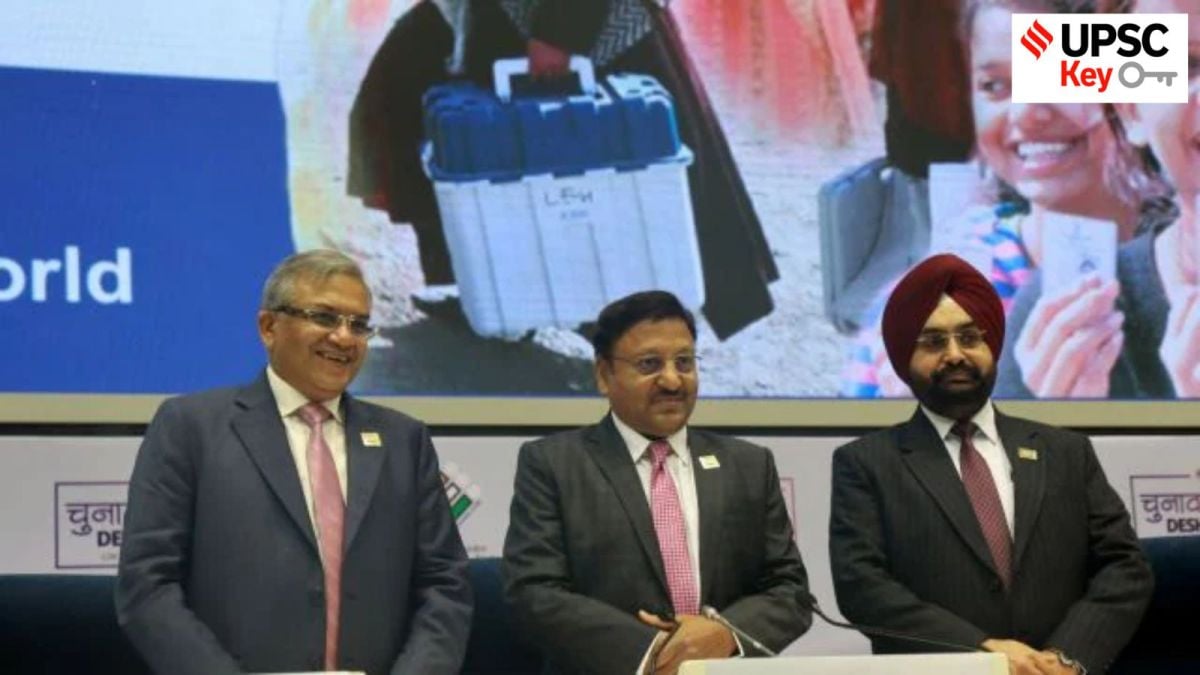
What’s the ongoing story: Traditionally, the successor to the Chief Election Commissioner (CEC) has been the next senior most Election Commissioner. For the first time, as per the Chief Election Commissioner And Other Election Commissioners (Appointment, Conditions of Service And Term of Office) Act, 2023, the net can be cast wider.
Key Points to Ponder:
• What are the constitutional provisions related to the appointment of the Election Commission?
• How is the Chief Election Commission different from the other Election Commission?
• What is the role of EC?
• What is the process of selection of CEC?
• How did the constitution provide for the independence of constitutional bodies like the Election Commission?
• Why is the recent amendment to the Election Commission being criticised?
Key Takeaways:
• Current CEC Rajiv Kumar demits office on February 18. The Election Commission comprises the CEC and two election commissioners — Gyanesh Kumar and Sukhbir Singh Sandhu at present.
• Gyanesh Kumar could still be in contention but according to Sections 6 and 7 of the Act, the Ministry of Law will set up a Search Committee chaired by the Law Minister to prepare a panel of five names for the Selection Committee
• The Selection Committee, comprising the Prime Minister, a Cabinet minister and the Leader of the Opposition in the Lok Sabha, can select from this panel or consider “any other person” from outside.
• Section 6 of the Act specifies this process for the appointment of the Chief Election Commissioner and other Election Commissioners.
Even as Gyanesh Kumar remains a potential candidate for the top post, the Act gives the selection committee the option of considering names from outside the Election Commission.
This comes against the backdrop of the EC facing the heat from the Opposition parties over a range of issues – from the purity of electoral rolls to the efficacy of EVMs. On Tuesday, Kumar rebutted the allegations calling them “irresponsible.”
• As per Section 5 of the Chief Election Commissioner And Other Election Commissioners (Appointment, Conditions of Service And Term of Office) Act, 2023, the candidates for the post would be current or former Secretary-level officers.
• This Act was brought after an intervention from the Supreme Court, following a clutch of petitions filed between 2015 and 2022 challenging the Centre’s exclusive powers in picking the Election Commissioners.
Do You Know:
• In March 2023, the Court ruled that the President would do the appointment of the CEC and ECs on the advice of a committee comprising the Prime Minister, the Leader of the Opposition and the Chief Justice of India. This arrangement was to prevail until the Parliament enacted a law for the appointments.
• The Union government eventually brought a law in December 2023, which made it mandatory to appoint the CEC and ECs by way of a shortlist panel and a selection committee. However, the Chief Justice of India was dropped as a member of the Selection Committee.
• On March 2, 2023, the five-judge bench ruled on the matter.
• The Supreme Court delved into the legislative history of Article 324, including the discussions in the Constituent Assembly regarding the role of the Election Commission and the appointment of its members.
• The Court observed that it was evident that the founding fathers of the Constitution did not want the Executive to have exclusive authority in appointing Election Commission members. Therefore, the inclusion of the words “subject to any law to be made by Parliament” in Article 324 (2) was representative of the need for Parliament to legislate on this matter.
• The absence of such a law, the court noted, left a vacuum. Taking note of the “devastating effect of continuing to leave appointments in the sole hands of the Executive’’, the court deemed it appropriate to lay down a process for the appointment of election commissioners.
• The Centre introduced a Bill in Parliament in August last year, outlining a procedure for appointing Election Commissioners.
• The composition of the committee was criticised by the Opposition. This is because, as per the intent of the Constitution’s framers, the Election Commission should be an independent body. The proposed committee’s composition effectively sidelines the Leader of Opposition, who could be consistently outvoted by the Prime Minister and the Union minister.
Other Important Articles Covering the same topic:
📍Explained: The new process for picking Election Commissioners, why it was brought in
📍Election Commission of India is one of the greatest gifts of the Constitution
Previous year UPSC Prelims Question Covering similar theme:
(1) Consider the following statements: (UPSC CSE 2017)
1. The Election Commission of India is a five-member body.
2. Union Ministry of Home Affairs decides the election schedule for the conduct of both general elections and bye-elections.
3. Election Commission resolves the disputes relating to splits/mergers of recognised political parties.
Which of the statements given above is/are correct?
(a) 1 and 2 only
(b) 2 only
(c) 2 and 3 only
(d) 3 only
Previous year UPSC Mains Question Covering similar theme:
Discuss the role of the Election Commission of India in the light of the evolution of the Model Code of Conduct. (UPSC CSE 2022)
Syllabus:
Mains Examination: General Studies-II: Appointment to various Constitutional posts, powers, functions and responsibilities of various Constitutional Bodies.
What’s the ongoing story: The Comptroller and Auditor General of India (CAG) is again in the spotlight amid a political row triggered by its report on the cost of renovation at the office and residence of former Delhi Chief Minister Arvind Kejriwal.
Key Points to Ponder:
• What are the constitutional provisions related to CAG?
• What is the role and function of the CAG?
• What are the criticisms and challenges associated with the CAG?
• What is the role of the Public Accounts Committee?
• CAG plays a crucial role in this democratic framework by ensuring transparency, accountability, and financial integrity in the government’s functioning. Analyse.
Key Takeaways:
• The CAG, which is the country’s supreme audit body, has submitted a dozen audit reports to the Lieutenant Governor of Delhi in recent years. But the AAP government has not laid them in the Assembly, triggering a backlash from the BJP whose MLAs have approached the High Court.
• Articles 148 to 151 in part 5 of the Constitution are on the appointment, duties, and audit reports of the auditor general, who is appointed by the President.
• The Comptroller and Auditor General’s (Duties, Powers and Conditions of Service) Act, 1971, determines the CAG’s service conditions and prescribes the duties and powers of their office. Several other statutes grant powers to the CAG. For instance, the Fiscal Responsibility and Budget Management Act, 2003, says the Central Government may entrust the CAG to “review periodically as required, the compliance of the provisions of this Act and such reviews shall be laid on the table of both Houses of Parliament”.
• Apart from conducting audits of the Central and state governments, the CAG also maintains state government accounts (both financial and appropriations), provides pension authorisation for all state government employees, and maintains the General Provident Fund accounts of serving employees.
• The CAG conducts three kinds of audits: compliance audit, or an assessment of whether the provisions of the applicable laws, rules, and regulations, and various orders and instructions issued by the competent authority are being followed; performance audit, or an assessment of the implementation of schemes or programmes; and financial audit, or certification of government’s accounts and the accounts of Public Sector Undertakings.
• Article 151 provides for laying CAG reports in Parliament or state legislatures but no time limit is specified. This is why governments often do not lay CAG audit reports on time.
• A CAG report becomes public only after it is laid in the House. The Public Accounts Committee examines the selected reports and seeks a response from the government. The PAC also asks the government to take action on the recommendations and submit an Action Taken Report. Since 2019, the PAC has submitted 152 reports to Lok Sabha till July last year. These include scrutiny of CAG audit reports and action taken by the government on them.
• The audit reports highlight losses to the exchequer and procedural losses and also provide recommendations that play a key role in changing rules and procedures. Among the CAG reports that have had a big impact in recent decades is the one on licences and allocation of 2G spectrum that was tabled in November 2010.
Do You Know:
• Constitutional bodies are institutions or authorities whose powers, duties, and structures are explicitly defined in the Constitution. Their roles extend beyond mere administrative functions, as they are designed to serve as checks and balances on governmental power.
• Some of the constitutional bodies are the Election Commission of India (ECI), Union Public Service Commission (UPSC), Finance Commission, Comptroller and Auditor General (CAG), National Commissions for SCs, STs, and Minorities, and Attorney General of India.
• Apart from constitutional bodies, there are statutory bodies that play a vital role in strengthening our democracy. Statutory bodies are institutions established by an act of Parliament or state legislatures, deriving their authority from legislation rather than directly from the Constitution.
• Some examples of statutory bodies are the Securities and Exchange Board of India (SEBI), the National Green Tribunal (NGT), the Insurance Regulatory and Development Authority of India (IRDAI), the Central Vigilance Commission (CVC), the University Grants Commission (UGC)…
• On the other hand, non-statutory bodies, also known as executive or advisory bodies, are organisations or committees that are established by an executive order or administrative resolution rather than by an act of Parliament or state legislatures. They are created for specific purposes and may not have a legal framework backing them, as is the case with statutory bodies.
Other Important Articles Covering the same topic:
📍What are constitutional, statutory, and non-statutory bodies?
📍CAG of India writes: As our democracy matures, my role is becoming more vital
Previous year UPSC Prelims Question Covering similar theme:
(2) Consider the following statements The Parliamentary Committee on Public Accounts (UPSC CSE 2013)
1. consists of not more than 25 Members of the Ink Sabha
2. scrutinizes appropriation and finance accounts of the Government
3. examines the report of the Comptroller and Auditor General of India
Which of the statements given above is/are correct?
(a) 1 only
(b) 2 and 3 only
(c) 3 only
(d) 1, 2 and 3
Previous year UPSC Mains Question Covering similar theme:
Exercise of CAC’s powers in relation to the accounts of the Union and the States is derived from Article 149 of the Indian Constitution. Discuss whether audit of the Government’s Policy implementation could amount to overstepping its own (CAG) jurisdiction. (UPSC CSE 2016)
Syllabus:
Preliminary Examination: General issues on Environmental Ecology, Biodiversity and Climate Change – that do not require subject specialisation
Mains Examination: General Studies-III: Conservation, environmental pollution and degradation, environmental impact assessment
What’s the ongoing story: Observing that soapstone mining continued despite a ban, the Uttarakhand High Court on Thursday asked the Bageshwar Superintendent of Police to depute personnel to inspect mines and seize all machinery found at the site.
Key Points to Ponder:
• What is soapstone mining?
• What is land subsidence?
• What are the concerns with soapstone mining?
• What is a landslide?
• What are the reasons for the sinking of Josimath?
• What steps need to be taken to protect these sites?
• What is the National Landslide Risk Management Strategy?
Key Takeaways:
• The bench of Chief Justice G Narendar and Justice Manoj Kumar Tiwari on January 6 ordered the suspension of soapstone mining in Bageshwar after a court-appointed report showed evidence of land subsidence in the area.
• The HC said the report was “not only alarming but also shocking”. On Thursday, the Amicus Curiae submitted material, including photographs reflecting GPS coordinates. It said despite the court’s order prohibiting mining, “certain anti-social elements have proceeded to violate the orders… and have continued the mining activity”.
Do You Know:
• Soapstone is a metamorphic rock made of talc, a naturally occurring mineral, and is used in construction and design for countertops, sinks, hearths, and sculptures. Talc is used in cosmetics, pharmaceuticals, and other industries. According to the Indian Bureau of Mines, the states of Rajasthan (57%) and Uttarakhand (25%) boast substantial reserves of soapstone in India.
• Land subsidence is a major concern across Uttarakhand. The issue made national news in 2022 after cracks appeared in many roads and hundreds of houses in Joshimath — authorities declared the area as a landslide and subsidence-hit zone. In Bageshwar district, areas such as Kanda-Kanyal, and Kanda are particularly vulnerable.
• According to the United States’ National Oceanic and Atmospheric Administration (NOAA), subsidence is the “sinking of the ground because of underground material movement”. This can happen due to a host of reasons, anthropogenic or otherwise. These include mining activities, removal of water/oil, soil erosion, soil compaction, and earthquakes.
• The aforementioned report states that mining operations in the lower parts of the slopes has led to the loss of their structural integrity, and increased the vulnerability to mass movement.
• The report points to a lack of green belts and retaining walls around the mine boundaries, coupled with a dearth of safety protocols such as buffer zones, slope monitoring, and protective structures — all of which continue to accelerate erosion.
Other Important Articles Covering the same topic:
📍How soapstone mining is leading to land-subsidence in Uttarakhand’s Bageshwar
Previous year UPSC Mains Question Covering similar theme:
Describe the various causes and effects of landslides. Mention the important components of the National Landslide Risk Management Strategy. (UPSC CSE 2021)
Bring out the causes for more frequent landslides in the Himalayas than in the Western Ghats. (UPSC CSE 2013)
Syllabus:
Preliminary Examination: Current events of national and international importance
Mains Examination: General Studies-II: Effect of policies and politics of developed and developing countries on India’s interests, Indian diaspora.
What’s the ongoing story: Terming the “Viksit Bharat 2047” initiative a “national mission,” President Droupadi Murmu on Friday called for “proactive and enthusiastic participation” of all Indians, including the diaspora, for achieving it.
Key Points to Ponder:
• What is the Pravasi Bhartiya Divas?
• What is the significance of diaspora?
• How is India becoming a leading voice for the Global South?
• How are “India First” and “Vasudhaiva Kutumbakam” perspectives redefining India’s approach to the world?
Key Takeaways:
• In her valedictory address at the Pravasi Bharatiya Divas in Bhubaneswar, where she also presented the Pravasi Bharatiya Samman, Murmu said India’s vision for a Viksit Bharat aligned with its growing stature on the world stage, particularly as a leading voice for the Global South.
• On safeguarding the interests of Indians abroad, she said the government has launched a number of missions to assist those in distress. She also praised the Odisha government’s decision to appoint a nodal minister to engage with the diaspora for projects and investments.
• External Affairs Minister S Jaishankar said India at present approaches the world with the twin perspectives of “India First” and “Vasudhaiva Kutumbakam (world is one family)”.
Do You Know:
• The history of Indian diaspora is interesting and has grown significantly since the first group of Indians was brought to countries in the East Pacific and the Caribbean islands under the “Girmitiya” arrangement as indentured laborers.
• In the second wave of migration, nearly 2 million Indians moved to Singapore and Malaysia to work on farms. The third and fourth waves saw professionals migrating to Western countries and workers heading to Gulf and West Asian nations during the oil boom.
• India has the world’s largest diaspora, and is also the largest recipient of remittances. Remittances, according to the World Bank, are a vital source of household income for low- and middle-income countries like India.
• India saw the highest amount of remittance inflows in the world in 2023 at USD 125 billion, driven by several factors, including the country’s agreement with the UAE, for promoting the use of dirhams and rupees for bilateral trade, the World Bank said.
• According to the World Bank, remittance flows to India from the United Arab Emirates, which account for 18 per cent and are the second largest source of India’s remittances after the United States. The International Organization for Migration (IOM) also reported that India has consistently remained the leading recipient of remittances globally.
• India’s soft power plays a crucial role in its global presence, highlighting its rich culture, traditions, and values. Through cultural diplomacy, India engages with other nations, fostering relationships that extend…
• An award called The Pravasi Bharatiya Samman Award is given out as part of the programme. According to the official website, “It is the highest honour conferred on a Non-Resident Indian, Person of Indian Origin; or an organisation or institution established and run by them.”
• The award is to commemorate the contribution of the Indian diaspora to create a better understanding of India abroad, support India’s causes and work for the welfare of the local Indian community.
Other Important Articles Covering the same topic:
📍What to know about Pravasi Bharatiya Diwas, inaugurated by PM Modi
📍The role of Indian diaspora in nation’s economic growth and cultural diplomacy
Previous year UPSC Mains Question Covering similar theme:
Indian diaspora has scaled new heights in the West. Describe its economic and political benefits for India. (UPSC CSE 2023)
‘Indian diaspora has a decisive role to play in the politics and economy of America and European Countries’. Comment with examples. (UPSC CSE 2020)
Syllabus:
Preliminary Examination: Current events of national and international importance
Mains Examination: General Studies-III: Conservation, environmental pollution and degradation, environmental impact assessment
What’s the ongoing story: Wildfires continued to blaze across Los Angeles, California, on Friday, killing 10 people, forcing over 130,000 people to evacuate, and burning down homes, including of celebrities like Paris Hilton, Adam Brody, Billy Crystal, and others.
Key Points to Ponder:
• What is a forest fire?
• What is the link between climate change and forest fires?
• What are the reasons for devastating wildfires in California?
• How frequent are forest fires in India?
• What are the steps taken to control forest fires in India?
• What are the reasons for forest fires in India?
Key Takeaways:
• The cause of these wildfires is yet to be determined — nearly 85% of all forest fires across the US are started by humans, either deliberately or accidentally, according to the US Forest Service.
• However, experts have suggested that the three wildfires in Southern California have moved so quickly and caused large-scale destruction because of two reasons, the “Santa Ana” winds and climate change.
• Santa Ana winds blow when high pressure builds over the Great Basin — the area between the Rocky Mountains and Sierra Nevada (a mountain range in the Western United States) — and the pressure is low over California’s coast. The difference in pressure triggers the movement of powerful winds from the Basin’s inland deserts, east and north of Southern California, over the mountains toward the Pacific Ocean.
• As the wind comes down the mountains, it compresses and heats up. The wind’s humidity also drops, sometimes to less than 20% or even less than 10%. The extremely low moisture turns vegetation dry, making it ready to burn. This process helped fuel the three wildfires in Southern California. Santa Ana winds usually occur from October to January.
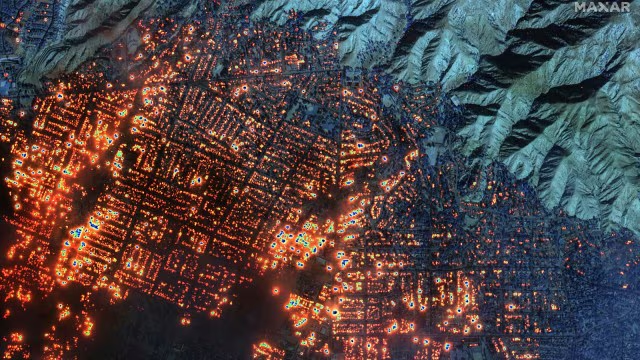
• Santa Ana-driven wildfires are a natural part of California’s landscape. However, experts say the wildfire season in California has lengthened in recent years. For instance, a 2021 study, published in the journal Nature Scientific Reports, found that the state’s annual burn season has lengthened in the past two decades and that the yearly peak has shifted from August to July.
• The wildfires have also become more intense in the past few years. This has happened primarily because of climate change. Rise in global temperatures over the years has led to warmer springs and summers, and early spring snow melts.
• The situation will only get worse as humans continue to emit greenhouse gas emissions into the atmosphere.
Do You Know:
• November to June is considered to be forest fire season in India, with hundreds of thousands of small and large fires burning every year, especially from February onward as summer approaches. April-May are usually the worst fire months across the country.
• The biennial India State of Forest Report (ISFR) published by the Forest Survey of India (FSI) under the Ministry of Environment, Forest and Climate Change recorded in its 2019 report that more than 36% of India’s forest cover was prone to frequent fires. About 4% of the forest cover was ‘extremely prone’ to fire, and another 6% was ‘very highly’ fire prone (ISFR 2019).
Other Important Articles Covering the same topic:
📍Southern California wildfires 2025 explained: Why the blaze in winter, why it is so bad
📍How are forest fires caused and how frequent are they in India?
Syllabus:
Preliminary Examination: Current events of national and international importance
Mains Examination: General Studies-III: Conservation, environmental pollution and degradation, environmental impact assessment
What’s the ongoing story: The year 2024 has now been confirmed to have breached the 1.5 degree Celsius global warming threshold, becoming the first calendar year to do so. The annual average temperature of Earth’s surface in 2024 was 1.6 degrees Celsius above pre-industrial times (average of the 1850-1900 period), according to data from the Copernicus Climate Change Service run by the European Centre for Medium Range Weather Forecasting (ECMWF).
Key Points to Ponder:
• What will be the impact of breaching 1.5 degree Celsius annual average temperature?
• What is the role of climate change in global warming?
• How does El Nino impact global warming?
• What is the Paris Agreement?
• What are the initiatives taken to control climate change?
• What is the impact of the rise in global temperature on human health and the marine environment?
Key Takeaways:
• The World Meteorological Organization (WMO) used six datasets, including the one used by ECMWF, to conclude that 2024 was 1.55 degrees Celsius warmer than pre-industrial levels. Each of the six datasets found 2024 to be the warmest year ever, but not all of them recorded the warming to be in excess of 1.5 degrees Celsius.
• The 1.5 degree mark is an arbitrarily decided threshold. In terms of climate change impacts, there is nothing new that will begin to happen once this threshold is crossed. Science only says that the climate impacts are expected to become more severe and frequent as warming increases.
• The 2024 breach does not mean that the 1.5 degree target is over. This target, mentioned in the 2015 Paris Agreement, refers to long-term temperature trends, usually over two to three decades, not annual or monthly averages.
• Global emissions are still on the rise, and the 2030 emission cut targets are almost certain to be missed. Therefore, there is every likelihood that the breach that has happened in 2024 would become a norm within the next decade.
• The year 2024 has now become the warmest year ever, taking over from 2023 which was 1.45 degrees Celsius warmer than pre-industrial levels. Together, these two years were exceptionally warm, and witnessed several record-breaking temperature events.
• The years 2023 and 2024 stand out even in the rapidly warming trend witnessed in the last decade, ECMWF said. For instance, the previous warmest year, 2016, which was 1.29 degrees Celsius warmer than pre-industrial levels, was influenced by a very strong El Niño.
• There was an El Niño prevailing during 2023 and 2024 as well, but it was mild compared to the 2015-2016 event. ECMWF said the unusual warming of 2023 and 2024 could be because of several other factors, though there was no one dominant reason.
• An underwater volcanic eruption near Tonga in the southern Pacific Ocean in January 2022, and lower sulphur dioxide emissions from the shipping industry in 2024 could also have contributed to the warming, ECMWF said.
• The unusual warming could also be because of the Sun, which was in its solar maximum phase in 2024 during its routine 11-year solar cycle. During the cycle, the magnetic poles of the Sun flip from one end to the other.
• The exceptional trends seen in 2023 and 2024 are unlikely to continue this year. As of now, 2025 is not expected to emerge as the warmest year. However, it is unlikely to be substantially cooler either.
Do You Know:
• Climate change has been “wreaking havoc” on Earth’s water cycle by disrupting how water circulates between the ground, oceans and atmosphere, according to a new report. This has led to extreme precipitation, ferocious floods and droughts, which affected billions of people across the world in 2024.
• The report, ‘2024 Global Water Monitor Report’, was produced by an international team of researchers from universities in Australia, Saudi Arabia, China, Germany, and elsewhere. For their analysis, the researchers used data from ground stations and satellites to access water variables such as soil moisture, rainfall etc.
• The water cycle involves water evaporating from the ground and sea, and eventually returning to the Earth as rain snow. Climate change has intensified this cycle as air temperatures soar, more water evaporates into the air.
• Warmer air can hold more water vapour — for every 1 degree Celsius rise in average temperature, the atmosphere can hold about 7% more moisture. This makes storms more dangerous as it leads to an increase in precipitation intensity, duration and/or frequency, which ultimately causes severe flooding across the world.
Other Important Articles Covering the same topic:
📍Extreme rainfall, ferocious floods: How climate change is affecting Earth’s water cycle
📍Nine years after being finalised, why the Paris Agreement looks more fragile than ever
Previous year UPSC Prelims Question Covering similar theme:
(3) With reference to the Agreement at the UNFCCC Meeting in Paris in 2015, which of the following statements is/are correct? (UPSC CSE 2016)
1. The Agreement was signed by all the member countries of the UN and it will go into effect in 2017.
2. The Agreement aims to limit the greenhouse gas emissions so that the rise in average global temperature by the end of this century does not exceed 2°C or even 1.5°C above pre-industrial levels.
3. Developed countries acknowledged their historical responsibility in global warming and committed to donate $ 1000 billion a year from 2020 to help developing countries to cope with climate change.
Select the correct answer using the code given below.
(a) 1 and 3 only
(b) 2 only
(c) 2 and 3 only
(d) 1, 2 and 3
Previous year UPSC Mains Question Covering similar theme:
The Intergovernmental Panel on Climate Change (IPCC) has predicted a global sea level rise of about one meter by AD 2100. What would be its impact in India and the other countries in the Indian Ocean region? (UPSC CSE 2023)
Syllabus:
Preliminary Examination: Current events of national and international importance
Mains Examination: General Studies-II: Issues relating to development and management of Social Sector/Services relating to Health, Education, Human Resources.
What’s the ongoing story: Rama V Baru writes: The incessant siren of a speeding ambulance has become part of urban life across India. The only time uncaring drivers are willing to give way to a fellow citizen on a crowded street is in response to the wailing of an ambulance. An increase in chronic diseases and road accidents has spurred the demand for emergency services and hospitalisation. Ambulance services are an important link for transporting patients who require emergency care.
Key Points to Ponder:
• What are the issues facing healthcare in India?
• Mere expansion of ambulance services does not ensure quality. Analyse.
• What are the regional disparities in healthcare quality in India?
• What steps need to be taken to ensure quality healthcare facilities in India?
• What are the new emerging challenges of the healthcare facilities in India?
Key Takeaways:
• For a long time, ambulances were available only at a hospital. In the 1980s, non-government organisations stepped in, particularly in southern India, to provide voluntary and free ambulance services. Over the last decade, several state governments have provided ambulance services for women in the reproductive age group and for children below five years.
• As a part of the national programme to increase institutional deliveries, ambulance services were introduced to transport expectant mothers to healthcare facilities mostly in urban areas. Under the National Rural Health Mission, ambulance services were introduced in a public-private partnership mode.
• Blinkit, an online delivery service, has recently launched a “10-minute” ambulance service in Gurugram. A press release says that their ambulances will be equipped with life-saving facilities for patient transport.
• A “10-minute” ambulance service, like the 30-minute pizza delivery offers, sounds far-fetched given the bumper-to-bumper traffic in urban India. At any rate, it exerts enormous pressure on the ambulance driver, as is the case with delivery service providers.
• According to recent reports, the Indian ambulance market, valued at $1.5 billion in 2022, is projected to grow by over 5 per cent compounded annual growth rate in the 2024-2028 period.
• Despite this growth, the focus remains largely on patient transfer rather than critical emergency care. Out of 17,495 operational ambulances currently, only 3,441 have Advanced Life Support (ALS) units.
• Moreover, there is much variation in the availability of ambulance services across states. Western states, including Maharashtra, Gujarat, Rajasthan and Goa, followed by southern Indian states with a large private healthcare sector, dominate the market for ambulance services.
• There is much variation in ambulance services offered. These range from just transporting of patients, with no support services, to those that have Basic Life Support (BLS) to Advanced Life Support (ALS) units. Each is designed for specific medical needs.
• A recent study by Niti Aayog shows that not all these services have the required infrastructure, equipment and technical staff to qualify as ambulance services. It revealed that 88 per cent of the hospitals had in-house ambulances but only 3 per cent of them had Emergency Medical Technicians. Only 12 per cent of all the hospitals have provisions for specialised care during transportation.
• Studies evaluating some of these services have suggested a range of policy issues that need to be addressed. To begin with, one must recognise that a large number of the so-called ambulance services are nothing more than patient transport facilities.
• Even in the case of well-equipped ambulances, the rapidity of patient transport in a critical condition is dependent on road connectivity and traffic conditions. Poor planning of roads and traffic congestion in metros make navigating ambulances in emergencies problematic and delay timely treatment.
• The non-availability of a standard pan-India toll free number, along with the lack of a systematic plan for monitoring and accountability to ensure timely and optimal care are some of the other areas needing action.
• The haphazard and unregulated growth of private ambulance services is a serious shortcoming in the provisioning of prompt and quality services. There is a need for investment in developing standard protocols for general and specialised ambulance services.
Do You Know:
• Zomato-owned quick commerce platform Blinkit has announced a 10 minute ambulance delivery service, as the firm looks to expand beyond grocery and print out deliveries.
• The Covid-19 pandemic highlighted the stark shortages of ambulances across the world, including in India, with people in need of immediate medical care struggling to find an ambulance service to a hospital. Generally, the high cost of securing ambulances in crucial times also make them inaccessible for several people.
• As per data available with the National Health Mission, India had only 17,495 operational basic life support (BLS) ambulances until December 2023. The number of advanced life support ambulances was even lower, with 3,441 such operational vehicles.
Other Important Articles Covering the same topic:
📍Blinkit’s 10-minute ambulance service puts the spotlight on why India needs more life support units
Previous year UPSC Mains Question Covering similar theme:
Appropriate local community level healthcare intervention is a prerequisite to achieve ‘Health for All’ in India. Explain. (UPSC CSE 2018)
| ALSO IN NEWS | |
| ISRO’s SpaDex mission | The two satellites launched by the Indian Space Research Organisation (ISRO) for a space docking experiment may soon attain the conditions needed to commence the mission. The docking experiment, originally scheduled for Thursday, was postponed after the satellites drifted more than expected during a manoeuvre to reduce the distance between them. |
| PM Modi to visit France in February | Prime Minister Narendra Modi is set to make a state visit to France and then participate in the AI Summit to be held here in February, French President Emmanuel Macron said on Friday. |
| PRELIMS ANSWER KEY |
| 1. (d) 2. (c) 3. (b) |
The Indian Express UPSC Essentials brings to you the December issue of its monthly magazine. Click Here to read. Share your views and suggestions in the comment box or at manas.srivastava@indianexpress.com
Subscribe to our UPSC newsletter. Stay updated with the latest UPSC articles by joining our Telegram channel – IndianExpress UPSC Hub, and follow us on Instagram and X
For your queries and suggestions write at khushboo.kumari@indianexpress.com


