24 min read

© IE Online Media Services Pvt Ltd



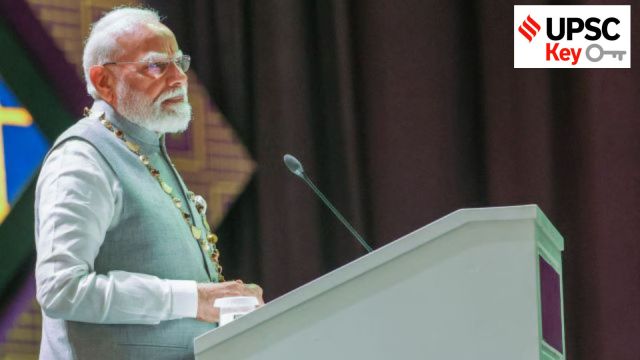 This was Modi’s second leg of the three-nation tour, beginning with Jordan. He is headed to Oman after wrapping up his visit in Ethiopia. Know more in our UPSC Key.(File Photo)
Important topics and their relevance in UPSC CSE exam for December 18, 2025. If you missed the December 17, 2025, UPSC CSE exam key from the Indian Express, read it here.
Syllabus:
Preliminary Examination: Current events of national and international importance.
Mains Examination: General Studies-II: Bilateral, regional and global groupings and agreements involving India and/or affecting India’s interests.
What’s the ongoing story: As Prime Minister Narendra Modi and the Ethiopian President Abiy Ahmed Ali agreed to elevate the bilateral ties to strategic partnership, PM Modi said on Wednesday that India and Ethiopia are “natural partners” in regional peace, security and connectivity.
Key Points to Ponder:
— What is meant by a ‘strategic partnership’?
— What is the history of India-Ethiopia relations?
— What is the significance of the strategic partnership for India–Ethiopia relations?
— What are the areas of cooperation between India and Ethiopia?
— What do you understand by the Global South?
— What is the ‘Global Development Compact’ proposed by India?
— Read about the Hayli Gubbi volcanic eruption.
— Map work: Locate Ethiopia on a world map.
Key Takeaways:
— Modi, who addressed the Ethiopian parliament on Wednesday, said, “Ethiopia sits at a crossroads of Africa. India stands at the heart of the Indian Ocean. We are natural partners in regional peace, security, and connectivity…our commitment to mutual security became stronger with the signing of the Defence Cooperation Agreement earlier this year. This agreement focuses on closer military cooperation. It includes collaboration in cybersecurity, in defence industries, in joint research, and in capacity building.”
— This is Modi’s second leg of the three-nation tour, beginning with Jordan. He is headed to Oman after wrapping up his visit in Ethiopia.
— “Our vision is of a world where the Global South rises not against anyone, but for everyone. A world where development is fair, where technology is accessible, and where sovereignty is respected. A world where prosperity is shared, and peace is defended,” he said, adding that the world cannot move forward if its systems remain locked in the past.
— That is why, India has emphasised a Global Development Compact, he said, adding, it will prioritise technology sharing, affordable finance, capacity building, and trade for sustainable growth.
— Modi said he was honoured to receive the Grand Honour, Nishan of Ethiopia. Modi said the Indian companies have invested more than USD five billion in diverse sectors like textiles, manufacturing, agriculture, health, etc., and created more than 75,000 jobs in Ethiopia.
— He said the Strategic Partnership will unleash the potential of both economies through cooperation in technology, innovation, mining, clean energy, food security, capacity building, as well as defence and security matters.
— MEA officials said that in the context of food security and health security, Prime Minister Modi expressed and conveyed India’s readiness to share development experience in the area of agri-technology, natural farming, digital health, and how India is leveraging technology for better health services.
— He also said that India would be happy to organize special short-term courses in the field of Artificial Intelligence under the ITEC program for Ethiopia. Prime Minister Modi also announced doubling of the number of ICCR scholarships offered annually to Ethiopian students to study in India.
Do You Know:
— The Hayli Gubbi volcano in northeastern Ethiopia erupted on November 23, by all accounts for the first time in about 12,000 years.
— There was no lava or magma flow, but large amounts of gas and plume, consisting possibly of small fragments of rocks, glass, and some other material, were ejected in an explosive eruption.
Other Important Articles:
📍Hayli Gubbi volcanic eruption in Ethiopia: Everything you need to know
Syllabus:
Preliminary Examination: Current events of national and international importance.
Mains Examination: General Studies-II: India and its neighbourhood- relations, Bilateral, regional and global groupings and agreements involving India and/or affecting India’s interests.
What’s the ongoing story: Hours before protesters marched towards the Indian High Commission in Bangladesh, the Ministry of External Affairs Wednesday summoned the neighbouring country’s High Commissioner in New Delhi to convey India’s “strong concerns” at the deteriorating security environment in Dhaka. It also pointed out activities of some extremist elements who have announced plans to create a “security situation” around the Indian High Commission in Bangladesh capital.
Key Points to Ponder:
— What is the history of India-Bangladesh bilateral relations?
— What are the areas of cooperation between India and Bangladesh?
— What are the emerging challenges in India and Bangladesh ties?
— How does the political transition in Bangladesh and its impact on India’s foreign policy underscores the importance of neighbourhood diplomacy?
— Map work: Location of Bangladesh and Indian states sharing boundaries with Bangladesh.
Key Takeaways:
— The diplomatic action was taken in light of the anti-India rhetoric by National Citizen Party (NCP) leader Hasnat Abdullah, who had made a public speech threatening to isolate the Seven Sisters and provide refuge to Northeast separatists if Bangladesh is “destabilised”.
— Bangladesh media had reported that a group of protesters under the banner of “July Oikya” were stopped by Dhaka’s police while marching towards the Indian High Commission on Wednesday afternoon, with several demands, including the return of ousted Bangladesh Prime Minister Sheikh Hasina and others who fled to India in the wake of the July uprising last year.
— According to a statement from the Ministry of External Affairs, “The Bangladesh High Commissioner to India, Riaz Hamidullah, was today (December 17) summoned and apprised of India’s strong concerns at the deteriorating security environment in Bangladesh. His attention was drawn, in particular, to the activities of some extremist elements who have announced plans to create a security situation around the Indian Mission in Dhaka.”
— It said that India “completely rejects the false narrative” sought to be created by “extremist elements regarding certain recent events in Bangladesh”.
— It said that India has close and friendly relations with the people of Bangladesh rooted in the liberation struggle, and strengthened through various developmental and people-to-people initiatives. “
— The Indian Visa Application Centre (IVAC) in Dhaka closed its office Wednesday in view of the current security situation.
Do You Know:
— Former Bangladesh Prime Minister Sheikh Hasina has been convicted of “crimes against humanity” and sentenced to death by the International Crimes Tribunal (ICT), a tribunal that she herself set up in 2009 to allegedly go after political enemies.
— In a 453-page judgement delivered on November 17, the International Crimes Tribunal (ICT) found Hasina, 78, and two co-accused guilty of allowing the use of lethal force against protesters and failing to prevent atrocities against them during last July’s protests.
— Hasina’s 15-year-long rule over Bangladesh came to an abrupt end last July following months of protests against her over allegations of corruption and a deeply unpopular quota system for government jobs. She has since been living in exile in India.
Other Important Articles Covering the same topic:
Previous year UPSC Prelims Question Covering similar theme:
(1) With reference to river Teesta, consider the following statements: (UPSC CSE 2017)
1. The source of river Teesta is the same as that of Brahmaputra but it flows through Sikkim.
2. River Rangeet originates in Sikkim and it is a tributary of river Teesta.
3. River Teesta flows into Bay of Bengal on the border of India and Bangladesh.
Which of the statements given above is/are correct?
(a) 1 and 3 only
(b) 2 only
(c) 2 and 3 only
(d) 1, 2 and 3
Previous year UPSC Mains Questions Covering similar theme:
Critically examine the compulsions which prompted India to play a decisive role in the emergence of Bangladesh. (UPSC CSE 2013)
The protests in Shahbag Square in Dhaka in Bangladesh reveal a fundamental split in society between the nationalists and Islamic forces. What is its significance for India? ( UPSC CSE 2013)
Syllabus:
Preliminary Examination: Current events of national and international importance.
Mains Examination: General Studies-III: Indian Economy and issues relating to planning, mobilisation of resources, growth, development and employment.
What’s the ongoing story: Pravin Krishna and Monil Sharma write- “India’s decision to withdraw quality control orders (QCOs) on a wide basket of industrial raw materials marks one of the most meaningful regulatory resets in recent years. In a manufacturing economy where delays and compliance costs can quietly determine competitiveness, the rollback is both timely and necessary. It acknowledges what industry has long argued: Mandatory certification is a blunt instrument when applied to low-risk, widely traded inputs.”
Key Points to Ponder:
— What is the purpose of the QCOs?
— What is the process of issuing QCOs in India?
— Read about the BIS certification.
— Which authority is responsible for formulating the Indian Standards for different products?
— How does the QCOs curb cheap quality imports?
— How did the QCO regime impact India’s integration into global supply chains?
— How do excessive compliance costs and regulatory delays affect India’s goal of becoming a global manufacturing hub?
— What reforms are needed to strengthen India’s quality ecosystem?
Key Takeaways:
— “As detailed by NITI Aayog’s recent report, over the past few years, QCOs have grown from a targeted instrument of quality assurance into a sprawling system of mandatory certification, growing from 70 a decade ago to over 790 earlier this year. Intended to keep substandard imports out, they increasingly swept in a wide range of industrial inputs: Polymers, fibre intermediates, aluminium and copper products, and even steel grades that pose no direct safety risk.”
— “No major manufacturing economy regulates such raw materials through compulsory audits. In the EU and US, conformity requirements overwhelmingly apply to finished goods and safety-critical items, with quality for intermediate inputs managed through voluntary technical standards and contractual testing.”
— “India’s approach carried high costs. When foreign suppliers — including those in Japan, Korea and the EU — declined to undergo factory inspections for low-volume shipments, Indian manufacturers were left with fewer sourcing options and higher input prices. MSMEs in particular struggled with the paperwork, delays and limited BIS testing capacity. For export-facing sectors like man-made fibre textiles, engineering goods and electronics assembly, the QCO regime became a barrier, eroding the price-competitiveness India needs to hold its own against Vietnam, China and Bangladesh.”
— “Against this backdrop, the recent rollback is a sensible reset. It acknowledges that quality cannot be legislated by expanding the list of items under mandatory certification. Quality depends on identifying the right risks and regulating where safety or consumer harm is genuinely at stake. The NITI Aayog report argued, persuasively, that India’s standards regime must follow global practice: Regulate construction steel, pressure vessels, electrical equipment and other high-stakes products, but allow market mechanisms and voluntary standards to govern bulk raw materials.”
— “The withdrawal, notified on November 13, removes compulsory BIS certification for 14 products under the chemicals and petrochemicals department and six under the mines ministry.”
— “This signals a maturing regulatory philosophy. A country that can unwind overregulation is one that understands the complexities of modern supply chains. For industries targeted under the PLI schemes — electronics, specialty steel, technical textiles — the decision offers much-needed breathing room. Manufacturers cannot build globally competitive products if they cannot reliably source globally competitive inputs.”
— “None of this means India should dilute its quality ambitions. On the contrary, a sharper, risk-based framework will make quality enforcement more credible. Mandatory certification should be strengthened in areas with clear consumer or public-safety implications. At the same time, the government should invest in expanding testing capacity, speeding up certification timelines and conducting impact assessments before adding new products to the QCO list.”
— “The lesson is straightforward: Competitiveness and quality must advance together. Regulation that raises costs without raising safety standards undermines the very manufacturing strategy India is trying to build. In an era where global manufacturers value reliability as much as cost, India’s willingness to recalibrate sends a positive signal to investors and trading partners alike.”
— “The revocation marks a clear shift toward a more pragmatic, globally aligned quality regime. If India continues on this path — with quality regulation that is risk-based, proportionate and grounded in capacity — it will be better positioned to compete in the industries that will define the next decade.”
Do You Know:
— In India, BIS formulates Indian Standards for different products. While the BIS certification scheme is voluntary in nature, for a number of products, compliance to Indian Standards is made compulsory by the Central Government under various considerations viz. public interest, protection of human, animal or plant health, safety of environment, prevention of unfair trade practices and national security.
— The Bureau of Indian Standards (BIS) Act, 2016, empowers the government to mandate standardisation through compulsory certification.
— The aim of QCOs is to uplift the national quality ecosystem and curb substandard cheap imports of goods in the country, said the sources.
Other Important Articles Covering the same topic:
📍Quality control orders now cover 732 products helping curb cheap quality imports: Goyal
Previous year UPSC Prelims Question Covering similar theme:
(2) Consider the following statements: (UPSC CSE 2017)
1. The Standard Mark of Bureau of Indian Standards (BIS) is mandatory for automotive tyres and tubes.
2. AGMARK is a quality Certification Mark issued by the Food and Agriculture Organisation (FAO).
Which of the statements given above is/are correct?
(a) 1 only
(b) 2 only
(c) Both 1 and 2
(d) Neither 1 nor 2
Syllabus:
Preliminary Examination: Current events of national and international importance.
Mains Examination: General Studies-II: Bilateral, regional and global groupings and agreements involving India and/or affecting India’s interests.
What’s the ongoing story: A combination of factors led to a 22 per cent surge in India’s exports to the US market in November after two consecutive months of decline in September and October. This made November one of the strongest months on record despite the 50 per cent US tariffs that have left a broad range of products uncompetitive in the American market. While exporters seem resilient, data suggest that it could be short-term factors and a trade deal could still be necessary for sustained growth.
Key Points to Ponder:
— Track the history of India-US bilateral relations.
— What are the recent agreements signed between India and the US?
— What are the various issues between India and the US?
— What are the challenges related to the India-US trade deal?
— What is Carbon Border Adjustment Mechanism (CBAM)?
— What is the significance of export market diversification?
— How does exchange rate depreciation impact India’s exports?
— What are the challenges faced by Indian exporters?
— What are India’s import and export trends with regard to the US?
Key Takeaways:
— Exports in November surged to the US as well as other markets, particularly China and Hong Kong, and to several European markets. Exports indicate strong signs of diversification, but exporters may have also benefited from the recent tensions between China and Japan.
— Indian exports, particularly seafood, have surged to China as Beijing has begun restricting imports from Japan. Indian exports to China jumped 90 per cent and to Hong Kong by 35 per cent last month.
— Exports to European countries have also been on the rise ahead of the implementation of the Carbon Border Adjustment Mechanism (CBAM) from January 1. The new tax will raise duty on Indian engineering products from next year. In what typically triggers stocking, Indian exporters of engineering goods grew by 30 per cent, and exports to Germany, Spain, and Belgium surged 25 per cent, 180 per cent and 30 per cent, respectively.
— One of the prime reasons for the surge in Indian exports to the US is that exporters are hoping for a deal soon and are bearing the tariffs-related cost to maintain market access in anticipation of a trade deal. The first part of the deal, where the US would revoke 25 per cent tariffs, is expected, as India has stepped up crude imports from the US, signed an energy deal agreeing to source 10 per cent of its LPG imports from the US and is set to open its nuclear sector, which has been among the key US demands.
— However, exporters have said that they are no longer receiving fresh orders and most orders will end by December. This could have a long-term impact, as Indian competitors such as Vietnam and Bangladesh have begun receiving orders that are moving away from India. Exporters from Tiruppur, for instance, said that they have lost nearly Rs 7,000 crore worth of winter orders from the US that will have a long-term impact on the manufacturing hub.
— The sharp rise in exports in November also comes amid a rapid weakening of the rupee against the US dollar, with the 90-dollar mark being breached earlier this month in December. A weaker rupee is good for exporters as it makes Indian goods and services cheaper for foreign buyers.
— The rupee, which hit a fresh all-time low on Monday after it fell to 90.79 per dollar during the day, was 5.6 per cent lower in November against the US dollar compared with the same month last year. This is despite the greenback having weakened sharply by almost 8 per cent over the last 12 months.
Other Important Articles Covering the same topic:
📍India-US trade needs stable framework, not firefighting
Previous year UPSC Prelims Question Covering similar theme:
(3) With reference to the international trade of India at present, which of the following statements is/are correct? (UPSC CSE 2020)
(1) India’s merchandise exports are less than its merchandise imports.
(2) India’s imports of iron and steel, chemicals, fertilisers and machinery have decreased in recent years.
(3) India’s exports of services are more than its imports of services.
(4) India suffers from an overall trade/current account deficit.
Select the correct answer using the code given below:
(a) 1 and 2 only
(b) 2 and 4 only
(c) 3 only
(d) 1, 3 and 4 only
Previous year UPSC Mains Question Covering similar theme:
‘What introduces friction into the ties between India and the United States is that Washington is still unable to find for India a position in its global strategy, which would satisfy India’s National self-esteem and ambitions’. Explain with suitable examples. (UPSC CSE 2019)
Syllabus:
Preliminary Examination: Current events of national and international importance.
Mains Examination: General Studies-I, II: Salient features of Indian Society, Social empowerment, Role of women and women’s organization, Government policies and interventions.
What’s the ongoing story: Shashi Tharoor writes- “The foundational promise of India’s democracy rests on the commitment to equality, dignity, individual agency, privacy and bodily autonomy for all its citizens. The Constitution provides these; the Supreme Court has repeatedly reaffirmed them. Every Indian should be able to take these rights for granted.”
Key Points to Ponder:
— Know about Section 63 of the Bharatiya Nyaya Sanhita (BNS), 2023.
— What is the marital rape exemption?
— What is the Status of Constitutionality of the marital rape exception in India?
— What is the Concept behind marriages in Indian Subcontinent or in the Indian Society?
— The Institution of Marriage-Why marriage is referred as an institution?
— What is Marital rape immunity?
— Criminalisation And Non-Criminalisation Of Marital Rape-For and Against.
— What is the “Doctrine of Coverture”?
— Justice Verma Committee Report and Pam Rajput committee’s report ‘Status of Women in India’ on Marital Rape-Know the Key Highlights.
Key Takeaways:
— “Yet, a glaring anomaly persists that undermines these very principles for countless women: The marital rape exception in the Indian Penal Code (IPC), now carried over in Section 63 of the Bharatiya Nyaya Sanhita (BNS), 2023. This exception, which exempts a husband from punishment for engaging in non-consensual sexual intercourse with his wife who is not under 18 years of age, is a tragic anachronism — a stubborn remnant of colonial-era patriarchal mindsets that view a wife as her husband’s property. It is a legal and moral failing that we must rectify.”
— “In the ongoing session of Parliament, I have introduced a private member’s Bill in the Lok Sabha to remove this archaic provision. I did so because the continued failure to criminalise marital rape leaves married women legally defenceless. The arrogant presumption that marriage voids the necessity of consent directly undermines a woman’s fundamental rights to dignity, safety, and bodily autonomy, all guaranteed under Article 21 of the Constitution.”
— “The urgency of this is validated by alarming national data. The National Family Health Survey-5 (NFHS-5) reveals that 83 per cent of women aged 18 to 49 years who faced sexual violence named their current husband as the perpetrator. The pervasive nature of sexual violence within marriages highlights the inadequacy of our legal system. The marriage licence was never intended to be a waiver of the right to say no. Very often, separated husbands come by to assert their conjugal rights by force. For too many women, home is not a sanctuary, but a space of potential violation, legally sanctioned by a patriarchal statute.”
— “The demand for criminalising marital rape is not new; it has been strongly supported by authoritative legal bodies within India. The Justice Verma Committee Report (2013), in the aftermath of the horrific Delhi gang-rape case, unequivocally recommended the removal of the marital rape exception. The committee recognised the inherent contradiction in a law that aims to protect women from sexual violence yet creates a loophole for the most frequent perpetrators — their husbands. A wedding ring does not turn a bedroom into a battlefield, nor a partner into property.
— “Furthermore, international treaties and conventions mandate this reform. India is a signatory to the Convention on the Elimination of All Forms of Discrimination Against Women (CEDAW), which requires state parties to take all appropriate measures to eliminate discrimination against women in all matters relating to marriage and family relations. The continued exception for marital rape is in direct violation of this commitment. Article 253 of the Constitution empowers Parliament to legislate in alignment with international conventions, and Article 51 enjoins the state to respect international law. These constitutional provisions clearly mandate the removal of the marital rape exception to uphold both domestic and international commitments to human rights.”
— “The law’s core error lies in the assumption that the “sanctity of marriage” provides an all-encompassing grant of sexual access. This is fundamentally wrong. Consent is a fundamental human right, regardless of marital status. Allowing a husband to force sex upon his wife converts “I do” into “you must”. Legal protection for a husband who rapes his wife sends a dangerous message: That a woman’s control over her body is surrendered upon taking her vows.”
— “Concerns are often raised that criminalising marital rape will lead to misuse of the law, creating a new avenue for vengeful wives to file false cases. While the potential for misuse in any law cannot be entirely dismissed, it cannot be a justification for denying justice and safety to genuine victims. If we accept the possibility of misuse as a reason not to legislate, then no law protecting women — from domestic violence to dowry prohibition — could ever be enacted. We must tackle misuse through robust investigation and judicial procedures, not by denying a fundamental right to protection from sexual violence.”
Other Important Articles Covering the same topic:
📍Explained: The debate over marital rape
ALSO IN NEWS |
|
| PM in Oman, to sign free trade agreement today | In a bid to strengthen economic ties, India and Oman are set to sign a Comprehensive Economic Partnership Agreement (CEPA) on Thursday as Prime Minister Narendra Modi visits Muscat. Modi, who is on a three-nation tour, landed in Oman Wednesday, after visiting Jordan and Ethiopia. |
| Navy inducts 2nd Seahawk chopper squadron in boost to anti-sub combat | The Indian Navy on Wednesday commissioned its second MH 60R helicopter squadron, INAS 335, at INS Hansa in Goa. The squadron has been nicknamed ‘Ospreys’ after the fish-hunting bird of prey. These US-origin Seahawks, maritime versions of the Black Hawk (and distinct from the Bell Boeing V-22 Osprey, an American military transport aircraft), will strengthen India’s anti-submarine and surveillance capabilities and boost blue-water operations. |
| Interest rates likely to remain low for along period: RBI Governor | Reserve Bank of India Governor Sanjay Malhotra has said interest rates are likely to remain low for a “long period” as India continues to post strong economic growth, which could receive an additional lift from trade agreements currently being negotiated with the US and Europe. Malhotra said the rate cuts carried out during his tenure had helped engineer a “Goldilocks phase” of brisk growth with low inflation. A Goldilocks period in economics refers to a phase when the economy is “just right” — neither overheating nor slowing down. It is characterised by steady growth, low inflation and manageable interest rates. |
| SEBI overhauls mutual fund norms, cuts expense ratio limits | The Securities and Exchange Board of India (SEBI) on Wednesday announced sweeping reforms, including a revision in base expense ratio limits and a reduction in the fee paid by mutual funds to brokerages. The SEBI board, at its meeting held on Wednesday, considered the recommendations given by the high-level committee (HLC) on conflicts of interest, investment and liabilities of its members and senior officials but said these suggestions would need detailed deliberations in light of certain concerns raised by employees related to public disclosures of assets. |
| PRELIMS ANSWER KEY |
| 1. (b) 2. (a) 3. (d) |
Subscribe to our UPSC newsletter. Stay updated with the latest UPSC articles by joining our Telegram channel – Indian Express UPSC Hub, and follow us on Instagram and X.
🚨 Click Here to read the UPSC Essentials magazine for December 2025. Share your views and suggestions in the comment box or at manas.srivastava@indianexpress.com🚨

Read UPSC Magazine