22 min read

© IE Online Media Services Pvt Ltd



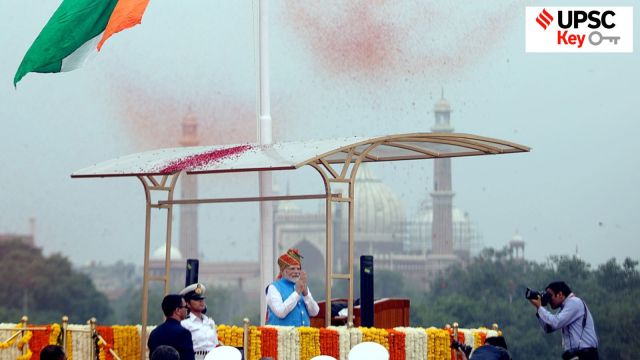 Prime Minister Narendra Modi at Red Fort during Independence day celebration in New Delhi on Thursday. Know more in our UPSC Key. (Express Photo by Praveen Khanna)
 🚨 Attention: UPSC Key is now all 7 Days a Week!🚨
Important topics and their relevance in UPSC CSE exam for August 16, 2024. If you missed the August 15th, 2024 UPSC CSE exam key from the Indian Express, read it here.
UPSC Syllabus:
Preliminary Examination: Current events of national and international importance
Mains Examination: GS-II: Government policies and interventions
What’s the ongoing story- Invoking the Constitution and the Supreme Court, Prime Minister Narendra Modi made a strong pitch Thursday for the Uniform Civil Code, saying it’s time the country moves towards a civil code that is “secular” and not “communal” and “discriminatory” as the existing one.
Prerequisites:
— What is the Uniform Civil Code (UCC)?
— What are the constitutional provisions related to UCC?
Key takeaways:
— “I say it is the need of the hour that there should be a Secular Civil Code in the country. We have spent 75 years under the Communal Civil Code. Now we will have to move towards a Secular Civil Code. Only then we will get relief from the discrimination happening on the basis of religion in the country, from which common citizens feel distanced,” he said.
— The UCC promise has long figured in BJP election manifestos and its 2024 Lok Sabha election manifesto said “Article 44 of the Constitution lists Uniform Civil Code as one of the Directive Principles of State Policy.
For Your Information:
— It was after the Supreme Court’s Shah Bano judgment in 1985 that the BJP took up the demand for a UCC in a big way.
— The UCC is the last unfulfilled ideological agenda of the BJP for now, and PM Modi threw a clear hint in this Independence Day speech that he would look to implement it.
Points to Ponder:
— What are the arguments for and against the implementation of UCC?
— What was the Constituent Assembly debate regarding the adoption of UCC?
— What are the important cases related to UCC?
Post Read Question:
Prelims
(1) Consider the following provisions under the Directive Principles of State Policy as enshrined in the Constitution of India: (UPSC CSE 2012)
1. Securing for citizens of India a uniform civil code
2. Organising village Panchayats
3. Promoting cottage industries in rural areas
4. Securing for all the workers reasonable leisure and cultural opportunities
Which of the above are the Gandhian Principles that are reflected in the Directive Principles of State Policy?
(a) 1, 2 and 4 only
(b) 2 and 3 only
(c) 1, 3 and 4 only
(d) 1, 2, 3 and 4
Mains
Discuss the possible factors that inhibit India from enacting for its citizens a uniform civil code as provided for in the Directive Principles of State Policy. (UPSC CSE 2015)
Other Important Articles Covering the same topic:
Amid UCC saga, PM Modi pitch for ‘secular civil code’ a bid to put Oppn on the back foot
UPSC Syllabus:
Preliminary Examination: Current events of national and international importance
Mains Examination: GS-II, III: Government policies and interventions, Science and Technology
What’s the ongoing story- The World Health Organisation, sounding its highest level of alarm, declared mpox as a Public Health Emergency of International Concern on Wednesday. This is the second time the infection has received the designation in as many years — the outbreak between July 2022 and May 2023 was also declared as PHEIC.
Prerequisites:
— What is Mpox?
— What are the criteria of WHO to declare any disease as a Public Health Emergency of International Concern?
Key takeaways:
— Mpox, previously known as monkeypox, is a self-limiting viral infection caused by mpox virus (MPXV). The most common symptoms of mpox include fever, headache, muscle aches, back pain, low energy, and swollen lymph nodes, along with pox-like rashes that last for two to three weeks.
— It is a self-limiting disease but can lead to death, especially among children and those with weak immune systems.
— While the infection has been reported in humans since 1970, it mostly affected people in the endemic regions in Africa till 2022.
— The current concern stems from the spread of clade Ib of the MPXV, which is predominantly transmitted through sexual contact.
— Sexual transmission of clade I infections has not been reported previously, according to a paper published this January in the journal Emerging Infectious Disease. Historically, clade I infections have spread through zoonotic spillover events — transmitted from animals to humans in close proximity.
— The first case of the more contagious clade Ib mpox infection outside Africa was reported from Sweden on Thursday. With interlinked global travel, the cases may reach other countries as well.
— During the 2022 global outbreak, India too reported cases of mpox, albeit of the less deadly clade II type.
— There are at least two vaccines currently in use for mpox, which have been recommended by the WHO’s Strategic Advisory Group of Experts on Immunization.
For Your Information:
— The World Health Organisation (WHO) has announced that it would start using the term “mpox” for monkeypox, which has infected about 80,000 people in the first major outbreak of the viral disease outside Africa that began early this summer.
— Monkeypox, which was named in 1970 because the virus that causes the disease was first discovered in captive monkeys in 1958, does not have much to do with monkeys.
— The most likely reservoir for the virus, which has circulated for several years in a few central African countries after jumping to humans through zoonosis in the bush, are rodents.
— According to WHO best practices, “new disease names should be given with the aim to minimize unnecessary negative impact of names on trade, travel, tourism or animal welfare, and avoid causing offence to any cultural, social, national, regional, professional or ethnic groups”.
Points to Ponder:
— What does a declaration on ‘emergency of international concern’ mean?
— What is the difference between endemic, pandemic and epidemic?
— What is India’s preparedness against the pandemic?
Post Read Question:
(2) Consider the following statements:
1. Smallpox and Chickenpox are caused by the Variola virus and Varicella-zoster virus (VZV) respectively.
2. Mpox is endemic in Central and West Africa.
3. According to the World Health Assembly, chickenpox was eradicated in 1980.
Which of the following statements is/are correct?
(a) 1 and 2 only
(b) 2 and 3 only
(c) 1 and 3 only
(d) 1, 2 and 3
Other Important Articles Covering the same topic:
Racist, stigmatizing: Why WHO will now call monkeypox ‘mpox’
UPSC Syllabus:
Preliminary Examination: Current events of national and international importance
Mains Examination: GS-III: Economy
What’s the ongoing story- Retail food inflation ruled above 8% for eight straight months from November 2023 to June 2024. That year-on-year increase, in the official consumer food price index (CFPI), fell to 5.4% in July, from 9.4% the month before.
Prerequisites:
— What is the consumer food price index (CFPI)?
— What is food inflation?
Key takeaways:
— Simply put, food inflation remains the economy’s bugbear, eating into household incomes and suppressing spending on other things, besides preventing the Reserve Bank of India (RBI) from cutting its policy interest rates.
— Amidst all this, there are at least two reasons for cautious optimism: Monsoon optimism and low global food prices.
— The overall good monsoon with well-distributed rainfall has led to higher acreages under most kharif crops this year. Area sown is up for rice, pulses such as arhar (pigeon pea) and moong (green gram), maize, oilseeds (soyabean and groundnut) and sugarcane – relative to both the corresponding period of 2023 and the normal coverage for this time.
— Farmers plant more when there is adequate water. They also go for crops whose prices are better or assured.
— Global food inflation has been in negative territory since December 2022. The United Nations’ Food and Agriculture Organization’s food price index averaged 120.8 points in July 2024, 3.1% down from its year-ago level…
— While global and domestic food inflation have been moving in opposite directions in recent times (see chart), low international prices, however, make imports more feasible.
— The prospects of a monsoon-aided bumper kharif crop should enable relaxation of the export ban/restrictions on non-basmati rice as well as sugar, along with the lifting of stockholding limits on pulses applicable to traders, retailers and dal millers.
— But all this optimism has to be tempered by the fact that the kharif crop’s harvesting is at least a month away, while not before March-end for wheat and other rabi crops. The uncertainty over food inflation will continue for some time till then.
For Your Information:
— In the Economic Survey for 2023-24, its author Chief Economic Advisor V Anantha Nageswaran made a case for excluding food prices from headline inflation, since food prices were keeping the CPI-based (Consumer Price Index) inflation high and delaying a cut in interest rates by the Reserve Bank of India.
— But RBI Governor Shaktikanta Das differed and said food inflation pressures cannot be ignored given the high share of food in the consumption basket.
— Rajani Sinha writes: “Food inflation is influenced by climatic factors and is beyond the control of the central bank. However, it cannot ignore food inflation as it has a strong bearing on household inflationary expectations, which in turn can feed into actual inflation. This is what makes RBI’s future policy uncertain and complex.”
Points to Ponder:
— How is food inflation impacting the overall health of the economy?
— What are the reasons for food inflation?
— How does a cut in the repo rate impact inflation in the economy?
Post Read Question:
Prelims
(3) Consider the following statements:
1. The weightage of food in the Consumer Price Index (CPI) is higher than that in Wholesale Price Index (WPI).
2. The WPI does not capture changes in the prices of services, which CPI does.
3. The Reserve Bank of India has now adopted WPI as its key measure of inflation and to decide on changing the key policy rates.
Which of the statements given above is/are correct?
(a) 1 and 2 only
(b) 2 only
(c) 3 only
(d) 1, 2 and 3
Mains
Do you agree with the view that steady GDP growth and low inflation have left the Indian economy in good shape? Give reasons in support of your arguments. (UPSC CSE 2019)
Other Important Articles Covering the same topic:
How uncertainty of food inflation affects RBI’s policy going forward
‘Can’t ignore food inflation pressures’: RBI Governor Shaktikanta Das differs from Survey idea
UPSC Syllabus:
Preliminary Examination: Current events of national and international importance
Mains Examination: GS-III: Economy
What’s the ongoing story- A rising and persistent gap between bank deposits and credit growth has led to the worst deposit crunch in two decades. The current and savings accounts (CASA) are banks’ bread-and-butter sources of funding. These are typically very low cost and currently account for 41 per cent of total deposits as against 43 per cent last year.
Prerequisites:
— What is core deposits?
— What is the significance of bank deposits for the economy?
Key takeaways:
— Core deposits provide a stable source of funding to banks, shielding them from fluctuations in market rates. As the core deposit share funds a smaller portion of their assets, banks face increasing pressure on profits.
— And if at the same time, the maturities of bank assets increase, it raises banks’ exposure to interest rate risks. In an environment of “higher for longer’’ policy rates and a potential rise in credit costs, there can be additional pressure on the profits and liquidity of the banking industry.
— The negative effects of declining deposit growth can extend beyond the banking sector and spill over into the broader economy. As banks’ liquidity risk increases, their ability or willingness to fund loan growth can decrease.
— As a result, at a time when banks are becoming more sensitive to credit risk and tightening underwriting standards and loan terms, deposit erosion can further impair the ability of some borrowers to obtain funds or can increase their cost of funding.
— Multiple disruptive forces are reshaping the foundational construct of the banking sector. Rising competition, technological advances and deregulation over the years have significantly upped the competitive pressures facing banks.
— First, what will be the impact of declining deposits on loan growth? This is a chicken-and-egg question: Do banks seek new deposits because of strong underlying loan growth? Or, do they seek opportunities to lend profitably because their deposit base goes up? Empirical evidence suggests that both are true.
— Second, how widespread is the decline in deposit growth? All banks are facing funding pressures including the biggest public and private sector banks as evidenced by their management commentaries and financial results.
— Third, is the erosion in deposits greater for smaller intermediaries? Since smaller entities have fewer alternatives to deposits, they typically fund a greater fraction of their assets through core and other deposits and rely less on external funds and other liabilities.
— Fourth, will last-mile lending be constrained as a result of the decline in deposit growth? The deposit crunch could impact eventual credit flow via NBFCs, microfinance institutions and other smaller players as they primarily depend on the banks for funds. Such constraints could hurt consumption and investment activities.
— Lastly, are all loan portfolios affected to the same degree by slower deposit growth? So far, the demand for funds is not yet broad-based. Retail demand has remained robust, and industry hasn’t yet felt the need to join the fray in a big way…
— Things could change — equity markets could cool off and relative returns may turn benign for banks or the government could chip in with tax breaks on interest from banks.
For Your Information:
— Banks need to take the old-fashioned route to bring back focus on mobilising “small deposits” and not just big deposits in order to reverse the flagging deposit growth rate, Finance Minister Nirmala Sitharaman said.
— Banks are facing challenges on the funding front with bank deposits trailing loan growth. As of July 12, while deposits grew by 11.7 per cent, loan growth increased by 15.5 per cent.
Points to Ponder:
— What are the reasons for the decline in the deposit ratio?
— What is the process of credit creation by the Commercial bank?
Post Read Question:
Prelims
(4) The money multiplier in an economy increases with which one of the following? (UPSC CSE 2021)
(a) Increase in the Cash Reserve Ratio in the banks
(b) Increase in the Statutory Liquidity Ratio in the banks
(c) Increase in the banking habit of the people
(d) Increase in the population of the country
Mains
Do you agree with the view that steady GDP growth and low inflation have left the Indian economy in good shape? Give reasons in support of your arguments. (UPSC CSE 2019)
Other Important Articles Covering the same topic:
Finance Minister to banks: Innovate, focus on small deposits to plug gap with credit growth
UPSC Syllabus:
Preliminary Examination: Current events of national and international importance
Mains Examination: GS-II: Government policies and interventions
What’s the ongoing story- One kind of politics of national speeches consists of the effort to present the nation’s diversity as a set of contradictions that are harmful to the public good. Another is to speak of diversity as a context of learning to get along with others. The latter view reflects the idea that it is neither necessary nor possible to obliterate diversity through treating it as a harmful contradiction.
Prerequisites:
— Why 15th of August is celebrated as Independence Day?
— What is the idea of Viksit Bharat?
— Why is the national flag hosted on Independence Day?
Key takeaways:
— The explicit aspect of the Prime Minister’s speech on the 78th Independence Day may have been the idea of “Viksit Bharat” (Developed India) by 2047 and the key imagined audience, the youth of the country, but the underlying tone reflected a particular understanding of how one deals with a complex past and present.
— The idea of reform — of governance, health systems, the financial system, the licence-permit system and much else — has formed an important aspect of the larger narrative through which the current regime seeks to differentiate itself from the earlier one.
For Your Information:
— In Prime Minister Narendra Modi’s I-day speech, the first of his third term, “Viksit Bharat at 2047” was the stated goal as well as recurring motif. The world was India’s stage, and it was upto Indians, especially its young, impatient for the “chhallang” or big leap into the future, to seize the golden hour and its “sambhavnayen (possibilities)”, he said.
— 5 takeaways from PM’s I-Day Speech: Secular civil code; One Nation, One Election; Women’s safety; War on corruption and Message to Bangladesh.
Points to Ponder:
— How can India achieve the idea of Viksit Bharat?
— What are the challenges in the path of Viksit Bharat?
Post Read Question:
Highlight the importance of the new objectives that got added to the vision of Indian Independence since the twenties of the last century. (UPSC CSE 2017)
Other Important Articles Covering the same topic:
5 takeaways from PM Modi’s I-Day speech
Express View on PM Modi’s Independence Day address
UPSC Syllabus:
Preliminary Examination: Current events of national and international importance
Mains Examination: GS-II, III: Polity, Economy
What’s the ongoing story- Underlining that a number of global companies want to invest in India, Prime Minister Narendra Modi called on state governments to create policies to attract such funding and reiterated his stance on state-level competition for investments, during his 78th Independence Day speech.
Prerequisites:
— What is the Production Linked Incentives (PLI)?
— What is the significance of the manufacturing sector?
Key takeaways:
— The Prime Minister called for state governments to establish clear policies to attract investments, offer assurances of good governance, and ensure confidence in the law and order situation. He also said that India will become a global manufacturing hub, leveraging its vast resources and skilled workforce.
— PM Modi’s comments come as India has outlined manufacturing in various sectors as a key driver of economic growth and an avenue for large-scale employment generation. The government has launched 14 production linked incentive (PLI) schemes in sectors like electronics and smartphones, telecom, pharmaceuticals etc. in its manufacturing push.
— The PM directed NITI Aayog to prepare an ‘investment-friendly charter’ of parameters which would include policies, programmes and processes to be put in place for attracting investments. States may be monitored on the basis of their achievement in these parameters to promote healthy competition among them for attracting investments, he said.
For Your Information:
From Economy Section: Centre’s guidelines for special assistance to states finalised, Rs 10,000 crore for land reforms
— The Centre has decided to provide states with Rs 10,000 crore in incentives for implementing land-related reforms in rural and urban areas, and Rs 5,000 crore for creating a Farmers’ Registry during the financial year 2024-25 (FY25).
— According to sources, states will need to undertake land-related reforms in rural areas, which include the assignment of a Unique Land Parcel Identification Number (ULPIN) or Bhu-Aadhaar for all lands; digitisation of cadastral maps; survey of map sub-divisions according to current ownership; and the establishment of a land registry.
— In urban areas, fiscal incentives will be provided for the digitization of land records using GIS mapping and the establishment of an information technology-based system for property record administration, updating, and tax administration.
— The Centre has also decided to provide Rs 5,000 crore for the construction of working women’s hostels.
— According to the guidelines, the land for the hostels will be made available by the state government free of cost, or the cost of acquiring the land will be borne by the state government.
— The state should adopt a Public-Private Partnership (PPP) model for the operation and maintenance of the hostels, according to the guidelines. Ownership of the hostel would rest with the state government, while operation and maintenance would be managed by a private party.
Points to Ponder:
— What is cooperative federalism?
— How are finances allocated by the Center to the states?
— What is the significance of the PPP model?
Post Read Question:
Prelims
(5) The Government of India has established NITI Aayog to replace the (UPSC CSE 2015)
(a) Human Rights Commission
(b) Finance Commission
(c) Law Commission
(d) Planning Commission
Mains
How far do you think cooperation, competition and confrontation have shaped the nature of federation in India? Cite some recent examples to validate your answer. (UPSC CSE 2020)
Other Important Articles Covering the same topic:
Coalition opens space for dialogue, makes tough reforms feasible: CEA
UPSC Syllabus:
Preliminary Examination: Current events of national and international importance
Mains Examination: GS-III: Economy
What’s the ongoing story- India will offer end-to-end semiconductor solutions to the world and will become a manufacturing hub for cutting edge technologies by leveraging its large skilled youth base, Prime Minister Narendra Modi said during his 78th Independence Day speech. He also urged young people to design products and services in India, and take a lead in creating games for the world.
Prerequisites:
— What is the importance of semiconductors?
Key takeaways:
— In December 2021, the government had rolled out a Rs 76,000 crore chip incentive scheme, under which it offered half the amount of a plant’s capital expenditure costs as subsidy.
— Under the scheme, the country has cleared four proposals – a fab being set up by the Tatas in partnership with a Taiwanese company, and three packaging plants including one by Micron. — Three of these projects are being set up in Gujarat, while a packaging plant by the Tatas is coming up in Assam.
— Modi called on India’s youth and IT professionals to work on developing games made in the country.
Points to Ponder:
— What are the issues concerning domestic manufacturing of semiconductors?
— What is the India Semiconductor Mission (ISM)?
— India’s agreement with other countries (USA, Taiwan, EU) on cooperation in the semiconductor ecosystem.
(Thought process: Highlight the significance of indiginisation of the semiconductor ecosystem–connect it with economy-import bills-India’s mission to atmanirbhar Bharat–look at the semiconductor materials imported from other countries–look at government schemes and various agreements signed by the government).
Post Read Question:
Prelims
(6) Which one of the following laser types is used in a laser printer? (UPSC CSE 2008)
(a) Dye laser
(b) Gas laser
(c) Semiconductor laser
(d) Excimer laser
Mains
Why India is aiming to become self-sufficient in chip manufacturing? Highlight the government initiatives to strengthen India’s semiconductor ecosystem.
Other Important Articles Covering the same topic:
How India’s first semiconductor fabrication plant can help plug in to global value chain
‘Wordly Wise’ from The Editorial Page
“A genuine leader is not a searcher for consensus but a molder of consensus.”
— Martin Luther King, Jr
(Thought Process: What does it mean to be a genuine leader? Is leadership merely about coming to an agreement? Why building a consensus an important aspect of leadership? What does it take to mold consensus rather than just seek it? How does this idea apply to administration? How can a civil servant embody this quality?)
| Prelims Answer Key |
| 1. (b) 2. (a) 3. (a) 4. (c) 5. (d) 6. (c) |
Subscribe to our UPSC newsletter and stay updated with the news cues from the past week.
Stay updated with the latest UPSC articles by joining our Telegram channel – Indian Express UPSC Hub, and follow us on Instagram and X.
https://www.youtube.com/watch?v=P2xAVzg_YKE?si=JVKEe-DQdz-XRbYw&w=560&h=315

Read UPSC Magazine