17 min read


© IE Online Media Services Pvt Ltd



 UPSC Key June 2023: Here's what you should be reading from the June 29, 2023 edition of The Indian Express.
 Important topics and their relevance in UPSC CSE exam for June 29, 2023. If you missed the June 28, 2023 UPSC key from the Indian Express, read it here
FRONT PAGE
National Research Foundation gets Centre nod, Rs 50,000 crore over 5 years for R&D
Syllabus:
Preliminary Examination: Current events of national and international importance.
Mains Examination: General Studies II: Government policies and interventions for development in various sectors and issues arising out of their design and implementation.
Key Points to Ponder:
• What’s the ongoing story– Delivering on a promise made four years ago, the government on Wednesday approved a proposal to set up a National Research Foundation (NRF) as an apex body to promote, fund and mentor scientific research in higher education institutions across the country, with the focus on cultivating the culture of research in universities and colleges.
• What is National Research Foundation?
• What is the aim of National Research Foundation?
• What is the purpose of National research Foundation?
• For Your Information-The Union Cabinet cleared the introduction of a Bill in Parliament to enable the setting-up of the NRF, which is modelled on the lines of the hugely successful National Science Foundation of the United States. The NRF is estimated to have an initial budget of Rs 50,000 crore over a five-year period between 2023 and 2028.
• How much does India barely spend on research and development?
• Do You Know-India barely spends 0.7 per cent of its GDP on research and development, which is extremely low compared to many other countries. In fact, the gross expenditure on R&D declined from 0.84 per cent in 2008 to about 0.69 per cent in 2018, the last year for which confirmed figures are available. In comparison, the US spent 2.83 per cent, China spent 2.14 per cent, and Israel spent 4.9 per cent. Even Brazil, Malaysia and Egypt spend more of their GDP on research. The proposal for an NRF was first floated in the public domain by Prime Minister Narendra Modi on January 3, 2019 during his address to the Indian Science Congress. The NRF found a second mention on January 20 that year during a joint session of Parliament, and then later in the Finance Minister’s speech during the Budget Session in July 2019. The creation of NRF was also one of the key recommendations of the National Education Policy 2020.
Other Important Articles Covering the same topic:
📍Cabinet approves Introduction of National Research Foundation Bill, 2023 in Parliament to strengthen research eco-system in the country
📍What is National Research Foundation?
Decision put on hold; credit card use abroad not to attract TCS
Syllabus:
Preliminary Examination: Current events of national and international importance.
Main Examination: General Studies II: Government policies and interventions for development in various sectors and issues arising out of their design and implementation.
Key Points to Ponder:
• What’s the ongoing story– In a reversal of its earlier decision, the government on Wednesday decided to defer the decision to include international credit card spends outside India under the Liberalised Remittance Scheme (LRS). This, in effect, means there will be no levy of Tax Collected at Source (TCS) on international credit card spends outside India as of now. The government also extended the timeline to levy the higher proposed TCS rates with effect from October 1 instead of July 1 this year. This postponement has come amid banks raising concerns about the unpreparedness of their reporting systems to roll out the differential TCS levy for various categories such as medical, education, overseas tour packages among others.
• What changes?
• What is Foreign Exchange Management Act?
• What is the Liberalised Remittance Scheme (LRS)?
• For Your Information-The usage of an international credit card to make payments towards meeting expenses during a trip abroad was not covered under the LRS. The spendings through international credit cards were excluded from LRS by way of Rule 7 of the Foreign Exchange Management (Current Account Transaction) Rules, 2000. With the latest notification, Rule 7 has now been omitted, paving way for the inclusion of such spendings under LRS.
• What do you understand by ‘Tax Collected at Source’?
• Why the changes?
Other Important Articles Covering the same topic:
📍Credit cards under LRS: Govt says will ensure parity in card use, aid domestic travel agents
After 12 yrs, UN drops India from its report on children & conflict
Syllabus:
Preliminary Examination: Current events of national and international importance.
Mains Examination: General Studies II: Important International institutions, agencies and fora- their structure, mandate.
Key Points to Ponder:
• What’s the ongoing story– The United Nations Secretary-General has taken India off a list of countries mentioned in a report on children and armed conflict over the alleged recruitment and use of boys by armed groups in J&K and their detention, killing and maiming by security forces. This is the first time since 2010 that India has not been named in the report alongside countries like Burkina Faso, Cameroon, Lake Chad basin, Nigeria, Pakistan and the Philippines.
• Children and Armed Conflict Report-What are the key findings?
• For Your Information-The report of UN Secretary-General Antonio Guterres on ‘Children and Armed Conflict’ said India has been “removed from the report in 2023” in view of measures taken by the government to “better protect children”. Officials of the Ministry of Women and Child Development said Wednesday that this became possible due to the introduction of various policies and institutional changes since 2019.
• Officials of the Ministry of Women and Child Development said Wednesday that this became possible due to the introduction of various policies and institutional changes since 2019-What kind of policies and institutional changes?
• What steps Government of India has taken in this regard?
• Meanwhile, can you explain why India was previously included in a report on children and armed conflict?
• For Your Information-The Ministry, in a statement said, “The Government of India had been consistently engaged in efforts to exclude our country’s name from this ignoble list. The ongoing engagement of the Government of India with the Special Representative of the Secretary General (SRSG) sped up after an inter-ministerial meeting was held in November 2021” and it “led to an agreement to appoint a national focal point to identify priority national interventions to enhance protection of children, joint technical mission to hold inter-ministerial, technical-level meetings with the UN to identify areas of enhanced cooperation for child protection”.
According to the statement, the technical team of the office of the SRSG visited India on July 27-29, 2022. This was followed by a workshop on strengthening child protection, held in J&K in November 2022 by the Ministry of WCD in collaboration with the Ministry of Home Affairs and the J&K government with the participation of the United Nations.
Other Important Articles Covering the same topic:
📍UNSG drops India from report on impact of armed conflict on children
Bad loans come down further, gross NPAs at 3.6% by next March
Syllabus:
Preliminary Examination: Economic and Social Development-Sustainable Development, Poverty, Inclusion, Demographics, Social Sector Initiatives, etc.
Mains Examination: General Studies III: Indian Economy and issues relating to planning, mobilization, of resources, growth, development and employment.
Key Points to Ponder:
• What’s the ongoing story– THE GROSS non-performing assets (GNPA) of the country’s scheduled commercial banks, which declined to a 10-year low of 3.9 per cent in March 2023, is expected to fall further to 3.6 per cent by March 2024, the Reserve Bank of India (RBI) said Wednesday. If the macroeconomic environment worsens, though, the GNPA ratio may rise sharply, the central bank said in its Financial Stability Report (FSR) for June 2023 released on Wednesday. The estimate for GNPA for March 2024 is based on the macro stress tests performed to assess the resilience of banks’ balance sheets to unforeseen shocks emanating from the macroeconomic environment. One of the reasons for the fall in gross NPA in 2022-23 was large write-offs by banks.
• What is bad loans?
• What are the causes of bad loan?
• India’s public sector banks have struggled with high levels of non-performing assets (NPAs)- What are the Non-Performing Assets (NPAs)?
• What are the reasons for assets becoming non-performing assets?
• What are the impacts of High level of non-performing assets (NPAs) on India’s Economy?
• What is a Write-Off?
• What is the difference between write-off and loan waiver?
• Why do banks write off loans?
• What is the amount written off by private banks?
• Who is at the forefront of write-offs?
• How much did PSU banks write off?
Other Important Articles Covering the same topic:
📍Credit card NPAs rise Rs 765 crore in 9 months to Rs 3,887 cr amid RBI caution
EXPRESS NETWORK
Chandrayaan-3 to take off on July13, landing moves in August
Syllabus:
Preliminary Examination: Current events of national and international importance.
Mains Examination: General Studies III: Achievements of Indians in science & technology; indigenization of technology and developing new technology.
Key Points to Ponder:
• What’s the ongoing story– INDIA’S THIRD lunar mission Chandrayaan-3 will be launched from the country’s only spaceport Sriharikota on July 13 at 2.30 pm, senior officials said on Wednesday. The spacecraft will travel just over a month and likely land on the surface of the moon around August 23. The landing site for the integrated Vikram lander and Pragyan rover will remain the same as the previous mission: near the south pole of the moon at 70 degrees latitude. If successful, Chandrayaan-3 will become the first mission to soft land near the southern pole of the moon.
• What is Chandrayaan-3 mission?
• What is the name of Chandrayaan-3 lander Rover?
• Is Chandrayaan-1 success or failure?
• Has the Chandrayaan-2 mission encountered failure?
• What was the Chandrayaan-2 mission?
• What went wrong with the Chandrayaan-2’s Vikram lander?
• What was missed because of the crash landing?
• How Chandrayaan-3 mission is different from Chandrayaan-1 and Chandrayaan-2?
• Do You Know-The landing site for the integrated Vikram lander and Pragyan rover will remain the same as the previous mission: near the south pole of the moon at 70 degrees latitude. If successful, Chandrayaan-3 will become the first mission to soft land near the southern pole of the moon. The site was selected as it has several craters that remain permanently in shadows, increasing the chances of examining water ice. Chandrayaan 1, which also carried NASA payloads, was instrumental in confirming the presence of water and hydroxyl (OH) molecules on the moon. The mission will also make India the fourth country in the world to achieve soft landing on the moon after the US, Russia and China.
Other Important Articles Covering the same topic:
📍Chandrayaan-3 to be launched on July 12: Chandrayaan-2 and why it partially failed
IAF plans biggest air exercise, forces from 12 nations to attend
Syllabus:
Preliminary Examination: Current events of national and international importance.
Mains Examination: General Studies III: Various Security forces and agencies and their mandate.
Key Points to Ponder:
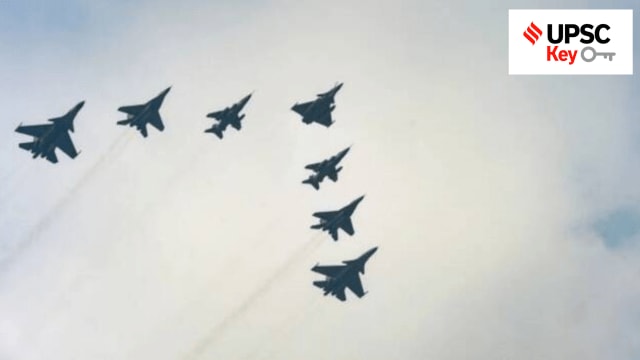
• What’s the ongoing story-The Indian Air Force is preparing to conduct a mega-multilateral exercise later this year that will bring together air forces of 12 nations, thus strengthening military cooperation with them, an official privy to the development said on Wednesday.
• What is air exercise?
• What is Tarang Shakti?
• For Your Information-The exercise, named Tarang Shakti, is slated to be the biggest air exercise to be conducted in India. Participating countries will join the exercise with both military combat jets and transport aircraft, among other assets. Among others, air forces of France, Australia, the US and the UK are likely to participate in the exercise — its location is not known yet. According to officials, the Tarang Shakti exercise will be held in October-November this year — six air forces will participate in the exercise, and the rest will attend as observers. They said the final approval on the exercise from the government is pending. Ahead of Tarang Shakti, the IAF is likely to participate in another exercise in Egypt, officials said.
• Earlier this year, the IAF took part in several joint exercises with many countries-can you recall all those?
• Exercise Orion, INIOCHOS exercise and Cope India-2023-Know about them
• What is the air exercise between India and UK?
• What is the exercise between Indian Army and Indian Air Force?
• What are the benefits of air exercise?
Other Important Articles Covering the same topic:
📍Army, IAF conduct joint multi-domain exercise close to LAC in Northeast
THE EDITORIAL PAGE
Syllabus:
Preliminary Examination: Current events of national and international importance.
Mains Examination: General Studies II: India and its neighbourhood- relations.
Key Points to Ponder:
• What’s the ongoing story-Arun Prakash writes: Prime Minister Narendra Modi’s evocative mention of, “the dark clouds of coercion and confrontation… casting their shadow on the Indo-Pacific,” in his recent address to a joint-sitting of the US Congress, reminded one of Mark Twain’s aphorism that, “history does not repeat itself, but it rhymes”. A similar situation prevailed in early April 1942, as imperial Japan, seeking a “greater Asia co-prosperity sphere,” overran Malaya, Singapore and Burma, and devastated the British Eastern Fleet, sinking the aircraft carrier HMS Hermes off Ceylon. As Japanese bombs fell on the east coast ports of Visakhapatnam and Kakinada, India steeled itself for an invasion.
• “History does not repeat itself, but it rhymes”-Decode the quote
• A similar situation prevailed in early April 1942-What situation prevailed at that time?
• “Rising Asian hegemon”-what you understand by this?
• China, seeking to expand its sphere of influence across the Indo-Pacific and beyond, will the US and India join hands in the spirit of “lend-lease” and agree to mutual use of logistics, repair and maintenance facilities, thus re-writing a “historic rhyme”?
• Rising Asian hegemon vs US Hegemon-compare and contrast
• “China is using the Belt and Road Initiative and the Maritime Silk Road not only to inveigle developing nations via “debt diplomacy”, but also to camouflage its actual aim, which is regional domination”-Elaborate further
• “Debt diplomacy”-What this term implies?
• Sino-Indian discord-Know the historical background
• For Your Information-As far as India is concerned, the roots of Sino-Indian discord go back to China’s annexation of Tibet and the grant of asylum to the Dalai Lama in 1959. The 1962 India-China war resolved nothing and created the anomalous “line of actual control” (LAC). The past few years have seen growing Chinese belligerency along the LAC, accompanied by persistent territorial claims over Arunachal Pradesh, as “Southern Tibet.” Given its growing asymmetry vis-à-vis China in the economic, military and technological domains, and the existence of a menacing Sino-Pakistan military axis, India finds itself in a difficult situation. But despite the balance of power heavily tilted in China’s favour, it is incumbent upon India, as a nuclear weapon state, a significant economic, military and demographic entity, and, above all, a democracy, to stand up to its hegemonic neighbour.
• India-China Relations during Nehruvian Era-Know in detail
• The 1962 India-China War-Know the background
• India-China Border Dispute- Know the background
• What is Line of Actual Control?
• China’s aggressive attitude towards Indo-China Border and What impact can it have on India-China relations?
• Changing dynamics in Indo-China relationships-what are the points of irritation in recent scenario?
• Jingoism and not pragmatism nowadays dominate bilateral relations of India with her Neighbours -do you think so? Attest your opinion with few examples
• Resolving the Sino-Indian imbroglio-How?
Other Important Articles Covering the same topic:
📍Explained: In India-China border dispute, strategic significance of Hot Springs, Gogra Post
📍India-China Galwan faceoff: How serious is the situation, what happens next?
EXPLAINED
Syllabus:
Preliminary Examination: Economic and Social Development and Indian Polity and Governance
Mains Examination:
• General Studies II: Issues relating to poverty and hunger.
• General Studies III: Indian Economy and issues relating to planning, mobilization, of resources, growth, development and employment.
Key Points to Ponder:
• What’s the ongoing story- There is a growing consensus across the world that corporate greed is the new villain in town, spiking inflation even as workers get doubly penalised by low wage increases and higher interest rates. How far is this true? What are the policy implications? And is India also witnessing greedflation?
• What is inflation — and disinflation, deflation and reflation?
• For Your Information-To begin with, inflation (or the inflation rate) is the rate at which the general price level rises. When it is reported that the inflation rate was 5% in June it implies that the general price level of the economy (as measured by a representative basket of goods and services) was 5% more than what it was in June 2022. Disinflation refers to the trend when the inflation rate decelerates. Suppose it was 10% in April, 7% in May and 5% in June. This is disinflation. In other words, disinflation refers to a period when even though prices are rising (or inflation is happening), it is happening at a slower rate each passing month. Deflation is the exact opposite of inflation. Imagine if the general prices level in June was 5% lower than what it was in June last year. That’s deflation. Reflation typically follows deflation as policymakers try to pump up economic activity either by government spending more and/or interest rates being reduced.
• What causes inflation?
• Cost-push inflation or demand-pull inflation-know about this
• How is inflation solved?
• What is the wage-price spiral?
• What is Greedflation and is it happening in developed countries?
• What are the policy implications?
• Is this happening in India?
• So what is contributing to higher profits?
• Do these higher profits point to the existence of greedflation in India?
Other Important Articles Covering the same topic:
📍Everyday Economics: What are WPI and CPI inflation rates?
For any queries and feedback, contact priya.shukla@indianexpress.com
The Indian Express UPSC Hub is now on Telegram. Click here to join our channel and stay updated with the latest Updates.

Read UPSC Magazine