


© IE Online Media Services Pvt Ltd
Tags:


UPSC Weekly Quiz is a current affairs-based quiz on relevant topics from the past week, curated for the aspirants of competitive examinations. Attempt the weekly quiz every Saturday and find answers to the MCQs with explanations.
🚨 Click Here to read the UPSC Essentials magazine for December 2025. Share your views and suggestions in the comment box or at manas.srivastava@indianexpress.com🚨

With reference to the Doppler weather radars (DWRs), consider the following statements:
1. They work on infrared waves.
2. It can provide information on both the position of targets as well as their movement.
3. An X-band radar is used to detect thunderstorms and lightning, whereas a C-band radar helps in cyclone tracking.
How many of the statements given above are correct?
(a) Only one
(b) Only two
(c) All three
(d) None
Explanation
How do Doppler weather radars (DWRs) work?
— In radars, a beam of energy, called radio waves, is emitted from an antenna. When this beam strikes an object in the atmosphere, the energy scatters in all directions, with some reflecting directly back to the radar. Hence, statement 1 is not correct.
— The larger the object deflecting the beam, the greater is the amount of energy that the radar receives in return. Observing the time required for the beam to be transmitted and returned to the radar allows weather forecasting departments to “see” raindrops in the atmosphere, and measure their distance from the radar.
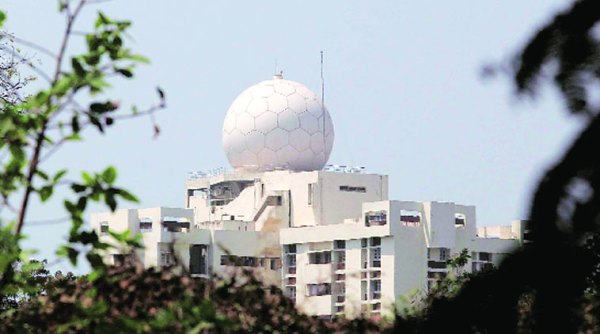
— In India, DWR of varying frequencies — S-band, C-band and X-band — are commonly used by the IMD to track the movement of weather systems and cloud bands, and gauge rainfall over its coverage area of about 500 km. The radars guide meteorologists, particularly in times of extreme weather events like cyclones and associated heavy rainfall. An X-band radar is used to detect thunderstorms and lightning, whereas a C-band radar helps in cyclone tracking. Hence, statement 3 is correct.
— The phase shift in these radars works on the same lines as the “Doppler effect” observed in sound waves, in which the sound pitch of an object approaching the observer is higher due to compression of sound waves (a change in their phase).
— What makes a DWR special is that it can provide information on both the position of targets as well as their movement. It does this by tracking the ‘phase’ of transmitted radio wave pulses; phase meaning the shape, position, and form of those pulses. As computers measure the shift in phase between the original pulse and the received echo, the movement of raindrops can be calculated, and it is possible to tell whether the precipitation is moving toward or away from the radar. Hence, statement 2 is correct.
Therefore, option (b) is the correct answer.
The Reciprocal Exchange of Logistics Support (RELOS) has been signed between:
(a) India and the United States
(b) India and France
(c) India and Italy
(d) India and Russia
Explanation
— The Reciprocal Exchange of Logistics Support (RELOS) was ratified by both houses of the Russian Parliament before receiving presidential approval. It will come into force after the formal exchange of instruments of ratification between Russia and India.
— The agreement sets out procedures governing the movement of military formations, warships and military aircraft between Russia and India, as well as the arrangements for providing logistical support to each other’s forces. It will facilitate the mutual use of airspace by Russian and Indian military aircraft, and has provisions related to port calls by warships of both countries.
— It is designed to regulate not only the dispatch of troops and military equipment, but also the logistics associated with such deployments. This includes support services that may be required when forces from either country operate on the other’s territory.
Therefore, option (d) is the correct answer.
Which of the following Indian banks has a presence in Japan?
1. Punjab National Bank
2. State Bank of India
3. Union Bank of India
4. Bank of India
Select the correct answer using the codes given below:
(a) 1 and 2 only
(b) 2 and 3 only
(c) 1 and 3 only
(d) 2 and 4 only
Explanation
— The growing Japanese presence is expected to bring long-term capital, global best practices and stronger risk management frameworks to Indian financial institutions, while also offering Japanese banks access to one of the world’s fastest-growing financial markets.
— On the other hand, only two Indian banks have a presence in Japan. State Bank of India (SBI) operates two branches—one in Tokyo and another in Osaka—primarily serving corporate clients, handling trade finance, forex, and remittance services, and supporting business ties between India and Japan. Bank of India also maintains two branches in Tokyo and Osaka. BOI’s presence dates back to the early 1950s and focuses on business banking services for Indian and local corporations.
Therefore, option (d) is the correct answer.
With reference to the Santosh Trophy tournament, consider the following statements:
1. It is related to Hockey.
2. It was started in 1941.
3. Haryana has won the Santosh Trophy tournament the maximum number of times.
How many of the statements given above are correct?
(a) Only one
(b) Only two
(c) All three
(d) None
Explanation
— The J&K government has set up an enquiry commission to examine the selection of players for the Santosh Trophy football tournament following allegations of regional and religious bias. Hence, statement 1 is not correct.
— The Senior NFC for Santosh Trophy is the premier Men’s National Football Championship of India. It was started in 1941 and was named after Sir Manmatha Nath Roy Chowdhary of Santosh, the then president of the Indian Football Association. Hence, statement 2 is correct.
— West Bengal are the record 32-time champions of the Santosh Trophy. Hence, statement 3 is not correct.
Therefore, option (a) is the correct answer.
(Other Source: http://www.the-aiff.com)
Which of the following is India’s 1st nature-themed airport terminal?
(a) Lokapriya Gopinath Bardoloi International Airport
(b) Sardar Vallabhbhai Patel International Airport
(c) Chhatrapati Shivaji Maharaj International Airport, Mumbai
(d) Indira Gandhi International Airport, New Delhi
Explanation
— During a two-day visit to Assam, Prime Minister Narendra Modi inaugurated the new terminal building of the Lokapriya Gopinath Bardoloi International Airport in Guwahati. Modi, during his visit, will also inaugurate major infrastructure projects and pay tribute to martyrs of the historic Assam Movement.
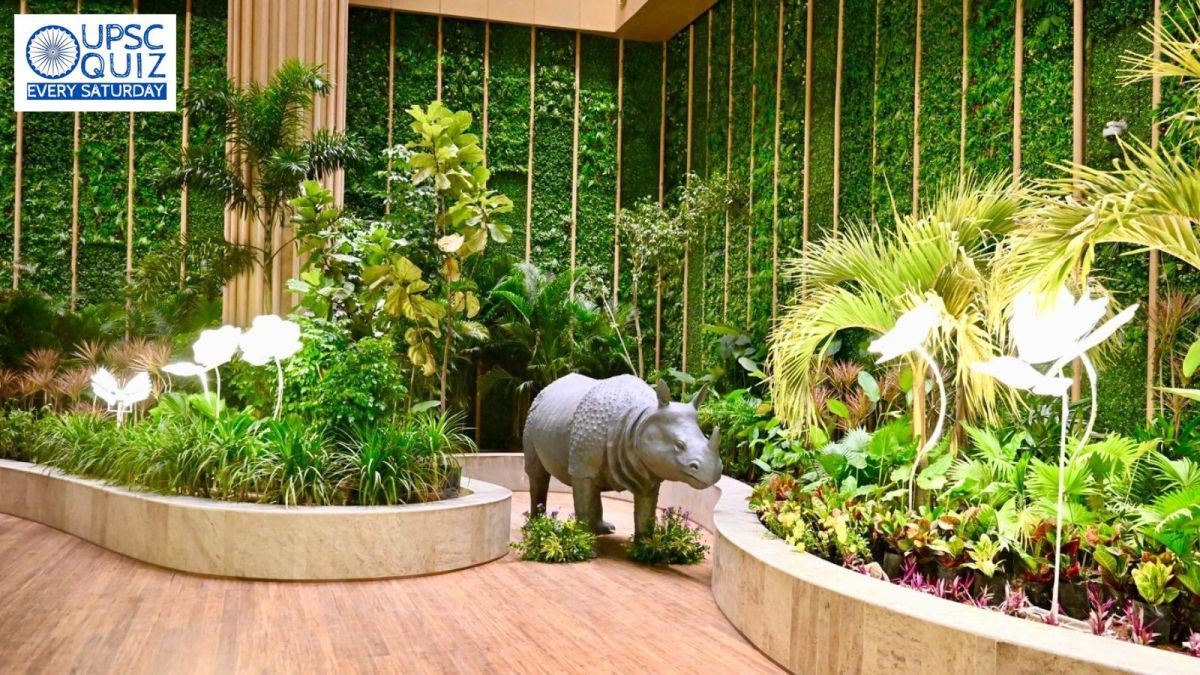
— The new terminal is India’s first nature-themed airport terminal, drawing inspiration from Assam’s biodiversity and cultural heritage under the theme “Bamboo Orchids”.
— A distinctive “Sky Forest,” featuring nearly one lakh indigenous plants, will offer arriving passengers a forest-like immersive experience.
— The terminal also sets new benchmarks in passenger convenience and digital innovation, with features including full-body scanners, DigiYatra-enabled contactless travel, automated baggage handling, fast-track immigration and AI-driven airport operations.
Therefore, option (a) is the correct answer.
With reference to the Pradhan Mantri Kaushal Vikas Yojana (PMKVY), consider the following statements:
1. It is a flagship scheme for skill certification.
2. Between 2015–2022, three versions of the scheme have been implemented with varied approaches and strategy.
3. PMKVY 4.0 scheme of the ‘Skill India Programme’ is being implemented between FY 2024-2029.
How many of the statements given above are correct?
(a) Only one
(b) Only two
(c) All three
(d) None
Explanation
— The use of “11111111111” as the bank account number; the same photograph used for multiple beneficiaries; payouts pending for more than 34 lakh candidates; and shuttered training centres.
— These are some of the glaring irregularities identified by the Comptroller and Auditor General of India (CAG) in the implementation of the Centre’s flagship skills training initiative, Pradhan Mantri Kaushal Vikas Yojana (PMKVY), in three phases from 2015-2022.
— The CAG findings were detailed in an audit report tabled in the Lok Sabha on Thursday. They are significant because PMKVY has been one of the major interventions by the Government to provide skills training to combat joblessness among youth — according to available data, the unemployment rate was 15 per cent in the age group of 15-29 years in May 2025.
About PMKVY
— Pradhan Mantri Kaushal Vikas Yojana (PMKVY) was launched in 2015 to encourage and promote skill development in the country by providing free short duration skill training and incentivizing this by providing monetary rewards to youth for skill certification.
— PMKVY is a flagship scheme for skill certification, being launched to help Indian youth take up industry-relevant skill training to get better livelihoods. Components of this scheme include Short Term Training, Special Projects and Recognition of Prior Learning. Hence, statement 1 is correct.
— Between 2015 – 2022, three versions of the scheme have been implemented with varied approaches and strategies. Hence, statement 2 is correct.
— PMKVY 4.0 under the umbrella scheme of the ‘Skill India Programme’ is being implemented between FY 2022-2026. Hence, statement 3 is not correct.
Therefore, option (b) is the correct answer.
(Other Source: http://www.msde.gov.in)
With reference to the Siliguri Corridor, consider the following statements:
1. The rest of India can only access the seven Northeastern states through this corridor.
2. It is straddled between Nepal and Bangladesh.
Which of the statements given above is/are correct?
(a) 1 only
(b) 2 only
(c) Both 1 and 2
(d) Neither 1 nor 2
Explanation
— The Seven Sisters refer to India’s seven Northeast states. Currently, the rest of India’s only access to the seven Northeastern states is through the narrow Siliguri Corridor, which goes by the apt moniker of “Chicken’s Neck”. Straddled between Nepal and Bangladesh, and only 20 km at its narrowest, this corridor has long posed an economic and a strategic challenge to New Delhi — one that has prompted some experts to call it “an Achilles heel for India”. Hence, statements 1 and 2 are correct.
Therefore, option (c) is the correct answer.
With reference to the India-Jordan ties, consider the following statements:
1. India is Jordan’s largest trading partner in 2023-24.
2. India imports a significant amount of fertiliser from Jordan.
3. India and Jordan do not have an MoU on defence cooperation.
4. This year marks the 75th anniversary of the establishment of diplomatic ties between the two countries.
How many of the statements given above are correct?
(a) Only one
(b) Only two
(c) Only three
(d) All four
Explanation
— Jordan is a significant trading partner for India and political ties have deepened in recent years.
— India is Jordan’s fourth-largest trading partner, with bilateral trade worth $2.875 billion in 2023-24. Hence, statement 1 is not correct.
— India imports a significant amount of fertiliser from the country — making it a key part of India’s food security push — and has also invested in the potash and phosphate sectors there. There is further potential for such investments to secure India’s requirements. Hence, statement 2 is correct.
— India and Jordan also signed an MoU on defence cooperation in 2018. Hence, statement 3 is not correct.
— Jordan is home to an Indian community of around 17,500, mostly in the garment, construction and manufacturing sectors and in the UN and other multilateral organisations.
— This year marks the 75th anniversary of the establishment of diplomatic ties between the two countries. Hence, statement 4 is correct.
Therefore, option (b) is the correct answer.
The Gulf Cooperation Council (GCC) comprises:
1. Bahrain
2. Oman
3. Yemen
4. Qatar
5. UAE
Select the correct answer using the codes given below:
(a) 1, 2 and 3
(b) 2, 3, 4 and 5
(c) 1, 2, 4 and 5
(d) 1, 2, 3, 4 and 5
Explanation
— Indian exporters have also been pushing for better market access in the Arab region due to less stringent standards compared with the European Union (EU). This not only raises the cost of compliance for exporters, but also often acts as a non-tariff barrier (NTB). The Oman deal comes even as talks for a trade deal with the Gulf Cooperation Council (GCC) — which comprises Bahrain, Kuwait, Oman, Qatar, Saudi Arabia, the UAE — did not materialise. India will now have a deal with two members of the GCC, namely, Oman and the UAE.
— Yemen is not a member of the GCC.
Therefore, option (c) is the correct answer.
The Bima Sabko Raksha (Amendment of Insurance Laws) Bill, 2025, seeks to reform India’s insurance framework through changes in:
1. The Insurance Act, 1938
2. The Life Insurance Corporation Act, 1956
3. The IRDAI Act, 1999
Select the correct answer using the codes given below:
(a) 2 only
(b) 3 only
(c) 1 and 2 only
(d) 1, 2 and 3
Explanation
— The amendment will increase the FDI limit in Indian insurance companies from 74% to 100% to attract investment, facilitate technology transfer, increase insurance penetration and social protection.
— To scale up the regulatory framework, the IRDAI will get higher enforcement powers, including the authority to disgorge wrongful gains made by insurers or intermediaries. The Bill gives LIC greater operational freedom, empowering it to set up new zonal offices without requiring prior government approvals, enabling faster expansion, improved administrative efficiency, and better regional oversight.
Therefore, option (d) is the correct answer.
Which of the following bills have not been passed by both the houses of Indian Parliament in the winter session 2025?
(a) The Viksit Bharat – Guarantee for Rozgar and Ajeevika Mission (Gramin) Bill, 2025
(b) The Viksit Bharat Shiksha Adhishthan Bill, 2025
(c) The Sustainable Harnessing and Advancement of Nuclear Energy for Transforming India Bill, 2025
(d) The Sabka Bima Sabki Raksha (Amendment of Insurance Laws) Bill, 2025
Explanation
— During the Winter Session 2025, total of 08 Bills were passed by both the Houses of Parliament:
1. The Manipur Goods and Services Tax (Second Amendment) Bill, 2025.
2. The Central Excise (Amendment) Bill, 2025
3. The Health Security Se National Security Cess Bill, 2025
4. The Appropriation(No.4) Bill, 2025
5. The Repealing and Amending Bill, 2025
6. The Sabka Bima Sabki Raksha (Amendment of Insurance Laws) Bill, 2025
7. The Sustainable Harnessing and Advancement of Nuclear Energy for Transforming India Bill, 2025
8. The Viksit Bharat – Guarantee for Rozgar and Ajeevika Mission (Gramin): VB – G RAM G Bill, 2025
— BILL REFERRED TO THE JOINT COMMITTEE OF BOTH THE HOUSES: The Viksit Bharat Shiksha Adhishthan Bill, 2025
Therefore, option (b) is the correct answer.
The US has demanded the return of “stolen” oil, land, and other assets, referring to the nationalisation of the oil industry in the 1970s of a country that holds the largest proven oil reserves in the world. Which country is being referred to?
(a) Costa Rica
(b) Guatemala
(c) Venezuela
(d) Saudi Arabia
Explanation
— The announcement came days after the US seized a tanker carrying Venezuelan crude off its coast. The US has also demanded the return of “stolen” oil, land, and other assets, referring to the nationalisation of the Venezuelan oil industry in the 1970s.
— Venezuela holds the largest proven oil reserves in the world, estimated at 303-304 billion barrels. Venezuela’s state-owned oil company, PDVSA, generated approximately $17.5 billion in oil sales in 2024. Venezuela uses a shadow fleet of oil tankers to bypass US sanctions.
Therefore, option (c) is the correct answer.
What are ‘Ospreys’ recently seen in the news?
(a) A newly discovered migratory fish species in the Pacific Ocean
(b) A squadron of naval helicopters inducted by the Indian Navy
(c) A new model of autonomous underwater drones used for coral reef mapping
(d) A type of space-based solar power satellite being tested by NASA
Explanation
— The Indian Navy on Wednesday commissioned its second MH 60R helicopter squadron, INAS 335, at INS Hansa in Goa. The squadron has been nicknamed ‘Ospreys’ after the fish-hunting bird of prey. These US-origin Seahawks, maritime versions of the Black Hawk (and distinct from the Bell Boeing V-22 Osprey, an American military transport aircraft), will strengthen India’s anti-submarine and surveillance capabilities and boost blue-water operations.
Therefore, option (b) is the correct answer.
With reference to the post of Chief Information Commissioner (CIC), consider the following statements:
1. The CIC in India is appointed by the President of India based on the recommendation of a selection committee comprising the Prime Minister (Chairperson), the Chief Justice of India, and a Union Cabinet Minister nominated by the PM.
2. Heeralal Samariya has been recently appointed as the CIC of India.
Which of the above given statements is/are correct?
(a) 1 only
(b) 2 only
(c) Both 1 and 2
(d) Neither 1 nor 2
Explanation
— The Chief Information Commissioner (CIC) in India is appointed by the President of India based on the recommendation of a selection committee comprising the Prime Minister (Chairperson), the Leader of the Opposition in the Lok Sabha, and a Union Cabinet Minister nominated by the PM.
— Former Indian Administrative Service (IAS) officer Raj Kumar Goyal was recently sworn in as Chief Information Commissioner (CIC) in the Central Information Commission by President Droupadi Murmu.
— The appointment of Goyal fills the post that has been vacant since September, when the previous CIC, Heeralal Samariya, demitted office.
Therefore, option (d) is the correct answer.
With reference to the Indian Naval Sailing Vessel (INSV) Kaundinya, consider the following statements:
1. INSV Kaundinya is modelled on a fifth-century vessel depicted in the Ajanta cave paintings.
2. The vessel has been constructed using modern shipbuilding techniques and synthetic materials for durability.
3. It is part of an initiative to revive and honour India’s ancient maritime heritage and trading routes.
Which of the statements given above are correct?
(a) 1 and 2 only
(b) 1 and 3 only
(c) 2 and 3 only
(d) 1, 2 and 3
Explanation
— The ‘stitched ship’ — Indian Naval Sailing Vessel (INSV) Kaundinya — sailed from the Naval Base in Karwar to Porbandar on Saturday. The vessel, with a 16-member Indian Navy crew aboard, will cast off from Porbandar for Oman on December 29 on a historic voyage retracing ancient maritime trading routes, as part of an initiative to revive and honour India’s traditional maritime heritage.
— The ‘ancient’ ship, modelled on a fifth-century vessel depicted in a painting in the Ajanta caves, has been recreated using traditional stitching techniques. It was constructed by artisans and traditional shipwrights from Kerala using coconut fibre stitching, traditional wooden joinery, coir rope and natural resins, and is powered by cotton sails. The vessel was inducted into the Indian Navy in May and had been docked at Karwar for trials.
— The project — part of an initiative to revive India’s rich maritime heritage — is being executed through a tripartite agreement between the Indian Navy, the Ministry of Culture and Goa-based shipbuilding company Hodi Innovations (OPC) Private Ltd.
Therefore, option (b) is the correct answer.
UPSC Weekly Current Affairs Quiz | December 07 to December 13, 2025
UPSC Weekly Current Affairs Quiz | November 30 to December 06, 2025
UPSC Weekly Current Affairs Quiz | November 23 to November 29, 2025
UPSC Weekly Current Affairs Quiz | November 16 to November 22, 2025
UPSC Weekly Current Affairs Quiz | November 09 to November 15, 2025
Subscribe to our UPSC newsletter and stay updated with the news cues from the past week.
Stay updated with the latest UPSC articles by joining our Telegram channel – IndianExpress UPSC Hub, and follow us on Instagram and X.


