10 min read
© IE Online Media Services Pvt Ltd
Latest Comment
Post Comment
Read Comments



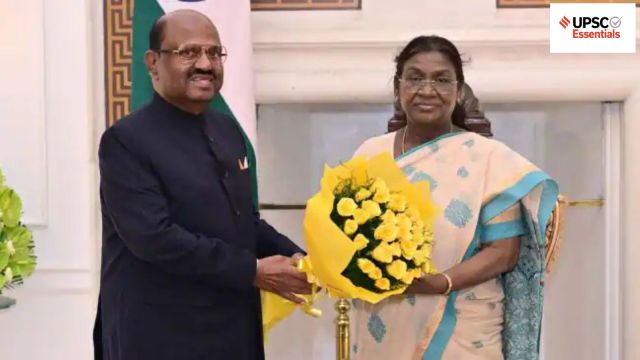 Check your progress and revise your topics through this quiz on Polity and Governance. Find a question on the Governor of an Indian State in today's quiz. (Photo: X/President of India)
UPSC Essentials brings to you its initiative of daily subject-wise quizzes. These quizzes are designed to help you revise some of the most important topics from the static part of the syllabus. Attempt today’s subject quiz on Polity and Governance to check your progress.
🚨 Click Here to read the UPSC Essentials magazine for November 2025. Share your views and suggestions in the comment box or at manas.srivastava@indianexpress.com🚨
Under Article 200 of the Constitution of India, the Governor can:
1. assent
2. withhold assent
3. return the Bill for reconsideration of the Legislature, including Money Bills
4. reserve it for the President
Select the correct answer using the codes given below:
(a) 1 and 2 only
(b) 1, 3 and 4
(c) 1 and 4 only
(d) 1, 2 and 4
Explanation
— In a balancing act, the court ruled out “deemed assent” and said that the judiciary cannot place timelines on the Governor to act on bills, but said that prolonged and unexplained delay can be examined, even if the content of the Governor’s decision was beyond judicial review.
— The powers of the Governor and the President over bills flow from Articles 200 and 201 of the Constitution, respectively. Article 200 allows the Governor to “assent”, “withhold assent”, “return the Bill” or “reserve” it for the President, and requires reservation if, “in the opinion of the Governor”, the bill affects High Court powers. Article 201 sets the President’s options when a Bill is reserved. Hence, 1, 2 and 4 are correct.
— The Governor can return a Bill (other than a Money Bill) for reconsideration under Article 200. Hence, 3 is not correct.
— Over the years, Courts have held that Article 163 binds the Governor to advice except in cases the Constitution itself “carves out” discretion — Article 200 is one such space. The contours of gubernatorial discretion have thus steadily consolidated the principle that the Governor is not a parallel political actor, and has only a few narrow zones to exercise discretion.
Therefore, option (d) is the correct answer.
With reference to the Tribunals, consider the following statements:
1. These are quasi-judicial bodies set up to provide speedy and specialised resolution of disputes.
2. Tribunals are established to reduce the caseload of District courts.
3. Recently, the Supreme Court has approved the Tribunals Reforms Act, 2021.
How many of the statements given above are correct?
(a) Only one
(b) Only two
(c) All three
(d) None
Explanation
— In a significant verdict asserting the judiciary’s role as the final arbiter of constitutional principles, the Supreme Court struck down the Tribunals Reforms Act, 2021. Hence, statement 3 is not correct.
— The judgment marks a decisive moment in the long-running confrontation between the judiciary and the executive over the independence and administration of tribunals, with the court holding that Parliament cannot simply re-enact a law that has already been declared unconstitutional.
— Tribunals are quasi-judicial bodies set up to provide speedy and specialised resolution of disputes, thereby reducing the caseload of high courts. Hence, statement 1 is correct and statement 2 is not correct.
— Passed in 2021, the Tribunal Reforms Act is a law that restructures the functioning of tribunals, giving the Union government greater control over these quasi-judicial bodies — especially in the areas of appointment, tenure, and service conditions of tribunal members.
— A two-judge Bench of Chief Justice of India BR Gavai and Justice K Vinod Chandran declared the Tribunals Reforms Act, 2021, unconstitutional. The court found that the Act was an impermissible “legislative override” of its previous judgments — particularly its July 2021 verdict in the Madras Bar Association (V) case that had struck down identical provisions in an ordinance.
— According to the court, the Act “fails to remove the defects identified in prior judgments and instead reenacts them under a new label”, thereby falling “afoul of the doctrine of constitutional supremacy”.
— Consequently, the court directed that the principles laid down in its earlier judgments, which mandate a five-year tenure for tribunal members and invalidate the 50-year minimum age limit for advocates, will continue to govern all appointments. It also directed the Union government to establish a National Tribunals Commission – an independent body to oversee appointments and functioning of tribunals, which the court has been recommending for years – within four months.
Therefore, option (a) is the correct answer.
The Constitution (131 Amendment) Bill 2025 is related to:
(a) Amending the jurisdiction of the Election Commission of India to hold elections for Union Territories
(b) Introducing reservation of 33% seats for women in the Lok Sabha and State Assemblies
(c) Mandating automatic removal of the Prime Minister, Chief Ministers and Ministers if arrested or detained for 30 consecutive days
(d) Including the Union Territory of Chandigarh under Article 240 of the Constitution
Explanation
— Earlier, a bulletin of the Lok Sabha and Rajya Sabha had stated that the Centre would introduce The Constitution (131 Amendment) Bill 2025 in the upcoming session, to include Chandigarh under Article 240 of the Constitution. This had led to the Aam Aadmi Party and the Congress accusing the Centre of trying to “weaken” Punjab’s claim over Chandigarh.
— Chandigarh is a Union Territory (UT), but is also the shared capital of Punjab and Haryana. The Governor of Punjab currently holds additional charge as the Administrator of the UT of Chandigarh.
— Bringing Chandigarh under the ambit of Article 240 of the Constitution would pave the way for the city to get an independent administrator, like the Lieutenant Governor (L-G) in many other UTs.
— Article 240 of the Constitution lays down the power of the President of India to make regulations for certain Union territories. It says the “President may make regulations for the peace, progress and good government” of the Union territory of the Andaman and Nicobar Islands; Lakshadweep; Dadra and Nagar Haveli and Daman and Diu; and Puducherry when its Legislative Assembly is dissolved or suspended.
Therefore, option (d) is the correct answer.
With reference to the Juvenile Justice (Care and Protection of Children) Act, consider the following statements:
1. The Act applies only to children in conflict with the law.
2. The Act provides for the establishment of Juvenile Justice Boards and Child Welfare Committees at the district level.
3. The Act deals only with criminal matters.
How many of the statements given above are correct?
(a) Only one
(b) Only two
(c) All three
(d) None
Explanation
— Nearly a decade after the Juvenile Justice (Care and Protection of Children) Act, 2015 was enacted to create a child-friendly approach to adjudication and rehabilitation, a new study suggests the system is struggling to meet its statutory mandates.
— The India Justice Report (IJR), in its study titled ‘Juvenile Justice and Children in Conflict with the Law: A Study of Capacity at the Frontlines’, released on November 24, paints a picture of a system grappling with structural deficits, high pendency and opaque data.
— The study highlights that as of October 31, 2023, more than 50,000 children in conflict with the law were awaiting justice. Analysing data from 362 Juvenile Justice Boards (JJBs), the report found that 55 percent of juvenile justice cases filed remained pending.
— This delay contradicts the core philosophy of the Act, which mandates speedy disposal to prevent children from languishing in the system. The report notes the human cost of these administrative failures: “The legislative promise that a child in conflict with the law will have their case disposed of without delay and in a manner that promotes the child’s sense of dignity and worth remains largely unfulfilled: like adult undertrial prisoners, children are left to bear the consequences of an inconsistent system.”
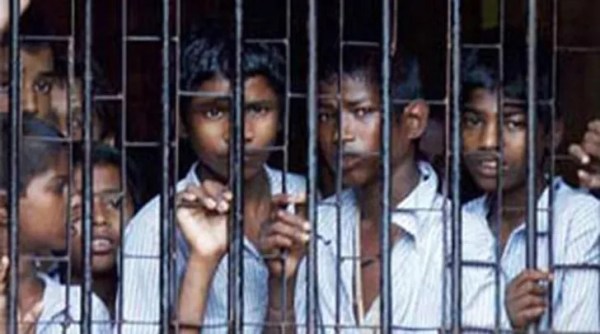 (file image)
About the Juvenile Justice (Care and Protection of Children) Act
— The Act provides for two categories of juveniles – “Children in Conflict with Law” and “Children in Need of Care and Protection.”
— The Act allows juveniles aged 16–18 to be tried as adults for heinous offences after assessment by the Juvenile Justice Board.
— The Act provides for the establishment of Juvenile Justice Boards and Child Welfare Committees at the district level. Hence, statement 2 is correct.
— The Act does not apply only to children in conflict with the law, it also applies to children needing care and protection. Hence, statement 1 is not correct.
— The Act deals not only with criminal matters but also with welfare, adoption, rehabilitation, custody, and protection issues. Hence, statement 3 is not correct.
Therefore, option (a) is the correct answer.
(Other Source: cara.wcd.gov.in)
Which of the following articles of the Constitution of India empowers the Supreme Court (SC) to review its own judgments through review petitions?
(a) Article 137
(b) Article 136
(c) Article 141
(d) Article 142
Explanation
— In a 2:1 ruling, the Supreme Court recalled its judgment in May that struck down a 2017 notification and a 2021 office memorandum (OM) issued by the Ministry of Environment, Forest and Climate Change (MoEFCC). These instruments had created a pathway for projects that began work without prior approval to seek ex post facto environmental clearance.
— Chief Justice of India B R Gavai and Justice K Vinod Chandran held that the May ruling, known as the Vanashakti judgment, was per incuriam, or delivered in ignorance of binding law. Justice Ujjal Bhuyan dissented, saying that the May decision reflected the correct position under environmental law. “[The] concept of ex post facto EC (environment clearance) is in derogation of the fundamental principles of environmental jurisprudence; rather, it is completely alien to environmental jurisprudence,” he noted.
— Article 137 of the Constitution empowers the SC to review its own judgments through review petitions.
Therefore, option (a) is the correct answer.
Daily Subject-wise quiz — History, Culture, and Social Issues (Week 133)
Daily subject-wise quiz — Polity and Governance (Week 137)
Daily subject-wise quiz — Science and Technology (Week 137)
Daily subject-wise quiz — Economy (Week 137)
Daily subject-wise quiz — Environment and Geography (Week 137)
Daily subject-wise quiz – International Relations (Week 137)
Subscribe to our UPSC newsletter and stay updated with the news cues from the past week.
Stay updated with the latest UPSC articles by joining our Telegram channel – IndianExpress UPSC Hub, and follow us onInstagramand X.

Read UPSC Magazine