In a significant verdict asserting the judiciary’s role as the final arbiter of constitutional principles, the Supreme Court Wednesday struck down the Tribunals Reforms Act, 2021.
The judgment marks a decisive moment in the long-running confrontation between the judiciary and the executive over the independence and administration of tribunals, with the court holding that Parliament cannot simply re-enact a law that has already been declared unconstitutional.
Tribunals are quasi-judicial bodies set up to provide speedy and specialised resolution of disputes, thereby reducing the caseload of high courts.
Passed in 2021, the Tribunal Reforms Act is a law that restructures the functioning of tribunals, giving the Union government greater control over these quasi-judicial bodies — especially in the areas of appointment, tenure, and service conditions of tribunal members.
A two-judge Bench of Chief Justice of India BR Gavai and Justice K Vinod Chandran declared the Tribunals Reforms Act, 2021, unconstitutional. The court found that the Act was an impermissible “legislative override” of its previous judgments — particularly its July 2021 verdict in the Madras Bar Association (V) case that had struck down identical provisions in an ordinance.
According to the court, the Act “fails to remove the defects identified in prior judgments and instead reenacts them under a new label”, thereby falling “afoul of the doctrine of constitutional supremacy”.
Consequently, the court directed that the principles laid down in its earlier judgments, which mandate a five-year tenure for tribunal members and invalidate the 50-year minimum age limit for advocates, will continue to govern all appointments. It also directed the Union government to establish a National Tribunals Commission – an independent body to oversee appointments and functioning of tribunals, which the court has been recommending for years – within four months.
The long-running tussle over tribunals
The judgment is the latest chapter in a legislative and judicial back-and-forth that began in 2017. The Finance Act of that year empowered the Centre to frame rules for tribunals, but these were struck down by a Constitution Bench in the 2019 Rojer Mathew case for undermining judicial independence.
When the Centre notified new rules in 2020, they were challenged by the Madras Bar Association. In its decision on the challenge, the Supreme Court reiterated these principles, recommending a five-year tenure.
However, the Centre then promulgated an Ordinance in April 2021 that fixed the tenure at four years and set a minimum appointment age of 50, only for it to be struck down as “arbitrary” three months later. In a direct legislative response, Parliament passed the Tribunals Reforms Act a month later, re-enacting the very provisions the court had declared unconstitutional, leading to the present challenge.
Over more than three decades, the Supreme Court has delivered nine key judgments, starting with the SP Sampath Kumar case in 1987 and extending to the 2021 decision, that have collectively built a strong jurisprudence on the independence of tribunals. Through these decisions, the court has established a set of binding constitutional principles: that tribunals must be independent from their sponsoring departments, that selection committees must have judicial primacy to ensure independence from the executive, that members must have a secure and sufficiently long tenure (of at least five years) and that the high courts’ power of judicial review over tribunals is part of the basic structure of the Constitution.
Why the Act was struck down
The Bench gave three primary reasons for its decision. First, it dismissed the Centre’s last-minute plea to refer the matter to a larger Bench. The court noted that the constitutional questions involved had already been “examined in detail by Constitution Benches” in earlier cases and that the present case “does not present any new or unresolved constitutional question”.
Calling the request a delaying tactic, the court said that deferring adjudication would “only prolong this state of uncertainty, to the detriment of litigants and the administration of justice”.
Second, the court held that Parliament cannot simply overrule a judicial verdict by passing a new law. Citing a series of judgments, it explained that while the legislature can enact a law to “cure the defect” pointed out by a court, it “cannot merely restate or repackage the invalidated provision”. The court found that the 2021 Act was a “verbatim reprise” of the provisions struck down in the 2021 Ordinance and therefore an “impermissible legislative override.”
Third, it rejected the government’s argument that the tenure and age of members were matters of “pure policy” beyond the scope of judicial review. The court explained that while it does not interfere in pure policy, the independence of tribunals is a matter of constitutional principle.
These principles – judicial primacy in appointments, security of tenure for members, and independence from executive control – distilled from the Constitution and the doctrine of separation of powers, are “not abstract judicial preferences” but “constitutional requirements” that any law on tribunals must satisfy, the court held.
Court’s disapproval
The judgment also gave a sharp rebuke to the government for what the court saw as a persistent refusal to adhere to judicial pronouncements, leading to repetitive and avoidable litigation.
“It is indeed unfortunate that instead of giving effect to the well-established principles laid down by this Court… the legislature has chosen to re-enact or re-introduce provisions that reopen the same constitutional debates,” the Bench said. It pointed out that in a judicial system “already burdened with a staggering pendency,” this recurrence of issues “consumes valuable judicial time that could otherwise be devoted to adjudicating matters of pressing public and constitutional importance”.
This institutional standoff has led to long delays in filling vacancies. Government data from December 2022 showed, for instance, 24 vacancies each in the National Company Law Tribunal, which had a sanctioned strength of 32, and the Armed Forces Tribunal, the sanctioned strength of which is 34. In the Railway Claims Tribunal, both posts of vice chairman (judicial) were vacant, as were 16 out of 20 judicial member posts.
The Supreme Court has previously observed that the delays have left tribunals “virtually defunct”. The establishment of an independent National Tribunals Commission, as directed by the court, is seen as a long-term solution to this systemic problem.
With this judgment, the ball is now firmly in the government’s court to either establish the commission or frame a new law that complies with the constitutional framework laid down by the judiciary.

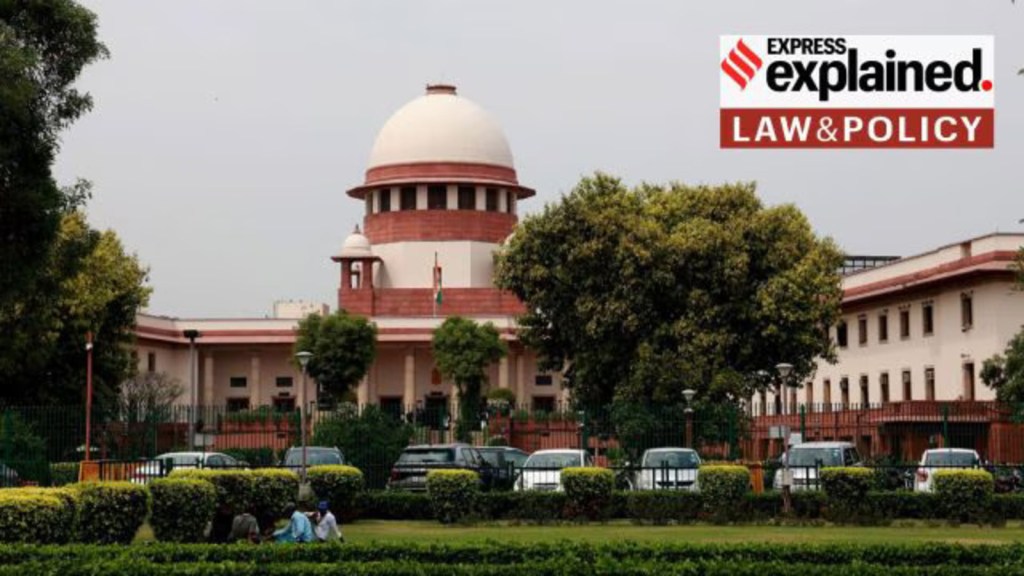 Tribunals are quasi-judicial bodies set up to provide speedy and specialised resolution of disputes, thereby reducing the caseload of high courts. (Express file photo)


 Share


