8 min read
© IE Online Media Services Pvt Ltd
Latest Comment
Post Comment
Read Comments



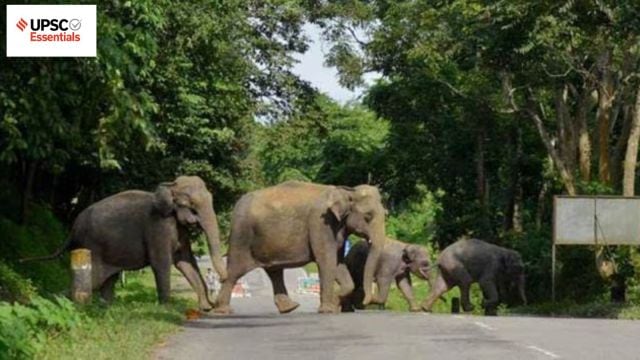 Check your progress and revise your topics through this quiz on Environment and Geography. Find a question on the elephant population in India in today's quiz. (file image)
UPSC Essentials brings to you its initiative of subject-wise quizzes. These quizzes are designed to help you revise some of the most important topics from the static part of the syllabus. Attempt today’s subject quiz on Environment and Geography to check your progress.
🚨 Read the UPSC Essentials magazine of October 2025. Share your views and suggestions at manas.srivastava@indianexpress.com 🚨
1. India’s Asian elephant population in 2025 has increased as compared to the last all-India estimate in 2017.
2. The population of elephants is highest in the North Eastern Hills and Brahmaputra floodplains.
3. Assam has the highest population of elephants in India.
How many of the statements given above are correct?
(a) Only one
(b) Only two
(c) All three
(d) None
Explanation
— India’s Asian elephant population is estimated to be 22,446, according to the results of the much-delayed Synchronous All India Elephant Estimation (SAIEE) 2021–25.
— Compared to the last all-India estimate in 2017 (27,312), the population is lower by 4,065 elephants, or 17.81%. However, the population report added a caveat that the two figures are not directly comparable due to a change in methodology, and said the latest estimate should be treated as a “new baseline.” Hence, statement 1 is not correct.
— As per the latest data, elephant numbers remain highest in the Western Ghats (11,934), followed by the North Eastern Hills and Brahmaputra floodplains (6,559), Shivalik Hills and Gangetic plains (2,062), and Central India and Eastern Ghats (1,891). Hence, statement 2 is not correct.
— Among states, Karnataka continues to harbour the largest population (6,013), followed by Assam (4,159), Tamil Nadu (3,136), Kerala (2,785), Uttarakhand (1,792), and Odisha (912). Hence, statement 3 is not correct.
Therefore, option (d) is the correct answer.
With reference to the tropical cyclone, consider the following statements:
1. These form over warm ocean waters near the equator.
2. These are mainly driven by easterly trades and temperate westerlies.
3. These rotate clockwise in the Northern Hemisphere and anticlockwise in the Southern Hemisphere.
How many of the statements given above are correct?
(a) Only one
(b) Only two
(c) All three
(d) None
Explanation
— Tropical cyclones form over warm ocean waters near the equator. When the warm, moist air from the ocean surface rises upward, a lower air pressure area is formed below. Air from surrounding areas with higher air pressure rushes into this low-pressure area, eventually rising, and it becomes warm and moist. Hence, statement 1 is correct.
— As warm, moist air rises, it cools down, and the water in the air forms clouds and thunderstorms. This whole system of clouds and winds gains strength and momentum using the ocean’s heat, and the water that evaporates from its surface.
— Tropical cyclones are the progeny of ocean and atmosphere, powered by the heat from the sea; and driven by easterly trades and temperate westerlies, high planetary winds and their own fierce energy. Hence, statement 2 is correct.
— Tropical cyclones rotate anticlockwise in the Northern Hemisphere and clockwise in the Southern Hemisphere due to the Coriolis effect. Hence, statement 3 is not correct.
— In India, cyclones are classified by:
(i) Strength of associated winds;
(ii) Storm surges; and
(iii) Exceptional rainfall occurrences.
— The weakest tropical cyclones are called tropical depressions. If a depression intensifies such that its maximum sustained winds reach 39 miles per hour [63 kmph], the tropical cyclone becomes a tropical storm.
Therefore, option (b) is the correct answer.
(Other Source: ndma.gov.in)
With reference to the Air Quality Index (AQI), consider the following statements:
1. There are four AQI categories.
2. Ozone is not measured among the pollutants covered under AQI.
Which of the statements given above is/are correct?
(a) 1 only
(b) 2 only
(c) Both 1 and 2
(d) Neither 1 nor 2
Explanation
— With the temperatures dropping in the country, especially in North India, the air quality is dropping too. The AQI, an indicator of air pollution, is rising quickly in multiple cities. In several cities, the air is nothing short of toxic.
— Madhya Pradesh’s Sagar topped the list of the most polluted cities in India, falling under the ‘poor’ category with an AQI of 264 followed by Sasroli in Haryana’s Jhajjar district with an AQI of 263.
— There are six AQI categories, namely Good, Satisfactory, Moderately polluted, Poor, Very Poor, and Severe. Each of these categories is decided based on ambient concentration values of air pollutants and their likely health impacts (known as health breakpoints). Hence, statement 1 is not correct.
— AQ sub-index and health breakpoints are evolved for eight pollutants (PM10, PM2.5, NO2, SO2, CO, O3, NH3, and Pb) for which short-term (upto 24-hours) National Ambient Air Quality Standards are prescribed. Hence, statement 2 is not correct.
Therefore, option (d) is the correct answer.
(Other Source: cpcb.nic.in)
With reference to the Ghost flowers, consider the following statements:
1. They are known for their ghostly pale white appearance and their unique ability to survive without sunlight.
2. They have an absence of chlorophyll.
3. They rely on underground fungi for sustenance.
Which of the statements given above are correct?
(a) 1 and 2 only
(b) 2 and 3 only
(c) 1 and 3 only
(d) 1, 2 and 3
Explanation
— Ghost flowers are some of nature’s most hauntingly beautiful plants, known for their ghostly pale white appearance and their unique ability to survive without sunlight or photosynthesis. These botanical ‘spectres’ pop up in shaded forests. Hence, statement 1 is correct.
— Ghost flower is the common name for ‘Monotropa uniflora’, also called ‘ghost plant’, ‘Indian pipe plant’, ‘corpse plant’, or ‘ice plant’. Unlike typical green plants, ghost flowers are almost always pure white or pinkish white due to the absence of chlorophyll — the pigment used by plants for photosynthesis. For some lucky observers, rare red varieties may be spotted too. Hence, statement 2 is correct.
— Ghost flowers rely on a completely different tactic — hijacking underground fungi for sustenance. These fungi are connected to tree roots and help exchange nutrients. Hence, statement 3 is correct.
— The ghost flower inserts itself into this partnership and steals carbon and nutrients, living as a parasite in the forest’s networking system, as per a report by Science.org. Because they don’t need sunlight, they thrive in deep, dark woods.
— Bumblebees are the main pollinators of ghost flowers.
Therefore, option (d) is the correct answer.
Barnawapara Wildlife Sanctuary was recently in the news. It is located in:
(a) Madhya Pradesh
(b) Jharkhand
(c) Chhattisgarh
(d) Telangana
Explanation
— In 2018, officials at Chhattisgarh’s Barnawapara Wildlife Sanctuary embarked on an ambitious venture: to revive the blackbuck population 50 years after it had become “locally extinct”.
— It was a gamble: the habitat loss, human encroachment and forest fragmentation that contributed to the animal’s erasure from the state still existed, and officials were unsure if their efforts would pay off. They did – Barnawapara now boasts 190 blackbucks, and officials plan to replicate the conservation model across the state.
— Over the last five years, the Chhattisgarh government has successfully reintroduced the blackbuck – a graceful medium-sized antelope that inhabits open grasslands of India and Nepal – back into the state’s forests through its five-year reintroduction plan. Once found in Barnawapara in Balodabazar district, the blackbuck is listed among endangered species under Schedule I of the Wildlife Protection Act, 1972.
Therefore, option (c) is the correct answer.
Daily Subject-wise quiz — History, Culture, and Social Issues (Week 127)
Daily subject-wise quiz — Polity and Governance (Week 132)
Daily subject-wise quiz — Science and Technology (Week 132)
Daily subject-wise quiz — Economy (Week 132)
Daily subject-wise quiz — Environment and Geography (Week 131)
Daily subject-wise quiz – International Relations (Week 131)
Subscribe to our UPSC newsletter and stay updated with the news cues from the past week.
Stay updated with the latest UPSC articles by joining our Telegram channel – IndianExpress UPSC Hub, and follow us onInstagramand X.


Read UPSC Magazine