7 min read
© IE Online Media Services Pvt Ltd
Latest Comment
Post Comment
Read Comments



 Check your progress and revise your topics through this quiz on Economy. Find a question on cryptocurrency in today's quiz. (Image: Reuters)
UPSC Essentials brings to you its initiative of subject-wise quizzes. These quizzes are designed to help you revise some of the most important topics from the static part of the syllabus. Attempt today’s subject quiz on the Economy to check your progress.
🚨 Click Here to read the UPSC Essentials magazine for December 2025. Share your views and suggestions in the comment box or at manas.srivastava@indianexpress.com🚨
With reference to Cryptocurrencies, consider the following statements:
1. These are issued by the central bank of the country and accepted as legal tender.
2. They have an intrinsic or legislated value.
3. They rely on blockchain technology.
How many of the statements given above are correct?
(a) Only one
(b) Only two
(c) All three
(d) None
Explanation
— Cryptocurrencies are essentially digital tokens, a version of digital currency that allows people to make payments directly to each other online without any intermediaries.
— Traditional currencies like the Indian rupee or the US dollar are called fiat currencies: they are typically issued by the central bank of the country and accepted as legal tender. In contrast, cryptocurrencies do not have any intrinsic or legislated value, and their value is determined by the market demand for and supply of such currency. Hence, statements 1 and 2 are not correct.
— Bitcoin is arguably the best-known cryptocurrency, launched in 2009 by the mysterious Satoshi Nakamoto. It was designed to mimic the features of a cash transaction electronically. Bitcoin and other cryptocurrencies like Ethereum aim to eliminate established intermediaries such as banks to enable instant transactions and reduce costs. To achieve this, they rely on blockchain technology. Hence, statement 3 is correct.
Therefore, option (a) is the correct answer.
Consider the following statements:
Statement 1: Indian exporters have been pushing for better market access in the Arab region.
Statement 2: The move towards the Arab region is due to the less stringent standards compared with the European Union (EU).
Which one of the following is correct in respect of the above statements?
(a) Both Statement 1 and Statement 2 are correct and Statement 2 is the correct explanation for Statement 1.
(b) Both Statement 1 and Statement 2 are correct and Statement 2 is not the correct explanation for Statement 1.
(c) Statement 1 is correct but Statement 2 is incorrect.
(d) Statement 1 is incorrect but Statement 2 is correct.
Explanation
— Amid increasing trade restrictions in the US due to tariffs and in the European Union due to the carbon tax, India is set to sign a trade deal with Oman, aiming to expand its export footprint in West Asia. This aligns with New Delhi’s strategy to rapidly pursue more free trade agreements (FTAs), thereby securing new alternative markets amid continued uncertainty surrounding the trade deal with the US.
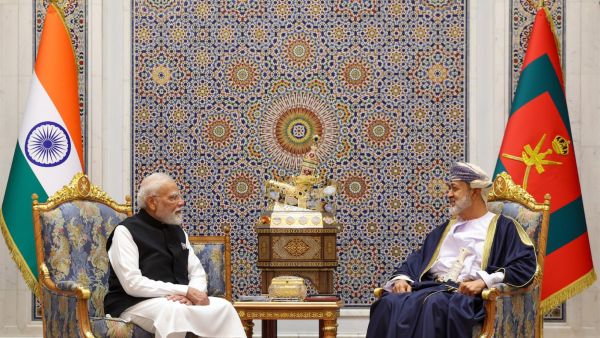 (PMO via PTI Photo)
— Indian exporters have also been pushing for better market access in the Arab region due to less stringent standards compared with the European Union (EU), which not only raises the cost of compliance for exporters but also acts as a non-tariff barrier (NTB). Hence, statements 1 and 2 are correct.
— However, Statement 2 is not the correct explanation for Statement 1, India’s outreach to the Arab region is motivated by strategic, trade diversification, logistics, and geopolitical factors, not merely lower standards.
Therefore, option (b) is the correct answer.
With reference to the Bharat Stage VI (BS VI), consider the following statements:
1. It helps in the reduction of 80 per cent of Particulate Matter emissions as compared to BS III.
2. The emission of NOx (nitrogen oxides) from diesel cars has come down by nearly 70 per cent as compared to BS IV.
Which of the statements given above is/are correct?
(a) 1 only
(b) 2 only
(c) Both 1 and 2
(d) Neither 1 nor 2
Explanation
— Private vehicles that flout the entry ban will be seized. Moreover, vehicles without a valid pollution under control certificate (PUCC) will not be allowed to buy petrol and diesel at fuel pumps in Delhi.
— Bharat Stage VI norms mandate a nearly 80% reduction in Particulate Matter (PM) emissions compared to BS III, mainly due to advanced engine standards and mandatory particulate filters. Hence, statement 1 is correct.
— By using technology like SCR (Selective Catalytic Reduction) and better after-treatment systems, NOx emissions from diesel vehicles have been decreased by roughly 68–70% under BS VI compared to BS IV. Hence, statement 2 is correct.
Therefore, option (c) is the correct answer.
Which of the following countries has faced near-zero real economic growth — averaging around 0.4 per cent between 1999-2000 and 2023-24 — along with persistently low inflation?
(a) Australia
(b) South Korea
(c) Japan
(d) Russia
Explanation
— For over two decades, Japan has faced near-zero real economic growth — averaging around 0.4% between 1999-2000 and 2023-24 — along with persistently low inflation. One of the major challenges for the economy has been an unfavourable demographic shift.
— “The rapid ageing of the population, coupled with a shrinking workforce and limited immigration, has significantly restricted labour supply and reduced the economy’s productive capacity. This decline in labour input and stagnant total factor productivity have weakened Japan’s manufacturing competitiveness, limiting the drivers of medium-term growth,” CareEdge Ratings said in a report.
— SMBC, part of Sumitomo Mitsui Financial Group (SMFG), acquired a 20% stake in Yes Bank for about Rs 13,483 crore (around $1.6 billion). The growing Japanese presence is expected to bring long-term capital, global best practices and stronger risk management frameworks to Indian financial institutions, while also offering Japanese banks access to one of the world’s fastest-growing financial markets.
Therefore, option (c) is the correct answer.
Which of the following occupations have been categorised under agriculture by the Labour Bureau?
1. Plant protection
2. Animal husbandry work
3. Bamboo/basket maker
4. Handicraft worker
5. Logging/wood cutting
Select the correct answer using the codes given below:
(a) 1 and 2 only
(b) 2, 3 and 5
(c) 2 and 5 only
(d) 1, 2 and 5
Explanation
— The Labour Bureau has 12 occupations categorised under agriculture (ploughing/tilling, sowing/planting, watering/irrigation, plant protection, harvesting/threshing/winnowing, picking of commercial crops, horticulture labour, animal husbandry work, crop/produce packaging, logging/wood cutting, inland fishing and coastal/deep-sea fishing).
— The remaining 13 non-agricultural occupations are: Plumber, electrician, mason, weaver, blacksmith, carpenter, tractor/light motor vehicle driver, beedi maker, bamboo/basket maker, handicraft worker, porter/loader, construction labourer and sweeper/cleaner.
Therefore, option (d) is the correct answer.
Daily Subject-wise quiz — History, Culture, and Social Issues (Week 135)
Daily subject-wise quiz — Polity and Governance (Week 141)
Daily subject-wise quiz — Science and Technology (Week 141)
Daily subject-wise quiz — Economy (Week 140)
Daily subject-wise quiz — Environment and Geography (Week 140)
Daily subject-wise quiz – International Relations (Week 140)
Subscribe to our UPSC newsletter and stay updated with the news cues from the past week.
Stay updated with the latest UPSC articles by joining our Telegram channel – IndianExpress UPSC Hub, and follow us on Instagram and X.

Read UPSC Magazine