6 min read


© IE Online Media Services Pvt Ltd



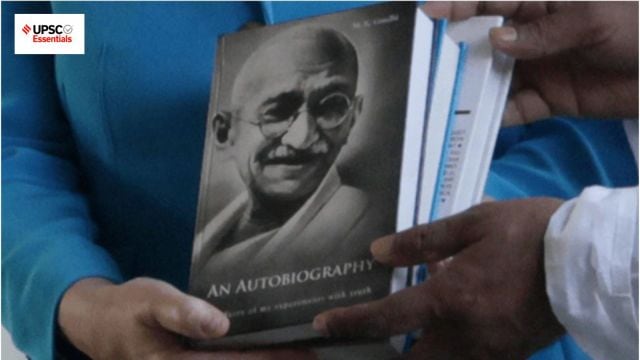 Gandhi’s autobiography completes 100 years, still topping Navajivan’s bestseller list with over one crore copies sold. Find more in our upsc quiz today. (Express photo by Renuka Puri)
UPSC Essentials brings to you its initiative of daily subject-wise quizzes. These quizzes are designed to help you revise some of the most important topics from the static part of the syllabus. Attempt today’s subject quiz on History and Culture to check your progress. Find links to previous History quizzes for UPSC towards the end of the article.
Consider the following statements with reference to Mahatma Gandhi’s autobiography “The Story of My Experiments with Truth”:
1. It was originally written in Gujarati language.
2. Jawaharlal Nehru wrote the preface for the first English translation of Gandhi’s autobiography.
Which of the above given statements is/are true?
(a) 1 only
(b) 2 only
(c) Both 1 and 2
(d) Neither 1 nor 2
— November 29 marked 100 years of the publication of Mahatma Gandhi’s autobiography in Gujarati – Satya na Prayogo Athva Atmakatha – in his weekly journal Navajivan in 1925 in a serialised format. During these 100 years, the autobiography has remained one of the most popular literary pieces from Gujarat and has been translated into around 50 languages across the world.
— On November 29, 1925, the first chapter of Gandhi’s autobiography was published in Navajivan. And the serial ended on February 3, 1929. The autobiography, originally written in the Gujarati language, was published in a total of 166 chapters. In a similar serialised manner, the English translation of the autobiography was published in Young India, another weekly journal published by Gandhi. The first chapter of the English translation was published on December 3, 1925 and ended in the edition of Young India dated February 7, 1929. Hence, statement a is correct.
— The English translation of the chapters, except for chapters 29 to 43, was done by Mahadev Desai, Gandhi’s secretary. He also wrote the first English translation of Gandhi’s autobiography. Chapters 29 to 43 were translated into English by Pyarelal Nayyar owing to Desai’s absence in Bardoli during an inquiry on the Bardoli Satyagraha by the Broomfield Committee in 1928-29. Hence, statement b is not correct.
— The title of the autobiography in Gujarati is ‘Satya na Prayogo athva Atmakatha’ whereas, the title of its English version is ‘An Autobiography or The Story of My Experiments with Truth’.
Therefore, a is the correct answer.
(For more, refer: 100 years of Gandhi’s autobiography by Parimal A Dabhi, The Indian Express)
Consider the following pairs of books and authors:
| Books | Authors |
| 1. From Yeravda Mandir: Ashram Observances | M.K.Gandhi |
| 2. To the Princes and their People | VallabhbhaiPatel |
| 3. The Indian State Problem | Dadabhai Naoroji |
How many pairs given above is/are correctly matched?
(a) Only one of the three pairs
(b) Only two of the three pairs
(c) All three pairs
(d) None of the three pairs
— All three books were written by M.K.Gandhi. In the given question, only the first pair is correctly matched.
Therefore, a is the correct answer.
Consider the following statements:
1. The ‘Aryan Invasion Theory’ for India was propounded by Mortimer Wheeler, who claimed that the Indus Valley Civilization was destroyed by an invasion of Indo-European tribes.
2. The term ‘Aryasatya’ refers to meditative stages that a true Arya practices.
Which of the above given statements is/are incorrect?
(a) 1 only
(b) 2 only
(c) Both 1 and 2
(d) Neither 1 nor 2
— Aryasatya is a foundational concept in Buddhism that refers to the four noble truths. Hence, statement 2 is not correct.
— The ‘Aryan Invasion Theory’ for India was propounded by Mortimer Wheeler, who claimed that the Indus Valley Civilization was destroyed by an invasion of Indo-European tribes. Hence, statement 1 is correct.
Therefore, a is the correct answer.
(For more, refer: The use and abuse of Sanskrit, Ranabir Chakravarti, Express Opinion, The Indian Express)
Consider the following sites of the Indus Valley Civilisation:
1. Banawali
2. Ropar
3. Ganweriwala
What is the correct order of the above-mentioned sites from north to south?
(a) 1-2-3
(b) 2-3-1
(c) 3-1-2
(d) 2-1-3
— Ropar archeological site is located in Punjab, India.
— The Banawali site is located in Fatehabad district of Haryana.
— The Ganweriwala site is located in the Cholistan Desert of southern Punjab, Pakistan.
— The correct order of the above-mentioned sites from north to south is Ropar-Banawali-Ganweriwala.
Therefore, d is the correct answer.
Who is the author of Dashakumaracharita?
(a) Banabhatta
(b) Bharavi
(c) Dandin
(d) Harshvardhana
— Dashakumaracharita was written by Dandin (7th to 8th centuries CE), an ancient Indian author of Sanskrit prose. The book is a collection of stories about the adventures of ten princes, and it is celebrated for its realistic portrayal of society, wit, and humor.
Therefore, c is the correct answer.
Daily Subject-wise quiz — History, Culture, and Social Issues (Week 133)
Daily Subject-wise quiz —International Relations (Week 138)
Daily subject-wise quiz — Polity and Governance (Week 138)
Daily subject-wise quiz — Science and Technology (Week 138)
Daily subject-wise quiz — Economy (Week 138)
Daily subject-wise quiz — Environment and Geography (Week 138)
Daily subject-wise quiz – International Relations (Week 137)
For more MCQs on other subjects and current affairs for UPSC Prelims CLICK HERE.
Subscribe to our UPSC newsletter and stay updated with the news cues from the past week.
Stay updated with the latest UPSC articles by joining our Telegram channel – IndianExpress UPSC Hub, and follow us on Instagram and X.

Read UPSC Magazine