8 min read

© IE Online Media Services Pvt Ltd



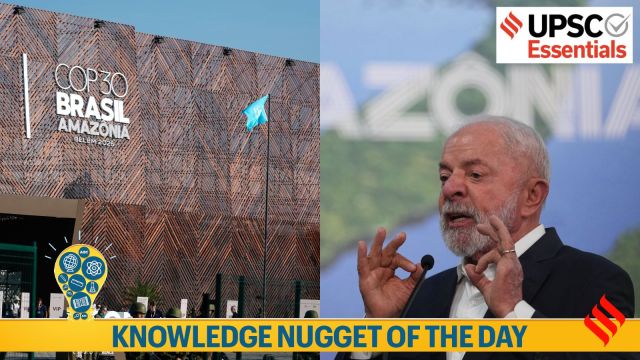 Brazil President Luiz Inacio Lula da Silva speaks during a news conference at the COP30 U.N. Climate Summit, Wednesday, Nov. 19, 2025, in Belem, Brazil. (AP Photo)
Take a look at the essential concepts, terms, quotes, or phenomena every day and brush up your knowledge. Here’s your upsc current affairs knowledge nugget on key takeaways from COP30.
(Relevance: UNFCCC COP is an important event for the fight against climate change. Countries come together to reach an agreement which is widely seen as a litmus test for turning decades of climate pledges into concrete action. Direct questions in the Mains have been asked on the outcomes of COP. Therefore, this topic is quintessential for your Prelims and Mains examination.)
The 30th edition of the Conference of the Parties to the UN Framework Convention on Climate Change (COP30), the annual two-week climate talks, concluded in Belem, Brazil on 22nd November. The Presidency has framed this year’s conference as the “implementation COP,”—was meant to focus less on what the world must do, rather on how to make it all happen.
The conference ended with the adoption of the Belem Political Package. However, the final statement diverged significantly from the earlier draft by removing references to a fossil fuel phase-out and instead focusing on a two-year process to negotiate climate finance, including Article 9.1 obligations. India has welcomed the key outcomes from the conference.
#1 Belem Health Action Plan: It is a flagship outcome of Brazil’s COP 30 Presidency, which was unveiled on the dedicated Health Day of COP30 – 13 November 2025. It is aimed at strengthening global health systems to cope better with the impacts of climate change. It is structured around two cross-cutting principles and concepts: health equity and ‘climate justice’ and leadership and governance on climate and health with social participation.
#2 Tropical Forests Forever Facility (TFFF): Brazil, on 6th November, formally launched the TFFF, which is designed as a “payment-for-performance” model that uses agreed satellite monitoring standards and systems to reward tropical forest countries with a continuing source of funding as long as they preserve their forests.
TFFF aims to mobilise around USD 125 billion through public and private investment, using returns to pay nations that conserve forests. Brazil made the first $1 billion investment in the facility.
#3 Belem Political Agreement: The new draft text on a political package, presented on the last day of the event, skirted each of the four long-standing issues it was meant to resolve, leaving almost everyone unhappy. A group of 29 countries, mainly small island states and those from Europe, rejected the draft text because it skipped any mention of a roadmap on fossil fuel phase-out, which was one of their key demands.
The four key demands were:
(i) Climate-finance obligation: Demand of the developing countries regarding full implementation of the finance provision contained in Article 9.1 of the Paris Agreement.
(ii) Climate-related trade measures: India, China, and some other developing countries have been flagging concerns related to trade-related restrictive measures, such as the European Union’s Carbon Border Adjustment Mechanism (CBAM). They have argued that CBAM is a discriminatory trade practice disguised as climate action.
(iii) Collective Response to the 1.5°C Goal/Fossil Fuels: Developed nations want to see enhanced mitigation actions in pursuit of the 1.5 degrees Celsius global warming target.
(iv) Transparency Reporting Framework: Demand mainly raised by developed countries to have greater transparency in reporting on climate actions.
#4 Santa Marta conference: In a move to push for a global phaseout of fossil fuels, Colombia announced an international conference on Just Transition Away from Fossil Fuels, to be co-hosted with the Netherlands, in Santa Marta on April 28-29, 2026.
The objective of the conference is to explore the legal, economic and social dimensions of phasing out fossil fuels — from trade impacts and subsidy reform to macroeconomic stability, energy security, renewable deployment, and labour transitions.
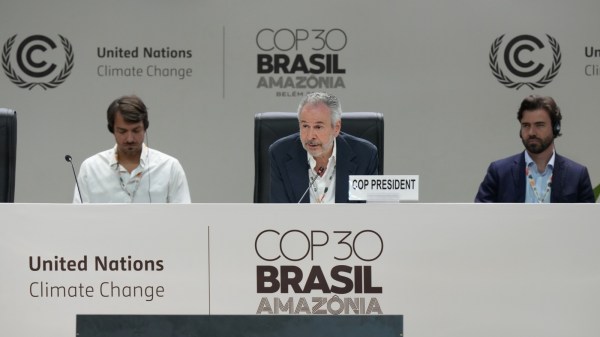 COP30 president André Corrêa do Lago speaks during a plenary session at the climate summit in Belem, Brazil, on Friday. (AP)
#5 The Open Planetary Intelligence Network (OPIN): This is launched for data interoperability, which will accelerate the global climate transformation by unifying critical digital technologies.
#6 The Global Ethical Stocktake (GES): This is yet another significant initiative, which seeks to incorporate moral and ethical considerations and civil society dimensions into the global climate action agenda. Its Asia edition was held in New Delhi this September.
#7 Belem 4x pledge: Belém 4X pledge on sustainable fuel is a “call to action” to accelerate the energy transition and expand the supply of liquid biofuels, biogas, hydrogen, and other inputs. It aims to provide political support and promote international cooperation to increase at least fourfold the use of sustainable fuels by 2035, from 2024 levels.
#8 Belem Declaration on Hunger, Poverty, and People-Centered Climate Action: At the climate summit, leaders from 43 countries and the European Union signed this declaration, placing the world’s most vulnerable populations at the center of global climate policy. The declaration recommends that “countries continue investing in mitigation, while giving greater priority to adaptation—particularly human-centered measures such as social protection, crop insurance, and other instruments that strengthen community resilience.”
#9 National Adaptation Plan (NAP) Implementation Alliance: It is a multistakeholder partnership aimed at accelerating the effective and impactful implementation of National Adaptation Plans (NAP), which was announced at the summit. The Alliance is a part of the Plan to Accelerate Solutions (PAS) within the COP30 Action Agenda which aims to accelerate collaboration between the organizations supporting the implementation of NAPs and mobilize public and private investment to advance national adaptation priorities
#10 Brazil pushes for Mutirao strategy: The Brazilian Presidency of COP30 today unveiled the official Global Mutirão platform within the COP30 website, a new digital entry point to unite and amplify climate action around the world. Mutirao is a Brazilian tradition of collective, community-driven mobilisation — a spirit the Presidency seeks to translate into global climate action. The proposal aims to close the gap between pledges and delivery and serves as Brazil’s high-stakes blueprint for COP30, centred on accelerating progress in energy, finance, and trade.
1. Turkiye will be the host country of COP31 next year. Australia and Turkiye both expressed their interest in hosting the COP31. Interestingly, the host for COP is not decided by vote. It has to be a consensus decision. That means one of the candidates has to eventually withdraw.
2. The host for the COP32 was announced at Belem. Ethiopia has been confirmed as the host of the 32nd edition of the annual climate change conference (COP32) in 2027. It will be organised in its capital city, Addis Ababa.
3. Meanwhile, India has expressed its intention to host the COP33 event in 2028, when the conference returns to the Asia region. If allocated, it would be the second time that India will host a COP. New Delhi had hosted COP8 in 2002.
4. The COP meetings are held by rotation in five UN-designated geographical regions – Africa, Asia-Pacific, Eastern Europe, Latin America and Caribbean, and Western Europe and Others. Countries volunteer to host the event. But if there are more than one candidate, the respective geographical region selects one by consensus.
Consider the following statements:
1. The first ever COP took place in Berlin, Germany, in 1995.
2. The Tropical Forests Forever Facility (TFFF) was launched at COP30.
3. Ethiopia’s capital Addis Ababa, has been confirmed as the host of COP31.
Which of the above-mentioned statements is/are correct?
(a) 1 and 2 only
(b) 2 and 3 only
(c) 1 and 3 only
(d) 1, 2, and 3
| Answer key |
| (a) |
(Sources: Five things you need to know about Conference of the Parties (COP), the world’s biggest climate meeting, COP29: Why it matters and what is the history behind it, Carbon markets, NCQG, Paris Agreement: As COP29 begins, climate jargon you need to know, cop30.br, unfccc, wri.org)
Subscribe to our UPSC newsletter. Stay updated with the latest UPSC articles by joining our Telegram channel – IndianExpress UPSC Hub, and follow us on Instagram and X.
🚨 Click Here to read the UPSC Essentials magazine for November 2025. Share your views and suggestions in the comment box or at manas.srivastava@indianexpress.com🚨

Read UPSC Magazine