


© IE Online Media Services Pvt Ltd
Tags:


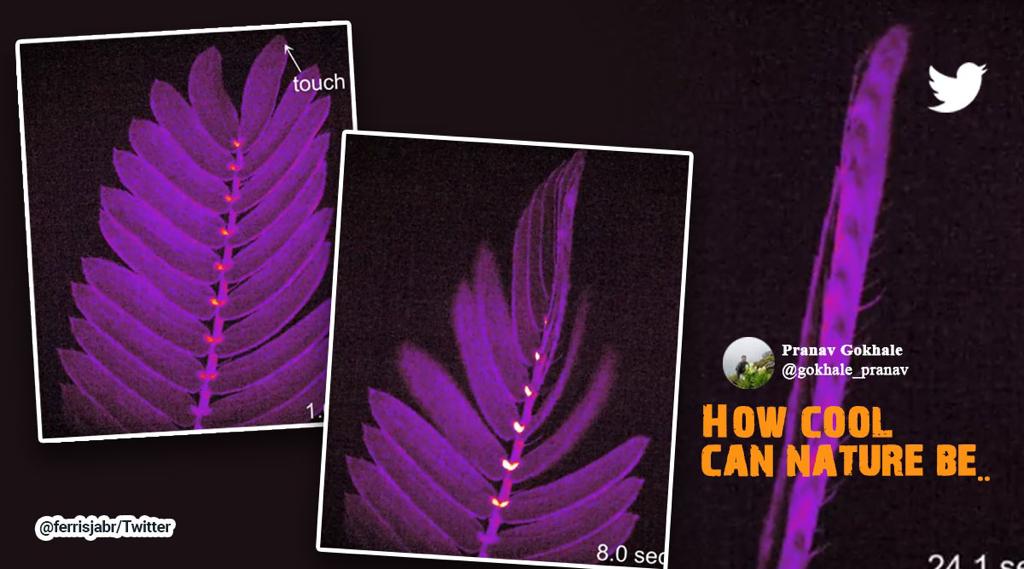
Mimosa pudica that folds its tiny leaves in response to the slightest of touches is one of the most fascinating plants in the world. It is found in tropical and semi-tropical environments around the world and goes by many local names such as ‘chuimui’, ‘hilahila’, and ‘lozzaboti’.
On Saturday, a science writer shared videos that captured how ‘electrical signals’ within the plant trigger its folding effect. Ferris Jabr shared the videos that were taken by Japanese scientists for a 2022 study published in Nature Communications, a scientific journal.


To explain this behaviour further, Jabr said, “Although plants don’t have neurons or muscles, they are electric—all cellular organisms are. Plants can generate waves of charged particles that travel quickly from one part of their body to another and trigger quick movements”.
His tweets soon gathered thousands of views and likes. Commenting on Jabr’s tweets, a Twitter user wrote, “Wow! Amazing video. I grew up in Hawaii, where M. pudica is known as “Hilahila”, meaning ‘bashful’ or ‘ashamed’. It is a common and much-despised weed there.”
Another person said, “I first saw this plant as a child at a museum and I was always disappointed when I encountered a similar-looking plant when out and about that did not exhibit the same ‘behavior’. Also, I never thought about plants as having electrical signals. So cool!”


