3 min read
© IE Online Media Services Pvt Ltd



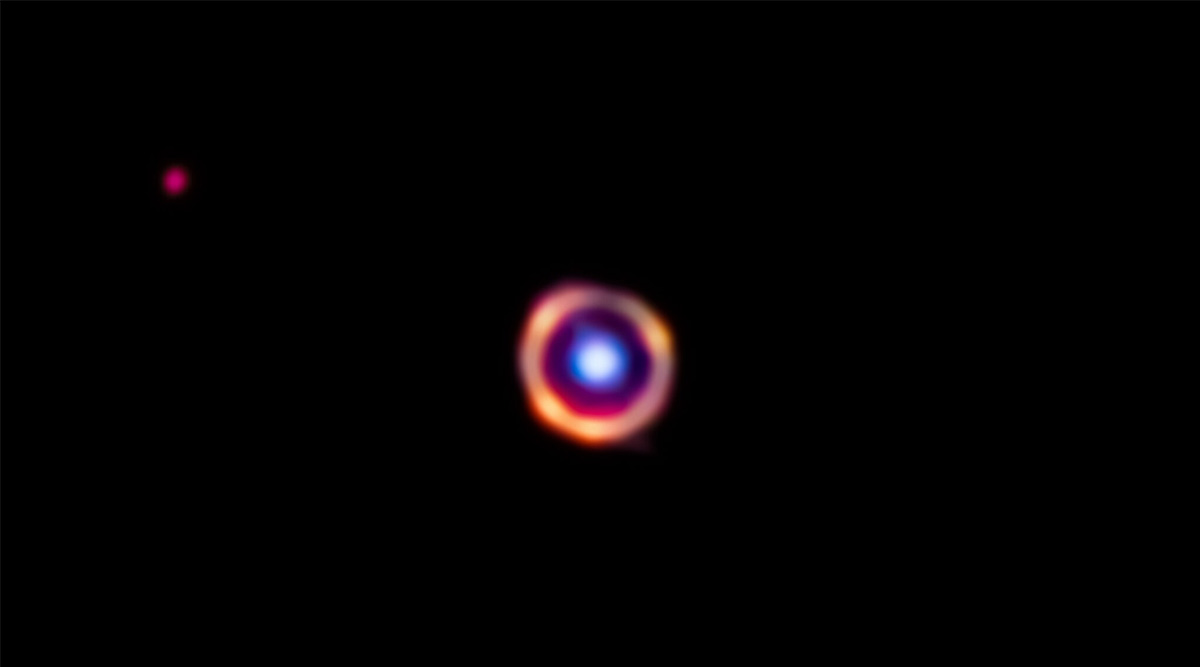 The distant galaxy is visible in the shape of an Einstein ring because of a phenomenon called "gravitational lensing." (Image credit: J. Spilker/S. Doyle, NASA, ESA, CSA)
 An international team of astronomers have used the James Webb Space Telescope to detect organic molecules in the most distant part of the universe to date using the James Webb Space Telescope. The kind of molecules discovered are abundant on Earth in the form of smoke, soot and smog.
The researchers used the Webb telescope to find organic molecules in a galaxy that is more than 12 billion light years away, according to the University of Texas A&M. Since the galaxy is that far, it means that the light took 12 billion years to reach the telescope. This means that astronomers are observing the galaxy as it was at the time–when the universe was less than 1.5 billion years old.
Apart from the impressive prowess of the Webb telescope, the researchers also got a little help from a phenomenon called gravitational lensing. When you are observing a distant cosmic object, if there is a massive galaxy in between that and you, the foreground galaxy will bend and distort the light from behind it, effectively creating a lens that will allow you to see the distant object better.
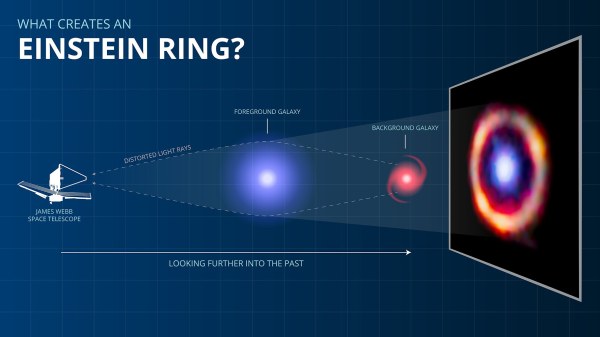 How gravity lensing can create an Einstein ring. (S. Doyle/J. Spilker)
In this particular case, the light from the background galaxy is stretched and magnified into a round-ish shape known as an Einstein ring. Albert Einstein originally predicted the phenomenon of gravitational lensing in his theory of relativity. The research was published in an article yesterday in the journal Nature.
In the data from Webb, researchers found the signature indicating the presence of large organic molecules like that found in smog and smoke.
“These big molecules are actually pretty common in space. Astronomers used to think they were a good sign that new stars were forming. Anywhere you saw these molecules, baby stars were also right there blazing away,” said Justin Spilker, lead author of the article, in a press statement.
But the new research shows that this idea may not always be true, according Spilker. In the high-definition images from Webb, the researchers saw a lot of regions with “smoke,” but no star formation and others with news stars forming but no smoke.