3 min read
© IE Online Media Services Pvt Ltd



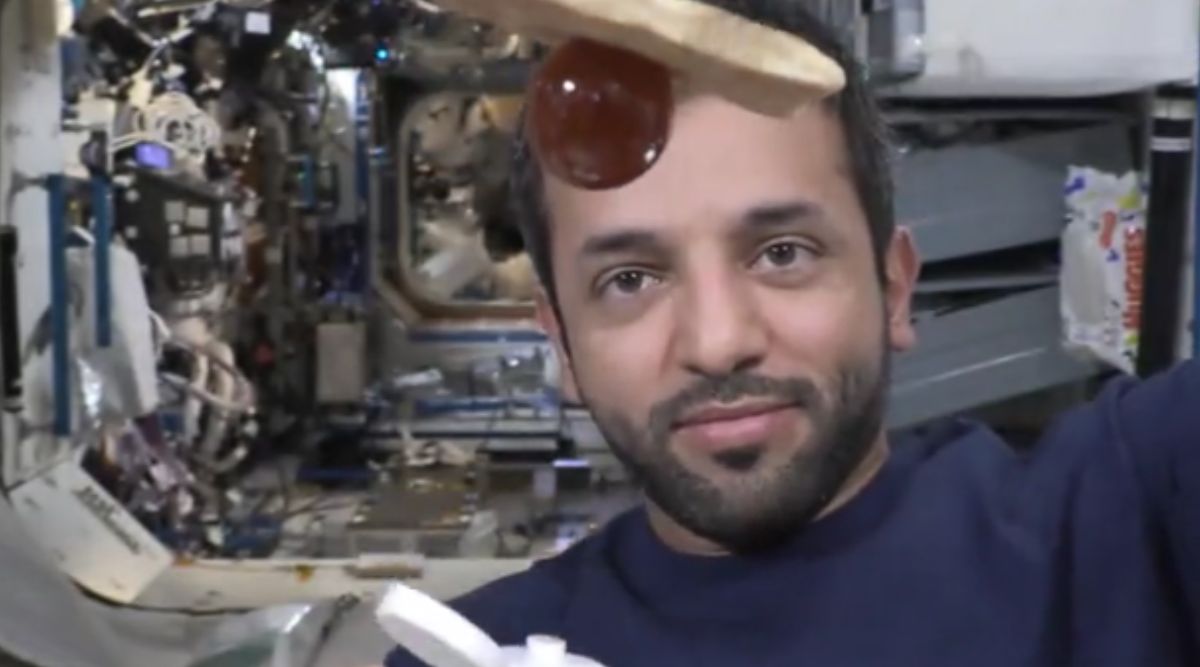 Do you know why the honey forms a spherical blob in space? (Sultan AL Neyadi via Twitter)
 United Arab Emirates (UAE) astronaut Sultan Al Neyadi, the first Emirati astronaut to go on a long-term space mission, shared a video on X (formerly Twitter) of him making and taking a bite out of a honey sandwich on the International Space Station (ISS). The Emirati honey behaves in a fascinating manner once it leaves the bottle.
In the video, Al Neyadi squeezes out a big blob of honey onto what looks like the kind of flatbread eaten by astronauts in space. Interestingly, the normal loaves of bread that we are used to here on Earth is not allowed on space missions because they can create crumbs that can become unmanageable.
Once squeezed out of the bottle in the zero-gravity environment of the ISS, the honey seems to form a circular blob of its own accord before it “sticks” to the piece of bread. Al Neyadi then waves around the piece of bread but the blob of honey continues to stick to the piece of bread.
Have you ever wondered how honey forms in space? 🍯
I still have some Emirati honey left that I enjoy from time to time. Honey has many benefits, especially for the health of astronauts. pic.twitter.com/RrjQYlNvLD— Sultan AlNeyadi (@Astro_Alneyadi) August 20, 2023
All kinds of liquids, including honey water, have a tendency to form spheres when there is a negligible amount of gravity acting on them. Without the effect of gravity, one of the main forces acting on the honey is its surface tension. As you can probably guess from the name, surface tension refers to the tension of the surface of a liquid caused by the attraction of its own molecules.
Surface tension forces the liquid to minimise the surface area in contact with the other “phase,” which in this case is the air in the space station. The shape which can have the lowest surface area for that set volume of liquid is a sphere.
Also, did you know that Earth’s gravity still has a strong influence on ISS? At the altitude at which the space station orbits, the effect of our planet’s gravity is about 90 per cent of that on its surface, according to NASA. But because the space station is essentially “falling” continuously towards and around Earth, the objects within the space station have no gravity affecting them with respect to ISS.