4 min read
© IE Online Media Services Pvt Ltd



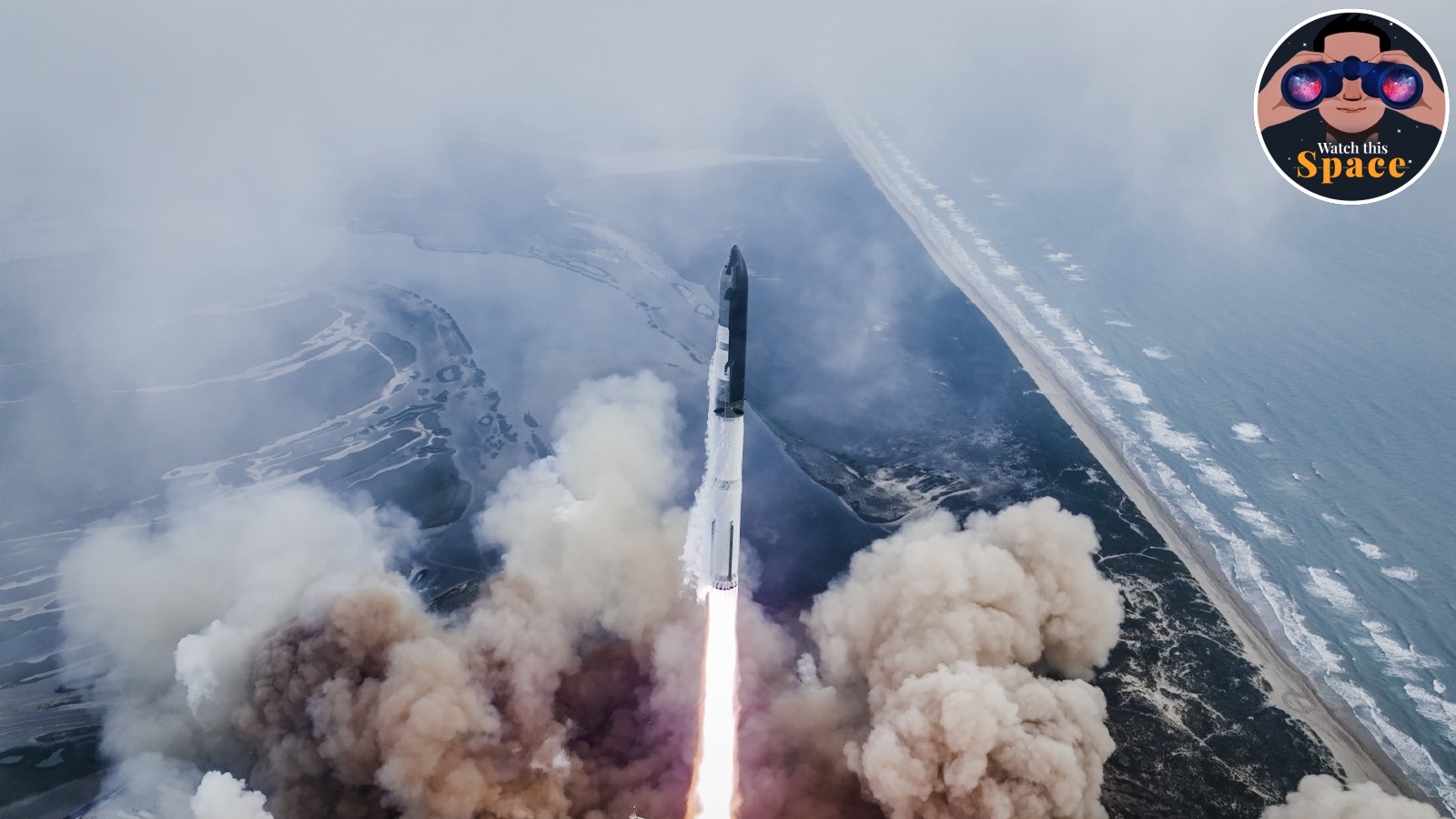 Starship launching for the third time (Image credit: Elon Musk/X)
It was a big week for SpaceX. Starship, the most powerful rocket in the world built by the company, had its third test launch on Thursday and unlike the previous two attempts, it did not explode. That is a big success for the Elon Musk-led company despite the fact it lost the actual spacecraft when it tried to re-enter Earth. While SpaceX lost a Starship, NASA is pulling out all stops to ensure that it does not lose Voyager 1, the most distant man-made object in space.
But surely, not exploding is a very low bar for a rocket? Well, not really. It is almost as if rockets love to explode. In fact, the day before the third Starship launch, Kairos, a privately-built Japanese rocket, exploded shortly after take off. And Kairos is not particularly large; its size means that it is dwarfed by the likes of SpaceX’s Falcon 9. And the thing is, Falcon 9 is a child’s playtoy compared to Starship.
Flight 3 liftoff as viewed from the top of the tower pic.twitter.com/JPlXDBONAb
— SpaceX (@SpaceX) March 15, 2024
Once it is done testing, not only will it be the biggest rocket in human history but it will also be the most powerful. The launch system will be capable of carrying 150 metric tonnes in reusable mode and 250 tonnes in expendable mode, according to the company.
The Super Heavy booster, which is the first stage of the Starship system, is powered by an unprecedented 33 Raptor engines that can provide close to 7,600 tons of thrust. The Starship spacecraft, the second stage of the system that will actually carry cargo or astronauts, will have six Raptor engines, three of which are specially designed to work in the vacuum of space.
SpaceX is adding simply mind-boggling numbers of extremely-powerful rocket engines to the Starship system. Considering the fact the company is doing something that has never been done before, an explosion would have been a more likely outcome than an almost-completely-successful flight, which is what we got to see.
Also, unlike government space agencies like NASA and others, SpaceX is a startup. This also means that they follow the startup mantra of failing faster and reiterating. Where NASA would try to get everything right and will delay missions until they are actually sure, SpaceX would prefer to get the mission done, even if it goes wrong, so they can learn from it and reiterate.
Despite their diametrically opposite approaches, NASA and SpaceX are very dependent on each other. SpaceX is very dependent on NASA funding to develop Starship while the success of NASA’s Artemis missions, which will put humans back on the Moon after nearly half a century, hinges upon the Elon Musk-led company’s ability to complete work on Starship in time.
In the same week that NASA lost Starship, NASA “regained” the Voyager 1 probe, which is the first spacecraft to go beyond the heliosphere into interstellar space and still continues to be the farthest man-made object in space. At the time of writing, the robotic spacecraft is more than 24 million kilometres away from our planet. To put that into perspective, that is more than 162 times the distance between the Earth and the Sun.
An update on my twin #Voyager1: The team recently sent a "poke" to prompt V1's flight data system (FDS) and received a signal that differed from past attempts. A DSN engineer helped decode this signal, which may contain clues to the source of the issue: https://t.co/tDWLtmu6D2 pic.twitter.com/fwL59We1nf
— NASA Voyager (@NASAVoyager) March 13, 2024
But since November 2023, NASA teams have only received what they are calling “incoherent” data from the spacecraft. After months of fear that the pioneering spacecraft may be lost after half a century of service, NASA finally has clues about what is going wrong with Voyager 1, and might be on the way to solving the issue.
Interestingly, if we lost the spacecraft, it would not be as big of a scientific loss as it would be an emotional one. Voyager 1 and its sibling Voyager 2 were launched in 1977 for a mission that was originally supposed to last for five years. It has since outlived its mission span by more than 40 years. When was the last time you bought something for five years that lasted for nearly 50?