4 min read
© IE Online Media Services Pvt Ltd



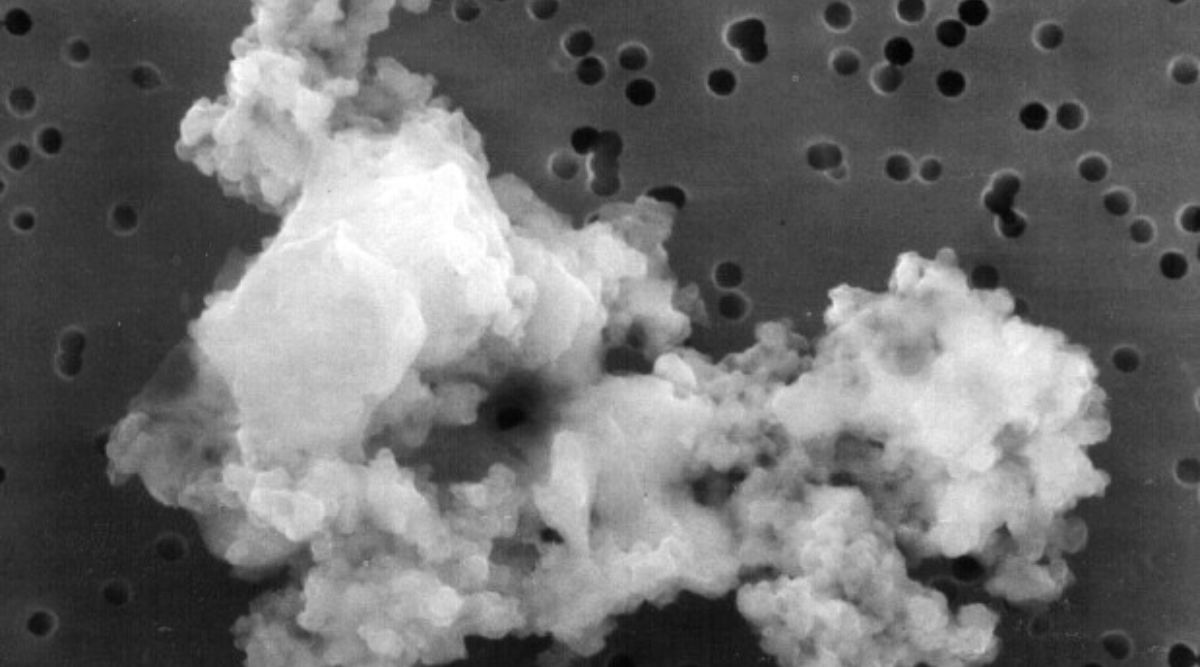 This piece of space dust is thought to be part of the early solar system and was found in our planet's atmosphere/ (Image credit: NASA via University of Tokyo)
Space dust and debris from other planets could contain traces of alien life, according to a new study. This could mean that capturing and finding space dust from other planets could be the best way to find signs of extraterrestrial life.
In a research article published in The International Journal of Astrobiology, Tomonori Totani, an astronomy professor at the University of Tokyo wrote that searching for signs of life from outside our solar system is important to understand life on Earth and its origin.
According to Totani, while astronomical observations might be able to find life signatures, it will be impossible to claim “unambiguous detection of life” by remotely observing planets. That is where the space dust comes in.
“I propose we study well-preserved grains ejected from other worlds for potential signs of life. The search for life outside our solar system typically means a search for signs of communication, which would indicate intelligent life but precludes any pre-technological life. Or the search is for atmospheric signatures that might hint at life, but without direct confirmation, there could always be an explanation that does not require life,” said Totani in a press statement.
When other planets are impacted by asteroids or other celestial objects, the collision will eject ground material into space. When this happens, there is a small chance that recently dead or even fossilised microorganisms could be contained in this ejected material.
This ejected material will vary in size and its behaviour in space is dependent on the sizes of their components. The larger pieces of the ejected material could fall back down to the original planet or end up orbiting a local star or another planet. The smallest pieces could be too small to contain any verifiable signs of life.
But according to Totani, a space dust grain that is approximately 1 micrometre in size could be the perfect candidate to bring signs of life to Earth. Not only can they host a specimen of a single-celled organism, they can also potentially escape their solar system, and under the right circumstances, reach ours.
“My paper explores this idea using available data on the different aspects of this scenario. The distances and times involved can be vast, and both reduce the chance any ejecta containing life signs from another world could even reach us. Add to that the number of phenomena in space that can destroy small objects due to heat or radiation, and the chances get even lower,” explained Totani.
Despite this, the paper estimates that around 100,000 such extraterrestrial grains, with the potential to carry alien life, could land on Earth every year. But because of the various unknowns involved, Totani admits that this number could possibly be too high or even too low.
The paper proposes that these grains from exoplanets could be collected using detectors based in space. Such detectors can use a low-density medium like silica aerogel, which can capture speeding particles by decelerating them slowly. This slow deceleration could help reduce the chances of any potential biosignature being damaged.
Another method of collecting this space dust could be by searching for them on Earth. While looking for dust particles from space on a planet made of dust might sound somehow worse than looking for a needle in a haystack, that is not necessarily the case.
Particles that are around the size of 1 micrometre can survive entering our atmosphere without any severe heating. This could mean that any potential biosignatures will not be seriously damaged.
Meteorites are often discovered in the ice in Antarctica. But the majority of the extraterrestrial material that arrives on Earth are sub-millimetre particles. Future technologies could be used to locate such particles in the right locations on Earth.