3 min read
© IE Online Media Services Pvt Ltd



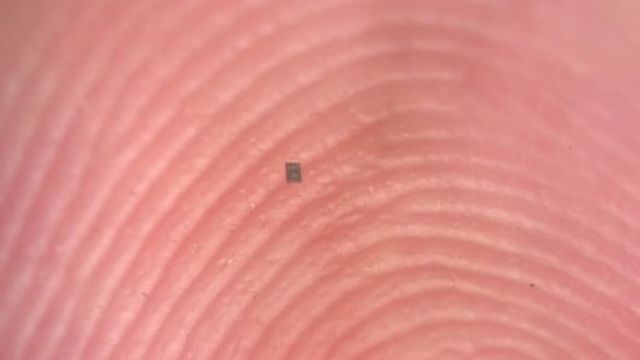 This image is for context of how small the robot is when placed on the finger tip. (Image: University of Pennsylvania )
Researchers at the University of Pennsylvania have unveiled what they describe as the world’s smallest fully programmable, autonomous robots, marking a major step forward in microscale robotics. Barely visible to the naked eye, each robot measures around 0.2 by 0.3 by 0.05 mm, placing it at the scale of many microorganisms. Despite their tiny size, the robots can sense their surroundings, move in complex patterns, and operate independently for months—all at a cost of roughly one penny per unit.
The robots combine engineering breakthroughs from two institutions. While the propulsion system was developed at Penn, the ultra-low-power “brain” was created at the University of Michigan. Together, the technologies allow the robots to swim through liquid environments, respond to temperature changes, and even coordinate their movements in groups, similar to a school of fish.
According to Marc Miskin, assistant professor of electrical and systems engineering at Penn, shrinking autonomous robots by a factor of 10,000 opens an entirely new frontier for programmable machines operating at microscopic scales.
One of the biggest challenges in building robots this small has been movement. At the microscale, water behaves less like a fluid and more like thick tar, making propulsion extremely difficult. To overcome this, the Penn team designed a system that moves the surrounding water instead of the robot itself. By generating an electric field, the robots nudge ions in the liquid, which then push nearby water molecules and create forward motion. With no moving parts involved, the robots are highly durable and can swim continuously for months.
Powering intelligence at this scale required a radical rethink of computing. The University of Michigan team developed tiny computers that run on just 75 nanowatts of power—far less than any consumer wearable device. Solar panels occupy most of the robot’s surface, and the program instructions were condensed so dramatically that complex propulsion control could be handled by a single specialised instruction. The robots are powered and programmed using pulses of light, and each one carries a unique identifier, allowing individual robots in a group to be assigned different tasks.
Equipped with temperature sensors with a precision of plus or minus one-third of a degree Celsius, the robots can move towards warmer areas or report temperature changes as a proxy for cellular activity. They communicate these readings by wiggling, a behaviour likened to the waggle dance used by honeybees. Researchers say such capabilities could one day help monitor the health of individual cells or assist in assembling microscale devices.
While the current generation of robots already demonstrates sensing, computing, and motion in an almost invisible package, the researchers see this as only the beginning. Future versions could carry more advanced programs, additional sensors, and operate in harsher environments, laying the groundwork for a new era of intelligent robotics at the smallest scales imaginable.