3 min read

Journalism of Courage



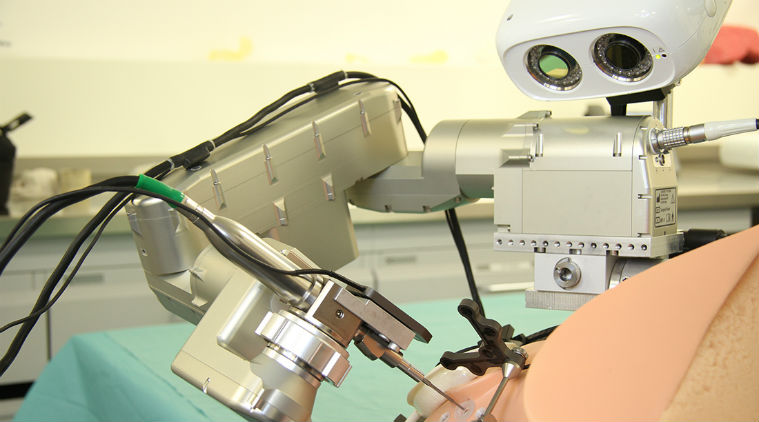 The surgical system involves a robotic drill optimised for arguably the riskiest part of the surgery – drilling a tunnel deep through skull bone into the inner ear. (Source: University of Bern)
In a first, a robot has successfully assisted in a risky surgery that involved placing a tiny hearing implant in the inner ear with unprecedented precision. A 51-year-old woman seeking assistive hearing surgery became the first patient to undergo robot-assisted cochlear implantation in a clinical trial.
The surgical system involves a robotic drill optimised for arguably the riskiest part of the surgery – drilling a tunnel deep through skull bone into the inner ear. This robot drills with the highest degree of accuracy yet reported for a medical device of its kind, and is equipped with a plethora of safety measures, including an optical camera that can track the robot on a scale of 25 microns -less than the width of a human hair.
“Our procedure is a first step towards a more minimally invasive (surgical) approach. We expect to achieve better and more consistent outcomes for hearing implants when the surgery is conducted with the robot,” said Stefan Weber, professor at the University of Bern in Switzerland.
Cochlear implantation involves feeding a thin (0.3 to 1 millimetre in diameter) hearing-assistive electrode through a tiny surgically drilled tunnel into the cochlea, the shell-shaped hollow hearing centre of the inner ear. Surgeons must bore the tunnel through the cramped space of the middle and inner ear without disrupting nearby facial and taste nerves only micrometres away from the tunnel route.
“Between the two nerves, we have 2.5 millimetres of space, and in this space we need to drill 1.8 millimetres of a hole. So we only have 0.5 to 0.7 millimetres on both sides, and therefore we need to be super, super precise,” Weber said. The limits of human abilities are tested while working on this microscopic scale, in which the slightest imprecise movement can cause irreparable damage.
As a result, of the 65,000 human-operated cochlear implants inserted globally each year, about 30 to 35 per cent of patients lose of residual hearing in the implanted ear. Robotics has the potential to provide dexterity and perception surpassing that of a human surgeon. The procedure begins with a robust computer analysis of the patient’s skull structure, in order to personalise the robotic treatment plan.
Also Read: ‘Robots may help provide social care for elderly’
This blueprint, along with several safety measures woven into the procedure before, during and after the surgery, verifies that the robot is drilling in the correct location. Most importantly, the robotic portion of the system contains sensors that each confirm the robot is a safe distance away from critical structures and not damaging surrounding tissues.
The robot tracks its movements at a scale less than the width of a human hair with an optical camera. The robotic drill was able to safely form a tunnel precisely 1.8 millimetres in diameter with an unprecedented accuracy. The research was published in the journal Science Robotics.