4 min read
© IE Online Media Services Pvt Ltd



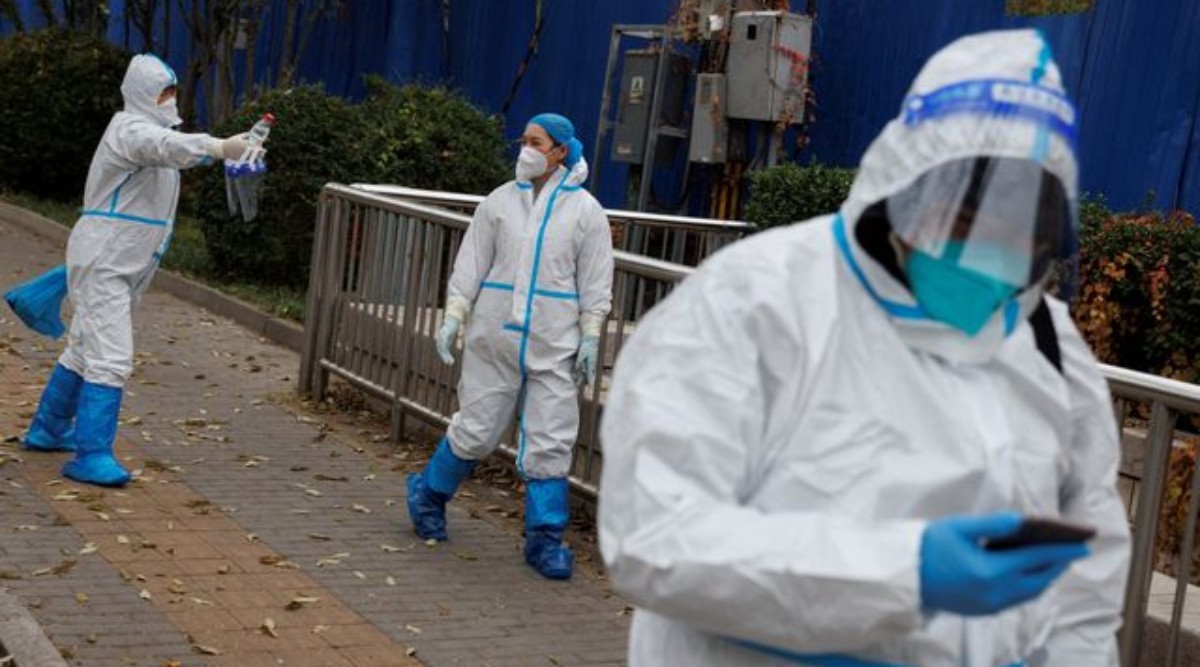 Pandemic prevention workers in protective suits walk outside a locked-down residential compound as outbreaks of the coronavirus disease (COVID-19) continue in Beijing, China November 18, 2022. (REUTERS/Thomas Peter/File Photo)
The lockdown and related shutdowns in South Asia during the pandemic led to reduced emissions during a short period. Curiously, while this did lead to cleaner air, new research has discovered that it also led to increased climate warming in the short term.
This is because the shutdowns barely affected the concentration of long-lived greenhouse gases in the atmosphere but they did reduce the concentration of some short-lived particles that have a cooling effect.
Emissions of sulphur oxides, nitrogen oxides and certain other pollutants can lead to the formation of aerosols in the air. These aerosols are known to have a “masking effect” on climate warming because they stay in the atmosphere and reflect some of the radiation from the Sun.
On average, aerosols reside in the atmosphere for about three to eight days until they settle out or are washed out by rain. But gases like carbon dioxide can reside in the atmosphere for hundreds of years, explained environmental scientist Örjan Gustafsson to indianexpress.com over an email. Gustafsson is a professor at the Department of Environmental Science of Stockholm University and a co-author of a research article on the aerosol demasking phenomenon published in the journal NPJ Climate and Atmospheric Science.
While this masking effect has been documented before, there is still a lack of knowledge surrounding its impact, according to Stockholm University. To actually determine how much of an effect it has, it would have required a large-scale experiment involving large parts of the world.
That was infeasible until the pandemic and its effects essentially created what can be described as a “natural” experiment. When many industries and transportation systems were shut down worldwide as a result of the pandemic, it provided researchers with a unique opportunity to study what will happen to the climate if emissions of greenhouse gases and aerosols are reduced expeditiously.
 Hanimaadhoo climate measuring station in the northernmost Maldives. The study was supplemented with data from the observatory. (Image credit: University of Stockholm)
Carbon dioxide and the kind of aerosols that the study looked into come from the same types of incomplete combustion processes, according to Gustafsson.
But since aerosols don’t last for long in the atmosphere, the pandemic shutdowns meant that their concentration decreased significantly. The concentration of other greenhouse gases, like carbon dioxide, on the other hand, was hardly affected, according to the study.
This means that if fossil fuels are completely phased out in favour of renewable energy sources with zero emissions, it could lead to a quick “unmasking of aerosols.” Due to this, climate warming could actually increase for a while before the long-term effects of reducing fossil fuel usage sets in.
But that doesn’t mean that we should continue using fossil fuels. Instead, it goes well with the prevailing scientific consensus that we need to switch to renewable sources as soon as possible. The longer we take to phase out fossil fuels, the more intense the heat from this “unmasking” would be.
“South Asia hosts almost one-fourth of the global population. Some of the world’s most populated and polluted cities in the world are also in the region. This unmasking effect will be especially severe in this region and is quite concerning,” said Hari RCR Nair, lead author of the research, to indianexpress.com. Nair is a PhD student at Gustafsson’s department.
The message to policymakers and planners remains the same and Gustaffson articulated it very clearly, “This year and the coming years are essential. Our generation has a choice on how we will be remembered. We can either be the ones that had the knowledge but did not act or we can be the ones that did.”
There is perhaps no better way to end this article than with the sentence that Gustaffson used to sign off on an email. We are in this together.