


Tags:


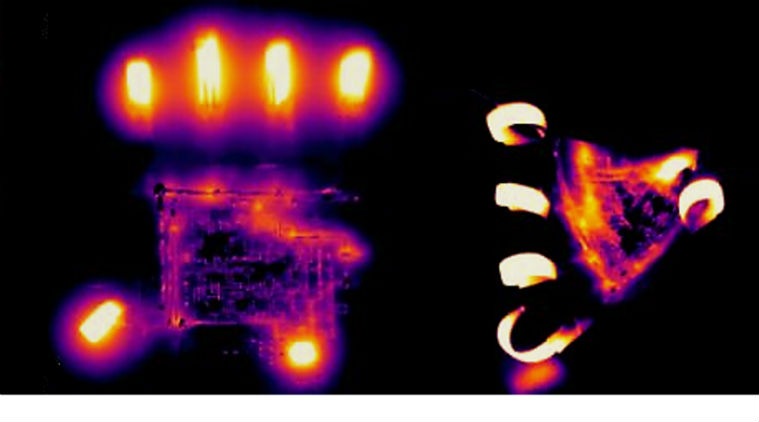
Scientists have developed a skin-like electronic system that is soft, thin, lightweight and can wirelessly activate soft robots through a simple lamination process. The researchers from Seoul National University in South Korea developed an electronic skin (e-skin) pair as a two-part, wireless soft driving system based on fully printable, stretchable hybrid electronics.
“Soft robots have great advantages in organically integrating every robot components without rigid boundaries, but current soft robotic designs still rely on rigid components mostly in driving parts,” the researchers wrote in the journal Science Robotics. “This e-skin opens a new avenue for soft robotic assembly. It is soft, thin, and light enough for a robot not to be perceptible, but it can activate the robot as a driving skin,” they said. One part is the e-skin for input sensing at a human side, and the other for activating soft robots.


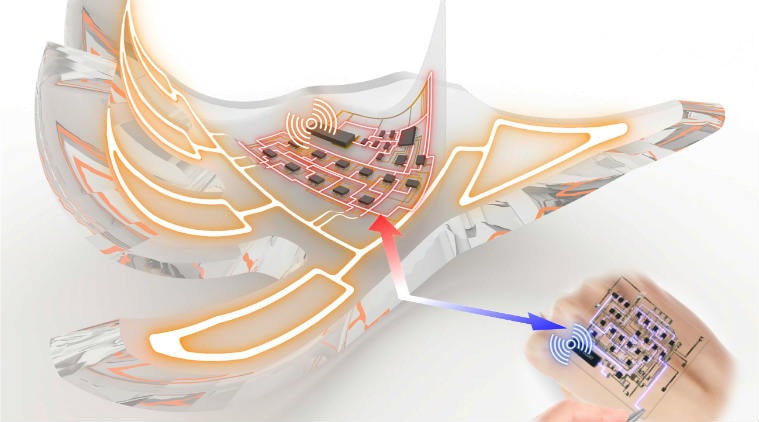
The proposed e-skins can be softly, compactly, and reversibly assembled into soft robot frames to activate muscle-like soft actuators without interfering with their soft motions. Benefits of this e-skin-mediated soft robotic assembly include co-adaptive movement that helps the robot pass through and/or operate in highly-confined spaces, whose cross section is even smaller than the robot size. The proposed e-skin pair and corresponding wireless inter-skin communication concept can wirelessly activate multiple types of soft robots through reversible assembly of the e-skins.


