3 min read
© The Indian Express Pvt Ltd



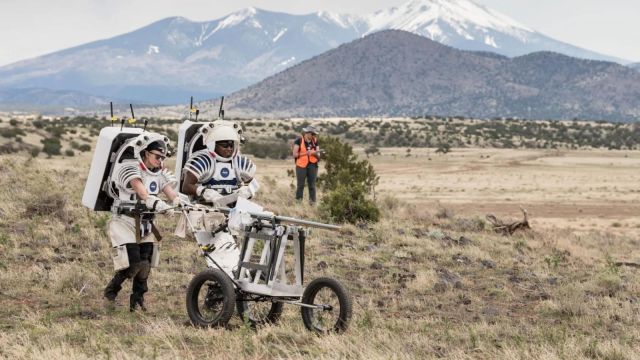 NASA astronauts Kate Rubins and Andre Douglas push a tool cart loaded with lunar tools through the San Francisco Volcanic Field north of Flagstaff, Arizona, as they practice moonwalking operations for Artemis III. (Source: NASA)
NASA astronauts began a week-long field test in the lunar-like landscape of San Francisco Volcanic Field near Flagstaff, Arizona to practice moonwalks during the Artemis campaign.
Wearing mock spacesuits, NASA astronauts Kate Rubins and Andre Douglas conducted a variety of technology demonstrations, hardware checkouts and Artemis science-related operations in the desert beginning Wednesday.
Throughout the week-long tests, two integrated teams – comprising astronauts, engineers, field experts, flight controllers and scientists – will practice end-to-end lunar operations. “Field tests play a critical role in helping us test all of the systems, hardware, and technology we’ll need to conduct successful lunar operations during Artemis missions,” said Barbara Janoiko, director for the field test at NASA’s Johnson Space Center in Houston.
During four simulated moonwalks and six advanced technology runs, NASA will evaluate gaps and challenges associated with lunar South Pole operations, including data collection and communications between the flight control team and science team in Houston for rapid decision-making protocols.
Teams will demonstrate technology that may be used for future Artemis missions, such as display and navigation data stream capabilities in the form of a heads-up display using augmented reality or lighting beacons that could help guide crew back to the lander.
“During Artemis III, the astronauts will be our science operators on the lunar surface with an entire science team supporting them from here on Earth. This simulation gives us an opportunity to practice conducting geology from afar in real time,” said Cherie Achilles, science officer for the test at NASA’s Goddard Space Flight Center in Greenbelt, Maryland.
The Arizona desert has been a training ground for lunar exploration since the Apollo era because of the many similarities to the lunar terrain, including craters, faults and volcanic features.
About Artemis III
Following two Artemis test missions, Artemis III, scheduled for launch in 2026, will see human landing on the Moon over 50 years since man last landed on the lunar surface. The mission aims to make history by landing humans on the lunar south pole, a harsh and undiscovered region.
Through Artemis, NASA will land the first woman, the first person of color, and its first international partner astronaut on the Moon.