4 min read
© IE Online Media Services Pvt Ltd



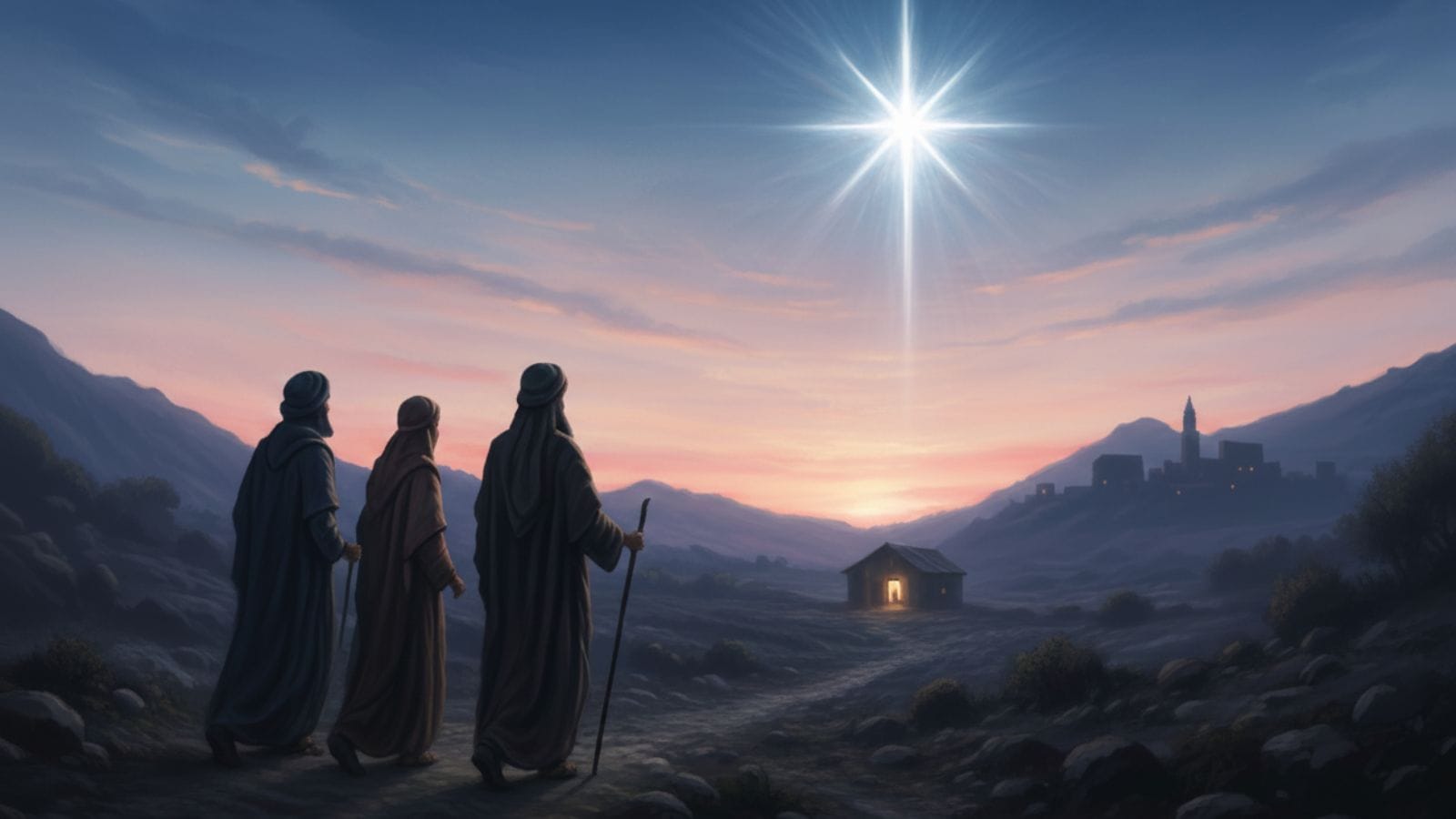 Matney believes the Magi could have seen it rising in the southern sky late in the morning, a striking and unmistakable sight during their journey. (Image: AI generated)
For centuries it has puzzled astronomers, historians and theologians. Now, a NASA scientist has claimed that the “Star of Bethlehem” mentioned in the Bible could be a bright comet recorded in 5 BC, whose motion may have briefly made it look like it “stood over” a location. The Bible says the star “stood over” Bethlehem, the place Jesus Christ was born, showing the way to the Magi – wise men from the east — who travelled to see him
Whose: Mark Matney, a planetary scientist at the National Aeronautics and Space Administration (NASA)
Claim: The “star” described in the Gospel of Matthew may have been a comet that passed unusually close to Earth just over 2,000 years ago.
Where he published it: Journal of the British Astronomical Association.
Matney points to a cosmic object documented by ancient Chinese astronomers in 5 BC. It is described as being visible for more than 70 days in spring. The timing matters because historians often place Jesus’s birth around 6–5 BC, linked (in part) to Herod the Great’s death no earlier than late 5 BC.
In Matthew, the star is said to rise “in the east,” move ahead of the travellers from Jerusalem to Bethlehem, then appear to “stand over” the place of Jesus’s birth. Matney writes,
This is the first astronomical candidate for the Star ever identified that fits Matthew’s description, a star that ‘went before’ the Magi until it ‘stood over’ the place where Jesus was.
Also Read: Comet 3I/ATLAS, from beyond the Solar System, found carrying key molecule linked to life
Matney used a new modelling technique to reconstruct possible orbits for the Chinese comet. In one set of trajectories, the comet passes so close that its apparent motion could nearly cancel out Earth’s rotation for a short time. Satellite engineers call this “temporary geosynchronous motion” — from the ground, it could look like the comet paused overhead briefly.
How close? For that visual effect, the comet would need to pass about 236,000–249,000 miles (380,000–400,000 km) from Earth — that is roughly the distance from the Earth to the Moon.
This is rare, but possible. He points out Comet Siding Spring came within 87,000 miles (141,000 km) of Mars in 2014.
A comet that close would have been spectacularly bright, possibly even visible during daytime. Matney suggests the Magi could have seen it rising in the southern sky late in the morning — “a striking and unmistakable sight.”
In Greco-Roman and Eastern traditions, comets were seen as omens tied to royal births or upheaval, which could explain why astrologers would travel.
Matney’s is no conclusive explanation on the Biblical account of the Star of Bethlehem. It’s just a scientific theory on how a “star” could “stand over” a place and guide travellers. Over the centuries, there have been more than 400 interpretations for the Star of Bethlehem. That include Kepler’s Jupiter–Saturn conjunction (7 BC) and a supernova.