2 min read
© IE Online Media Services Pvt Ltd



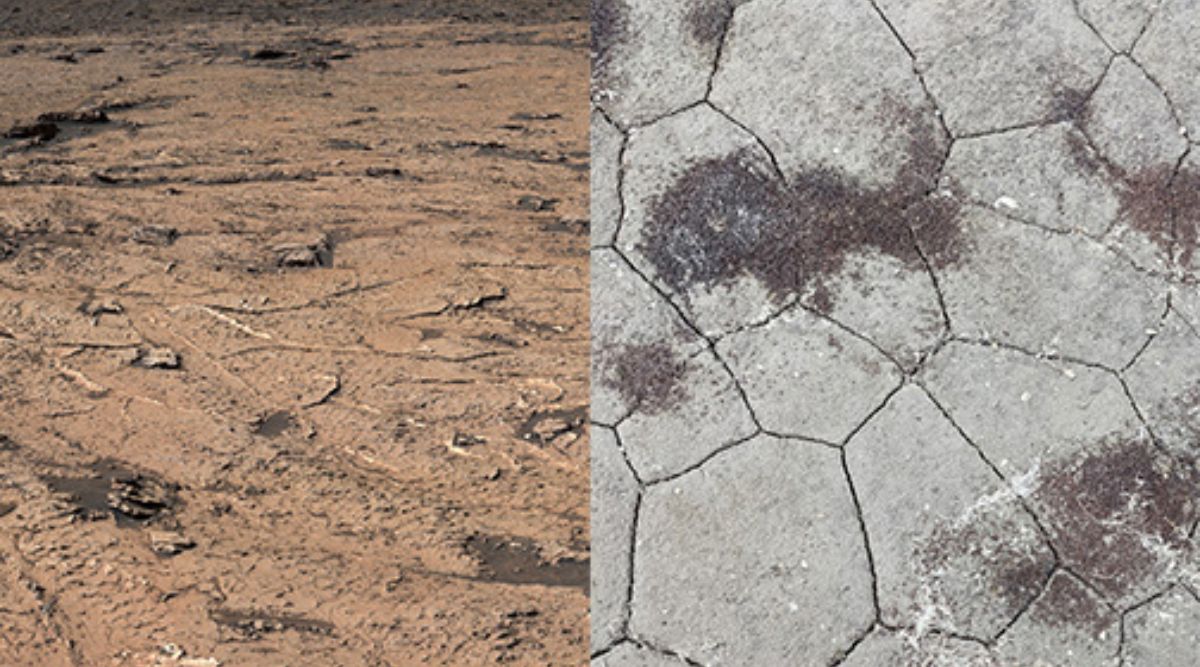 Mud cracks in Mars (left) were formed in ways similar to those on Earth (right). (Credit: LANL)
 When you think about the planet Mars it probably brings an image of a desolate desert landscape to your mind. While that holds true for the red planet in its current form, a new study seems to indicate that it once had seasons.
Observations of mud cracks made by the Curiosity rover show that Mars might have had wet-dry cycles happening with a high frequency, according to a study published in the journal Nature. This could mean that the planet once had seasonal weather patterns or flash floods.
For years, Curiosity explored regions that were mostly covered by silicates. Then, it entered a new area filled with sulphates. The research team found a change in mud crack patterns in that environment, which signifies a change in the way the surface would have dried, according to the Los Alamos National Laboratory in New Mexico, United States. Water could have been present for a time, evaporating and reappearing again until mud cracks in the shape of polygons formed.
“These exciting observations of mature mud cracks are allowing us to fill in some of the missing history of water on Mars. How did Mars go from a warm, wet planet to the cold, dry place we know today? These mud cracks show us that transitional time, when liquid water was less abundant but still active on the Martian surface,” said Nina Lanza, co-author of the research article, in a press statement. Lanza is the principal investigator of the ChemCam instrument onboard the Curiosity rover.
The forming of these shapes on Mars is not very different from processes that happen on our planet. On Earth, mud cracks initially form in a T-shaped pattern. But when these cracks are put through wetting and drying cycles, they begin forming more of a Y-shape. Almost exactly what Curiosity found on Mars.
Also, the mud cracks on Mars were only a few centimetres deep. This indicates that the wet-dry cycles were seasonal or could have happened even faster, like with flash floods.