2 min read
© IE Online Media Services Pvt Ltd



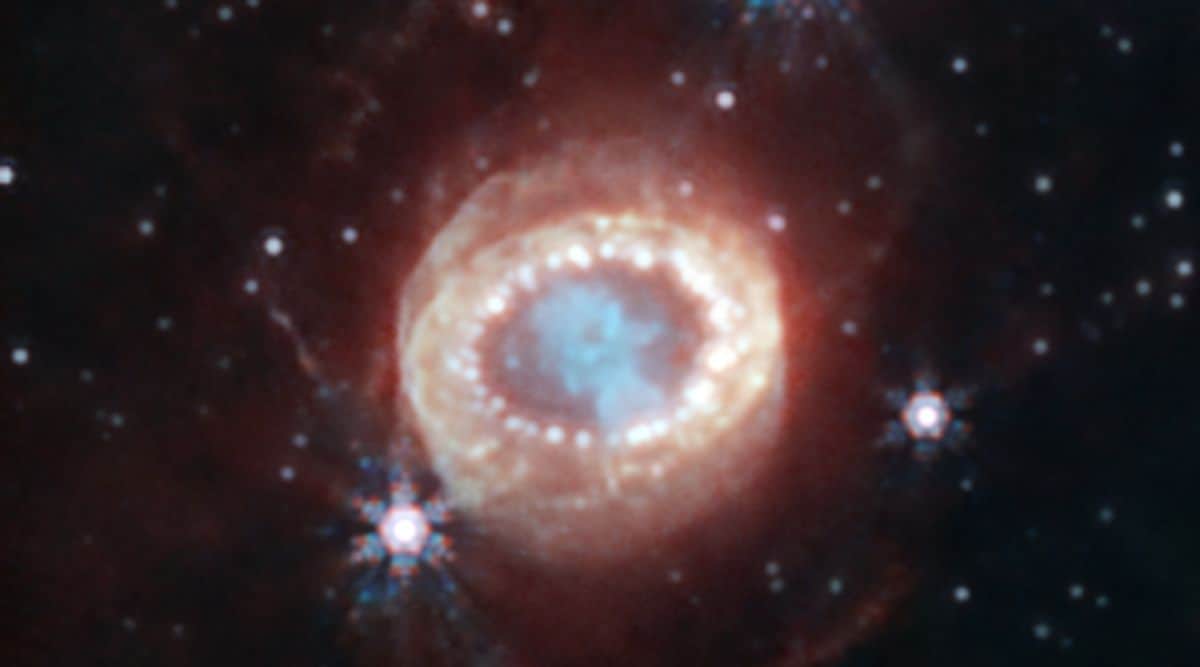 Webb's NIRCam captured this detailed image of the iconic supernova. (NASA’s Goddard Spaceflight Center & University of Maryland, Baltimore County), C. Fransson)
 The National Aeronautics and Space Administration (NASA) said Thursday that the James Webb Space Telescope has begun observations of the famous Supernova 1987A. Observations by the telescope’s Near-Infrared Camera (NIRCam) could give important clues about how such exploded stars develop over time.
The image reveals what looks like a cosmic jellyfish with a central structure like a keyhole. This centre is packed with clumpy gas and dust ejected by the explosion of the star. This dust is so dense that Webb’s vision can’t penetrate even in near-infrared, leaving the dark hole in the image.
That keyhole is surrounded by a bright, equatorial ring that forms a band and connects the two faint arms of the hourglass-shaped outer rings. This equatorial ring is formed from the material ejected tens of thousands of years before the explosion and contains bright hot spots that were formed as the supernova’s shock wave hit it. Some similar spots can be found outside the ring as well.
These structures have already been observed to varying degrees of clarity by the Hubble and Spitzer space telescopes and even the Chandra X-ray observatory. But Webb’s spatial resolution and sensitivity have revealed a new undiscovered feature—small near-crescent structures. These crescents are believed to be part of the outer layers of gas shot out from the explosion.
What looks like a cosmic jellyfish is the iconic #SUPERNOVA 1987A captured by the #jameswebb space telescope. pic.twitter.com/FWVgjIeEIe
— IE Science (@iexpressscience) September 1, 2023
The brightness of these crescents could be an indication of limb brightening, which is an optical phenomenon that happens when viewing expanding material in three dimensions. Basically, our viewing angle makes it look like there is more material in these two crescents than there actually might be.
Even decades after the supernova’s initial discovery, it still holds many mysteries., like the fact that there doesn’t seem to be a neutron star that should have formed in the aftermath of the explosion.