3 min read
© IE Online Media Services Pvt Ltd



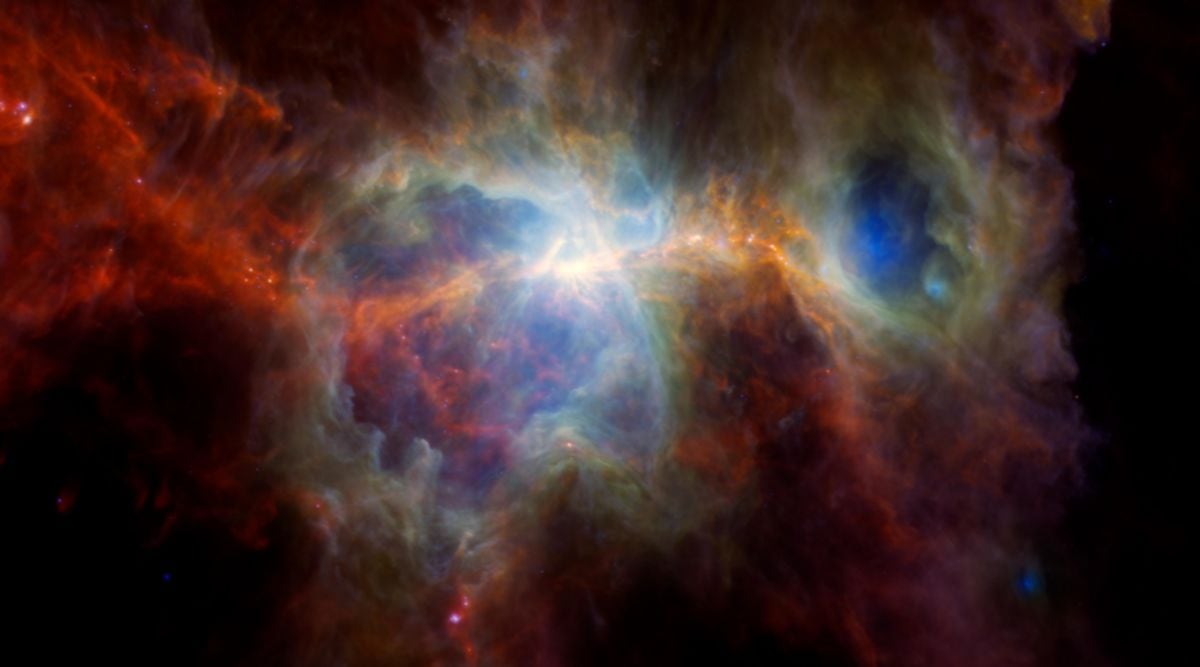 The study used data from the now defunct Spitzer space telescope to track frequent outbursts from baby stars. (Image credit: ESA/NASA/JPL-Caltech)
 Newly born stars have “surprisingly frequent” feeding frenzies where they consume material at a furious rate and grow larger, according to new research published in the journal Astrophysical Journal Letters. Until recently, the formation and development of the youngest stars have been difficult to study because there are hidden from view inside the nebulas from which they form, according to NASA.
Stars which are less than 100,000 years old, a category known as “class 0 protostars,” are quite challenging to observe using ground-based telescopes. These stars are the cosmic equivalent of a 7-hour-old infant.NASA says such an outburst was first detected nearly a century ago and that they have been rare since then. But analysis has found that these feeding outbursts happen roughly every 400 years. These outbursts are a signal of feeding bursts when the young growing star swallows material from the disks of gas and dust that surround them.
While these outbursts are difficult to observe, data from the Spitzer telescope, which ended its 16-year-long run of observations in 2020, was uniquely suited to help scientists peer through the thick dusts of dust and gas and look at the stars inside. This is because of the combination of Spitzer’s infrared capabilities and its long-lasting gaze.
The researchers used Spitzer data of the star-forming clouds of the Orion constellation, taken between 2004 and 2017. After analysing the data, they found three feeding outbursts, with two of them being previously unknown.
They then compared Spitzer data with data from other telescopes, including the Wide-field Infrared Survey Explorer (WISE) and the retired Herschel Space Telescope and the Stratospheric Observatory for Infrared Astronomy (SOFIA). With this, they were able to estimate that these feeding bursts last for about 15 years. Half or more than half the infant star’s bulk is added during this early period in its life.
These new findings will help researchers understand better about star formation and growth. In fact, according to NASA, it is even possible that even our Sun once fed with such outbursts to grow larger. The Sun is bigger than the stars that were observed but according to the researchers, there is “no reason to believe” that it did not go through outbursts.