3 min read
© IE Online Media Services Pvt Ltd



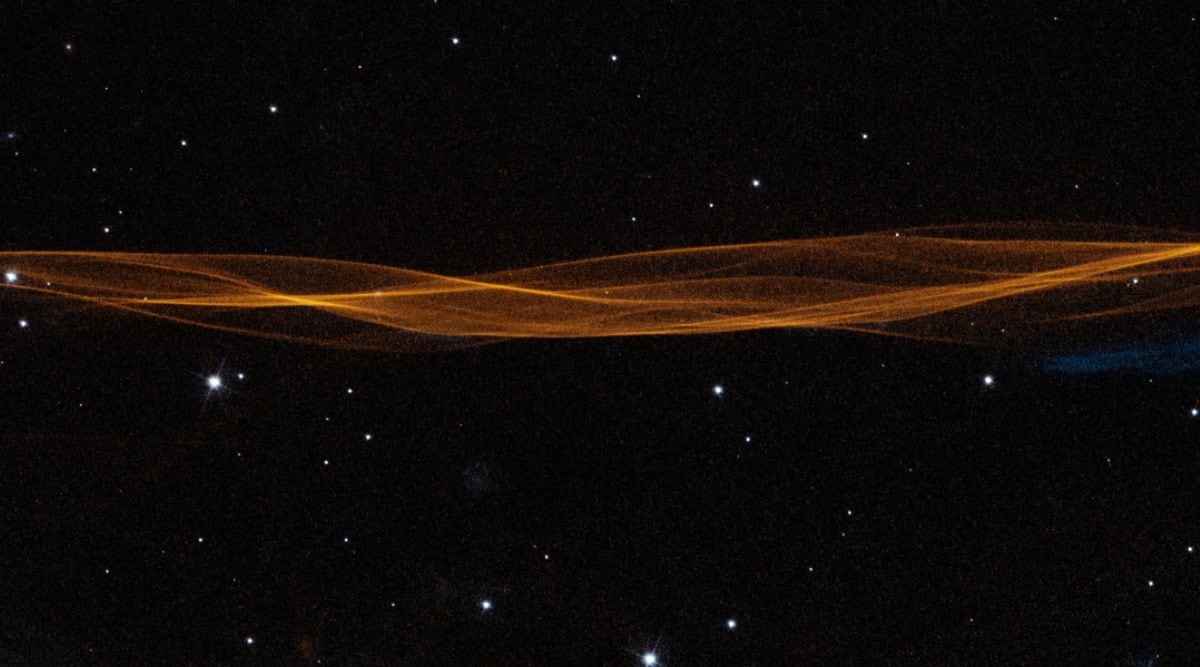 Hubble zoomed into a small section of the Cygnus loop to capture a "timelapse." (NASA/STScI)
 A star exploded around 20,000 years ago but today, in 2023, you can sit where you are and watch a timelapse video of its remnants racing into space at unimaginable speeds captured by the Hubble Space Telescope.
The National Aeronautics and Space Administration (NASA) on Friday released a timelapse video of a nebula called Cygnus Loop. It forms a bubble-like shape that is approximately 120 light-years in diameter. We are about 2,600 light-years away from its center and as seen from our planet, the entire nebula has the width of about six full Moons.
Scientists used the Hubble telescope to zoom into a very small part of the leading edge of this bubble, where the blast waves from the supernova is ploughing into the surrounding material in space. Images taken from 2001 to 2020 show how the shock front of the supernova remnant has expanded over time and the crisp images have helped astronomers clock how fast it is going.
Analysing the shock front’s location has revealed that it has not slowed down at all in the last 20 years—it continues to speed into interstellar space at over 800,000 kilometres per hour. That is fast enough to travel from the Earth to the Moon in less than half an hour. This may seem rapid but according to NASA, it is actually on the slower side for a supernova shockwave.
Scientists at the space agency made a “movie” out of the Hubble images to give you a close-up look at how remnants of the exploded star are slamming into the space around it.
“You’re seeing ripples in the sheet that is being seen edge-on, so it looks like twisted ribbons of light. Those wiggles arise as the shock wave encounters more or less dense material in the interstellar medium,” explained William Blair of the Johns Hopkins University, Baltimore, Maryland, in a press statement.
The Cygnus Loop was discovered by British-German astronomer and composer William Herschel in 1784 using nothing more than a simple 18-inch reflecting telescope. Little would he have imagined that we would have an extremely powerful telescope in space that could zoom into a very small slice of this nebula for such a spectacular view. And that is not even our most powerful space-based observatory.