2 min read
© IE Online Media Services Pvt Ltd



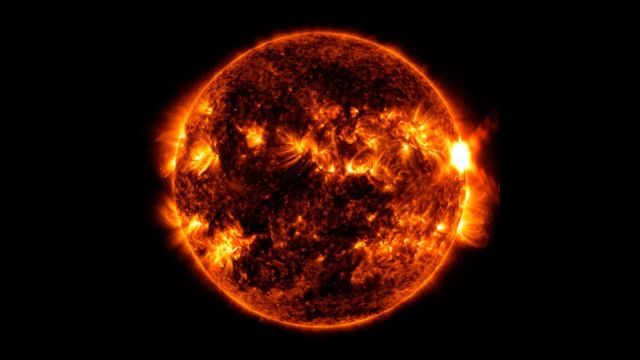 This illustrative image shows a solar flare captured by NASA's Solar Dynamics Observatory on August 5. 2023. (NASA/SDO)
The Sun on Saturday produced one of the most powerful solar flare in years from just behind its southwestern limbs. NASA’ Solar Dynamics Observatory recorded the flash and it was classified as an X 3.4-class explosion. You can watch a video of it below.
🌞 😱 🤩 X FLARE!!! An X3.4 from departed region AR3575. Given that it is over the limb the flare is much larger. There was a clear eruption with a coronal wave suggesting a very fast CME to the west. Waiting for more imagery. 😮 🤩 🤔
MORE at EarthSky: https://t.co/xD29wLfm4e pic.twitter.com/y57XmBgv4e
— Dr. C. Alex Young (@TheSunToday) February 9, 2024
X is the highest class of solar flares and the one on Saturday is the first X-class solar flare of the year. Scientists have traced the source of the sun to the sunspot AR3575. Since the site where the explosion occurred was eclipsed by the edge of the Sun, there is a good chance that it is stronger than the classification suggests.
X FLARE HAPPENING NOW! It looks as though it is from AR3576 which is over a day (~15 deg) behind the limb, so goodness knows how big this flare would have been if it had happened in this side of the Sun. More soon! pic.twitter.com/N2oTzlsN6c
— Keith Strong (@drkstrong) February 9, 2024
https://platform.twitter.com/widgets.js
The flare was followed by an S2 (moderate) class radiation storm that rained down solar protons on our planet’s upper atmosphere yesterday, causing a polar cap absorption event, according to SpaceWeather.com. A polar cap absorption event refers to a massive shortwave radio blackout caused by solar weather.
Even more interestingly, forecasters at the American National Oceanic and Atmospheric Administration say that there is a 25 per cent chance that an X-class flare could happen today. AR3576 is the most likely source since it is an unstable delta-class magnetic field and it is pointed in Earth’s general direction.