8 min read
© IE Online Media Services Pvt Ltd



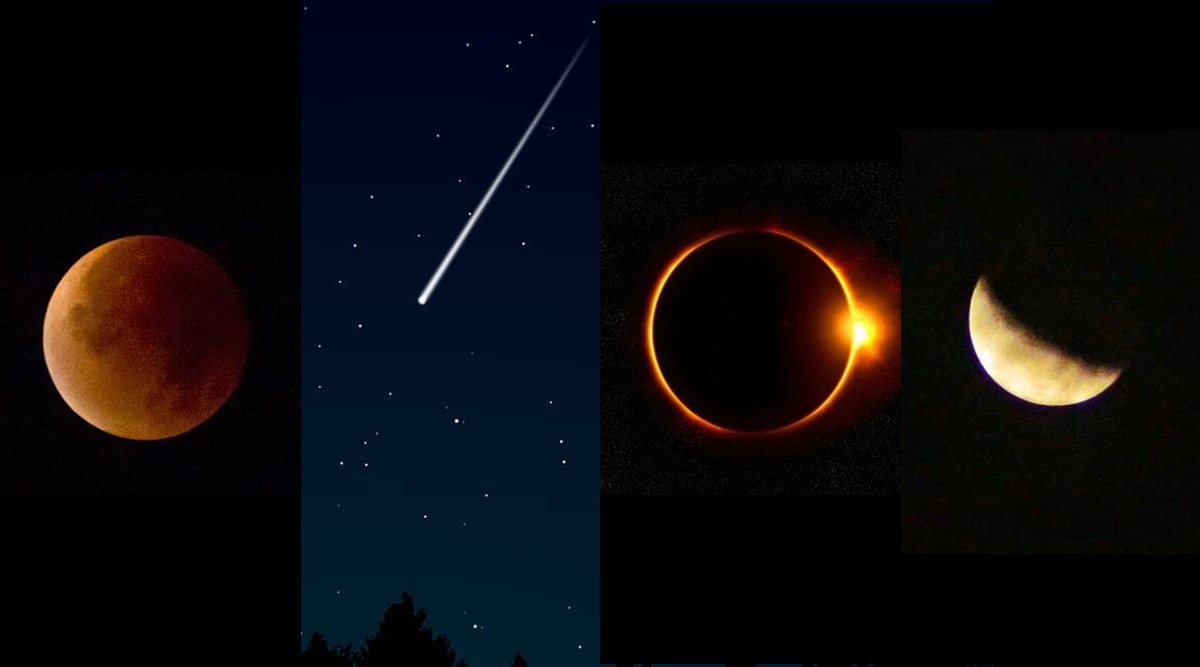 Astronomical Events 2023: 2023 will be a great year for skywatchers across the globe with two solar eclipses and two lunar eclipses. (Composite iamge, various source)
 List of Celestial Events 2023: Thousands of years ago, humans attributed celestial events like eclipses and meteor showers to the divine actions of gods. For example, solar eclipses were often seen as omens or signs of divine warning. Fast forward a few thousand years, and thankfully, not only do we understand why these celestial events happen, but we are also able to predict exactly when they will happen. No total solar eclipse will happen this year but there will be two partial solar eclipses. Here, we have put together a list of celestial events that you must not miss in 2023.
There will be a hybrid solar eclipse happening on April 23, 2023. A hybrid solar eclipse is a type of eclipse that looks like an annular solar eclipse or a total solar eclipse depending on where it is being observed from. During an annular eclipse, the Moon covers the Sun’s centre, leaving a “ring of fire” around the Moon’s dark shadow.
The eclipse is referred to as the Ningaloo eclipse as it will be best viewed from Ningaloo on the Western Australian coast. The region draws its name from the Australian Aboriginal Wajarri language word ningaloo meaning “high land jutting into the sea.” Aboriginal Australian clans have inhabited the area for over 30,000 years. A full eclipse will be visible at that part of Australia.
Apart from the western coast of Australia, the eclipse will also be visible in parts of many Southeast Asian countries. Unfortunately, skywatchers in India will not be able to catch a glimpse of the solar eclipse. But stay tuned to indianexpress.com to watch a livestream of the eclipse when it happens.
A penumbral lunar eclipse will happen on May 5, 2023. During a penumbral lunar eclipse, the Moon, Earth and Sun are imperfectly aligned and the Earth, meaning that the Earth’s main shadow (umbra) doesn’t cover the Moon, but rather, it is covered by the Earth’s “penumbra.” Penumbral lunar eclipses are a little harder to spot since the shadowed part of the Moon will only appear a little darker.
According to Time and Date, the penumbral lunar eclipse will begin in New Delhi at 8.44 PM IST on May 5 and it will end at 1.01 AM IST on May 6. The peak of the lunar eclipse will happen at approximately 10.52 PM IST on May 5.
According to Sky & Telescope, the peaks of the Perseids and Geminids meteor shower, the most prolific and reliable meteor showers of the year, will happen in the absence of moonlight. This means that 2023 is a great year to lie down on your back and watch shooting stars in the sky.
According to the online sky guide In the Sky, the Perseid meteor shower will happen in 2023 between July 17 and August 17, with the peak happening on August 13, which will be a Sunday. In New Delhi, the meteor shower’s peak will start around 8.10 PM IST on August 13 and will continue to be visible till around 5.21 AM IST the next day. However, for the best viewing experience, we recommend that you find yourself a safe and secluded spot away from the city’s light pollution to kick back and watch the meteor shower.
The Perseids meteor shower appears to originate from the constellation Perseus and also gets its name from the latter. The Perseids meteor shower is caused by the comet Swift-Tuttle. When the debris Earth passes through the debris left behind by the comet, the debris burns up in the planet’s atmosphere, appearing as a meteor shower to us.
The Moon orbits the Earth in an elliptical orbit which means that it gets closer and farther away from our planet during its journey around it. When a Moon is at its closest point to the Earth and that coincides with a full moon, it is called a supermoon. There will be a total of four supermoons in the year but the one on August 31 will be a little different, even though you might not be able to see that just by looking at the supermoon.
The full moon on August 31 will be the second one of the month after the August 1 full moon, meaning that the August 31 full moon is a “monthly blue moon.” No, the Moon will not actually appear blue, but rather it is just an obscure term for when a second full moon happens during the same month.
According to Time and Date, “Blue Moon” was the word used to describe the third Full Moon during an astronomical season with four Full Moons and the phrase can be traced back to the now-defunct Maine Farmer’s Almanac. The more popular definition of a blue moon, referring to a second full moon in a month, has its origin in a misinterpretation made by an author in the 1946 edition of the Sky & Telescope magazine. Now, this is considered to be a second definition instead of a mistake.
The second solar eclipse of the year will be an annular eclipse that happens on October 14, 2023 and will be visible to many more people than the previous one. For regions where the eclipse will be visible, the Moon will obscure the centre of the Sun, leaving a very thin ring of fire around the shadow.
Unfortunately, just like the other solar eclipse in the year, the October 14 eclipse will also not be visible to viewers in India. However, the eclipse will be visible in many parts of North and South America, including parts of the United States, Mexico, Panama, Colombia and Brazil.
While the penumbral lunar eclipse on May 5 will be hard to detect with the human eye, the partial lunar eclipse on October 28 will be easier to notice since a small part of the Moon will appear darker and might even appear slightly reddish.
The moon appears red during an eclipse due to a phenomenon called Rayleigh scattering, which interestingly is also responsible for the sky appearing blue. When the Moon enters the Earth’s shadow during an eclipse, the only thing that reaches it is the sunlight that passes through the Earth’s atmosphere.
The lower wavelength bluer spectra of light get scattered by the atmosphere, which allows redder light of higher wavelength to pass through. This red-tinged light is then reflected back by the Moon, giving it the signature “blood moon” appearance. During a partial lunar eclipse, only the part of the Moon covered by the Earth’s shadow will appear reddish.
According to Time and Date, the October 28 lunar eclipse will start at 11.31 PM IST on October 28, 2023 in New Delhi. It will go in till 3.56 AM on October 29, while its peak will be at 1.44 AM on October 29.
Along with the Perseids meteor shower, the Geminids meteor shower is considered to be one of the most spectacular during the year. But unlike most meteor showers, the Geminids are associated with an asteroid, the 3200 Phaeton, instead of a comet. But the cause remains the same—the Earth passing through the debris left behind by the celestial body.
According to In the Sky, the Geminids meteor shower will peak on the night of December 14, 2023 and according to Time and Date, you can expect to see up to 150 meteors per hour. To see the Geminids meteor shower, try to find a place far away from the city lights. Once you are there, give your eyes around 15 to twenty minutes to adjust to the darkness so that you can see the meteors well. The meteor shower will seem to originate from the constellation Gemini, so use a skywatching mobile application to spot the constellation in the night sky.