3 min read
© IE Online Media Services Pvt Ltd



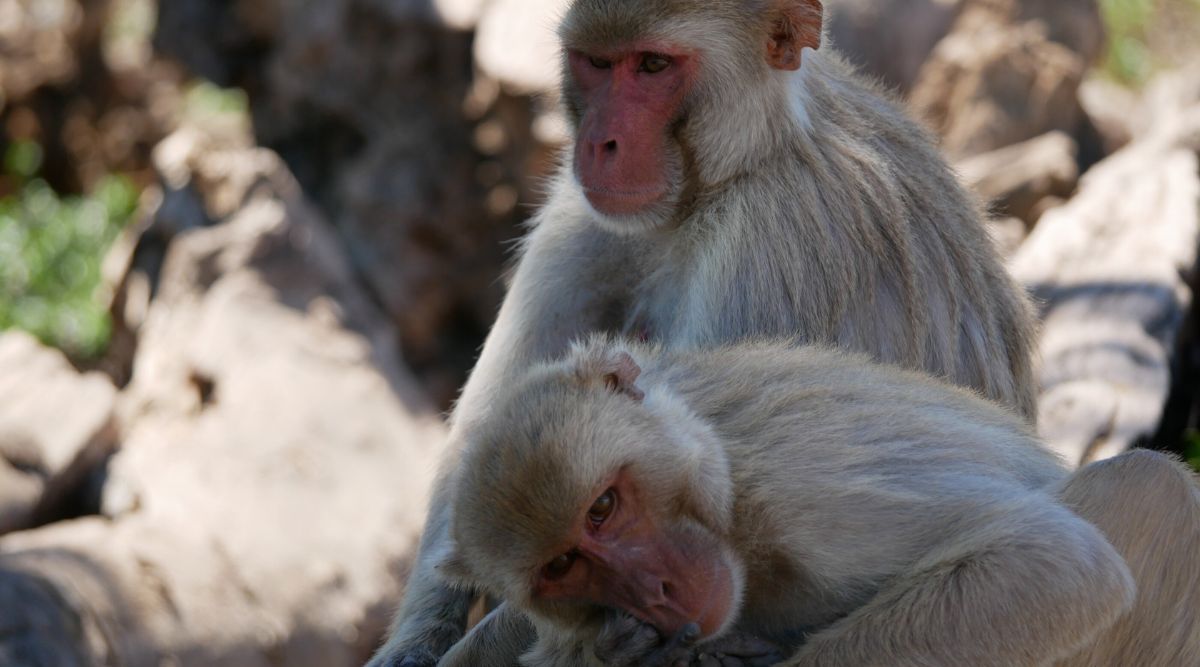 Same-sex sexual behaviour also seemed to give some evolutionary advantages to some macaques. (Image credit: Chloe Coxshall)
 A cornerstone of homophobic rhetoric often revolves around how homosexuality is “unnatural.” There has always been mountains of evidence that proved how this argument was based on ignorance rather than science and now, there is more. A study by researchers at Imperial College London has found that same-sex sexual behaviour (SSB) is a common feature of primate reproduction.
The research, published in the journal Nature Ecology & Evolution on Monday, is a long-term study of SSB in males within one species, according to Imperial College London. The study uses observations and genetic data and challenges the belief that SSB is rare among non-human animals.
“We found most males were behaviourally bisexual, and that variation in same-sex activity was heritable. This means that the behaviour can have an evolutionary underpinning; for example, we also found that males that mounted each other were also more likely to back each other up in conflicts – perhaps this could be one of many social benefits to same-sex sexual activity,” said first author Jackson Clive, in a press statement.
The researchers focused on a colony of 1,700 rhesus macaques living in the tropical island of Cayo Santiago in Puerto Rico. They focused on observing the behaviour of and conducting genetic analyses on 236 males within the colony.
They recorded all social “mountings” for the 236 males. This included both male-male and female-on-female action. The results were interesting—the researchers found that male same-sex mounting was quite widespread with 72 per cent of the males in the sample engaging in it, compared to 46 per cent engaged in different-sex mounting.
Same-sex sexual behaviour has been identified amongst thousands of different species which range from insects to penguins and there are many theories around how it came about as an evolutionary trait. Some of these theories include SSB helping establish dominance in groups, shortages of different-sex partners and helping reduce tension after aggression. But no one theory has enough data to support it.
While investigating some of these theories with their sample of rhesus macaque data, the researchers found SSM to be strongly correlated with “coalitionary bonds.” Essentially, it means that male pairs that regularly engaged in SSB were more likely to back up each other when conflicts happened. This gives them an advantage within their group, which could translate to an evolutionary advantage.
The research team also looked into whether the male rhesus macaques engaging in SSB faced reduction in the amount of offspring they had. The exact opposite of that seemed to hold true. The males that engaged in SSB were more successful in reproducing, and the “coalitionary bonds” may have something to do with that.
While the study once again underlines how homosexual behaviour is quite natural, the researchers cautioned against making direct comparison with humans.
“Unfortunately there is still a belief amongst some people that same-sex behaviour is ‘unnatural,’ and some countries sadly still enforce the death penalty for homosexuality. Our research shows that same-sex behaviour is in fact widespread amongst non-human animals,” said lead researcher Vincent Savolainen in a press statement.