4 min read
© IE Online Media Services Pvt Ltd



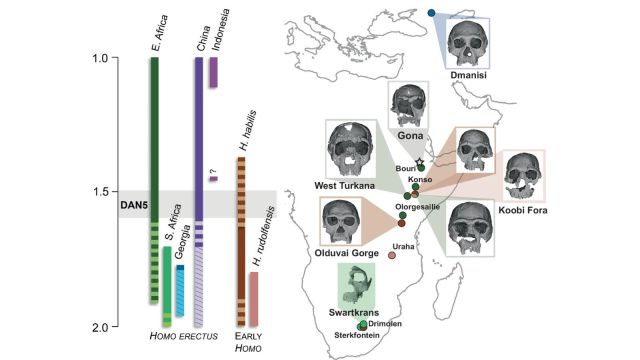 Researchers now plan to compare DAN5 with some of the earliest known European human fossils, including those attributed to Homo erectus and Homo antecessor, dated to around one million years ago. (Image: Nature)
A 3D reconstruction of an early Homo erectus face has revealed unexpectedly primitive features, offering new insight into the complex evolutionary history of one of humanity’s earliest widespread ancestors.
The reconstruction was produced by an international research team led by Dr Karen Baab, a paleoanthropologist at Midwestern University’s College of Graduate Studies in Arizona. The fossil, known as DAN5, was found near Gona in Ethiopia’s Afar region and dates to between 1.5 and 1.6 million years ago.
“The face is more archaic than we anticipated,” Dr Baab said. “Despite belonging to Homo erectus, it retains features that are closer to earlier hominin species.”
The findings, published on December 16 in Nature Communications, show that DAN5 combines a small braincase typical of early Homo erectus with a facial structure that appears more primitive than other African fossils from the same period.
According to Dr Baab, this may reflect the Gona population preserving traits from the earliest Homo erectus groups that left Africa around 300,000 years ago. “Some populations may have retained ancestral anatomy longer than others, which helps explain the diversity we see in the fossil record,” she said.
The fossil forms part of the Gona Paleoanthropological Research Project, co-directed by Dr Sileshi Semaw and Dr Michael Rogers. Decades of work at Gona have uncovered hominin fossils more than 6.3 million years old, along with stone tools spanning 2.6 million years of human evolution.
DAN5 was reconstructed by digitally combining a previously described braincase with smaller facial fragments recovered in 2000. The result is considered the most complete fossil human skull from this era yet found in the Horn of Africa.
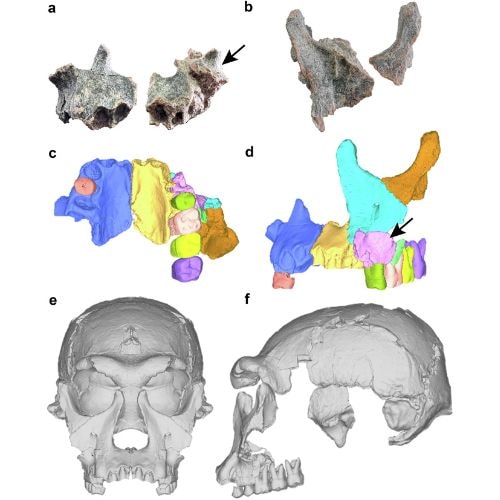 (Image: Nature)
Using high-resolution micro-CT scans, researchers created detailed 3D models of the fragments and aligned them to form a near-complete cranium. “It was like solving an extremely complex three-dimensional puzzle,” Dr Baab said.
The finished skull shows a striking mix of traits: a braincase consistent with Homo erectus, alongside ancestral facial and dental features, including a flat nasal bridge and large molars. “This combination is unique among African fossils of this age,” the research team noted.
Dr Yousuke Kaifu, a paleoanthropologist at the University of Tokyo and a co-author of the study, said the result was unexpected. “Seeing such a primitive face on a fossil this young was surprising,” he said.
The findings challenge long-standing ideas that key evolutionary steps in Homo erectus occurred outside Africa. “The fossil record increasingly supports an African origin for Homo erectus, with transitional forms present on the continent,” Dr Baab said.
Dr Rogers emphasised that the specimen highlights the anatomical diversity of early humans. “There was no single, uniform Homo erectus body plan,” he said. “Different populations evolved along slightly different paths.”
Dr Semaw added that DAN5 is also archaeologically significant. “This individual lived at a time when both Oldowan tools and Acheulian handaxes were being made,” he said. “It is among the earliest fossil hominins directly associated with these technologies.”
Researchers now plan to compare DAN5 with some of the earliest known European human fossils, including those attributed to Homo erectus and Homo antecessor, dated to around one million years ago.
Dr Sarah Freidline, a co-author from the University of Central Florida, said the goal is to better understand facial variation within the species. “These comparisons will help us clarify how Homo erectus adapted as it spread across different regions,” she said.
The team also suggests that DAN5 could represent a population shaped by admixture between Homo erectus and earlier species such as Homo habilis. Dr Rogers cautioned that firmer conclusions will require more fossils. “We need several additional specimens dated between one and two million years ago to fully untangle these evolutionary relationships,” he said.