3 min read
© IE Online Media Services Pvt Ltd



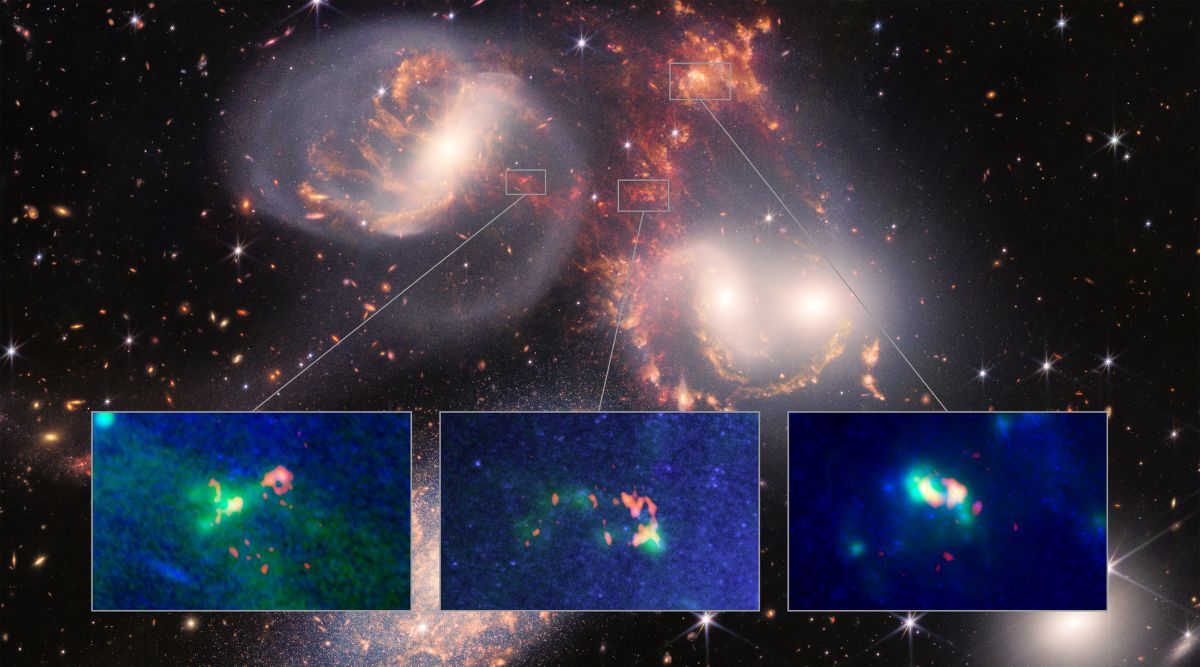 Stephan's Quintet was one of the first cosmic objects observed by the James Webb Space Telescope as part of its initial set of images. (Image credit: ALMA (ESO/NAOJ/NRAO)/JWST/ P. Appleton (Caltech), B.Saxton (NRAO/AUI/NSF))
 One of the first images taken by the James Webb Space Telescope depicted Stephan’s Quintet, a group of five galaxies that are located about 270 million light years away from our planet in the direction of the constellation Pegasus. Now, scientists have used Webb and the Atacama Large Millimeter/submillimeter Array (ALMA) to discover an intruder galaxy crashing into the quintet that has triggered a sonic boom many times the size of the Milky Way.
According to the US National Radio Astronomy Observatory, galaxy NGC7318b violently intruded the group at a relative speed of about 800 kilometres per second. To put that into context, you could go from the Earth to the Moon in about eight minutes at that speed.
“As this intruder crashes into the group, it is colliding with an old gas streamer that likely was caused by a previous interaction between two of the other galaxies, and is causing a giant shockwave to form,” said Philip Appleton, lead investigator of the project, in a press statement. Appleton is an astronomer at Caltech’s IPAC and presented the findings of the research at the 241st meeting of the American Astronomical Society (AAS) yesterday.
The shockwave is creating a highly turbulent cooling layer as it passes through the “clumpy” streamer. The scientists discovered unexpected structures and the “recycling of molecular hydrogen gas” affected by this unsteady cooling layer. Since molecular hydrogen is the raw material that ultimately forms stars, understanding this phenomenon helps scientists understand more about the evolution of Stephan’s Quintet and galaxies in general.
The intergalactic recycling plant is just one of the fascinating processes happening in the quintet due to the intruder’s collision. In a region of the quintet dubbed Field 5, scientists discovered two cold gas clouds connected by a stream of warm molecular hydrogen gas.
One of the clouds punched created a ring in the structure as it punched through, resembling a high-speed bullet of cold hydrogen gas colliding with a large thread-like filament of spread-out gas. According to Bjorn Emorns, co-investigator of the project, a molecular cloud creating havoc by piercing through interstellar is a rare phenomenon that is not yet fully understood.
These disparate, rare and little-understood phenomena demonstrate how Stephan’s Quintet provides scientists with a “laboratory” to study galaxy collisions and their impact on the galaxy’s surroundings. Usually, galactic collisions trigger intense bouts of star formation, obscuring galaxies from view. But in Stephan’s Quintet, galactic collisions happen in the interstellar medium, away from the galaxies, meaning that there is little to no star formation to obstruct the view for scientists.