5 min read




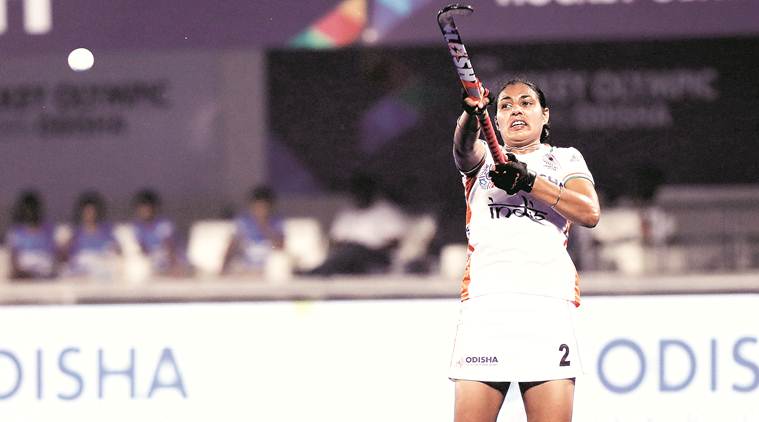 Gurjit Kaur netted a brace. (HI)
For Gurjit Kaur, drag-flicking was once a desperate measure. It is now India’s deadliest weapon. Ironic, in one sense, because until she picked it up, India’s women teams had never really warmed up to this essential art that has been a must in modern hockey since the turn of the century.
“But there was a two-fold problem for the women,” former women’s team coach AK Bansal says. “Strength was one issue and the second was they did not have anyone to learn from.”
Drag-flicking is an aspect, Bansal says, that no coach teaches a player. “Coaches refine or make some tweaks, but most Indians who are expert flickers are drawn to the art by themselves. If any coach says he has produced a drag-flicker, he is lying,” Bansal, chief coach of the National Hockey Academy in Delhi, says.
Until very recently, a hit was the only option from a penalty corner for the women players. It was the go-to method for the likes of Suman Bala, Jaspreet Kaur or Asunta Lakra. There used to be variations, but they were seen as lacking the strength to execute a perfect penalty corner. In a way, Gurjit is single-handedly changing that perception.
Her first goal against the USA was the 20th of the year from drag-flicks for Gurjit, who is regarded as the first exponent of the art in India’s women’s hockey. She has, in fact, scored 21 out of the 73 goals India have scored in 2019, making her indispensable to the team. Just two years ago, however, she was a bench-warmer.
Like most women players in the country, Gurjit has been in the national team set-up from the time she was a teenager. “I got a few opportunities to play but in important series, I was not getting chances,” she says.
READ| Olympic Qualifiers: After first leg, one foot in Tokyo
A defender with no real expertise, Gurjit remained in-and-out of the team for three years. “That’s when I realized I needed some x-factor,” she says. “Our team did not have a drag-flicker, so I thought of giving it a shot since strength has never been an issue for me.”
There was, however, no one woman player she could turn to for tips. “So I started watching videos. I saw how the best men and women players took their penalty corners and tried to copy their technique in training,” she says.
In 2017, during a tour to Europe, Sjoerd Marijne arranged a training session for Gurjit with Toon Siepman, who has mentored some of the best drag-flickers of all-time, including Pakistan’s Sohail Abbas and, more recently, Netherlands’ Mink van der Veerden.
Through the videos, Gurjit had learnt how to execute a drag-flick. Siepman, she says, taught her finer aspects like the footwork, hip movement and wrist positions. Marijne, meanwhile, got her to change her hockey stick, which he thought was light and did not generate enough power.
“The sessions with Toon seemed to have helped her,” former women’s team coach Harendra Singh says. Harendra tweaked her technique a little more, getting her to use shoulders to generate power behind the shots. “We practiced 50 to 75 drag flicks during every training session,” Harendra says.
The hours put in during training are now proving invaluable for the team. The 2017 Asia Cup became her breakthrough tournament, top-scoring with eight goals to help India win the title ahead of favourites China. At the World Cup last year, Gurjit delivered when the team needed the most, including the goal against USA which took India to the quarterfinals for the first time.
Olympic Hockey Qualifiers: Daylight between India and Russia
Her two goals against the same opponents on Friday have put India on the cusp of an Olympic berth. Gurjit took each of India’s seven penalty corners, forcing saves from USA goalkeeper Kealsie Robles each time and keeping her guessing with each attempt. Her first goal of the evening came via a low, hard flick on the goalkeeper’s right. Minutes before, she had targeted the top-left corner. “I enjoy big stage,” she says. “Also, it helps that we have quality back-up in case my drag-flicks do not turn into goals. So I don’t take much pressure.”
India’s back-up plan in penalty corner situations is Rani Rampal, whose deceptive short-hits have been equally effective. On Friday, India did not feel the need to turn to Rani. Marijne will hope he won’t have to fall back on the Plan B on Saturday as well.